
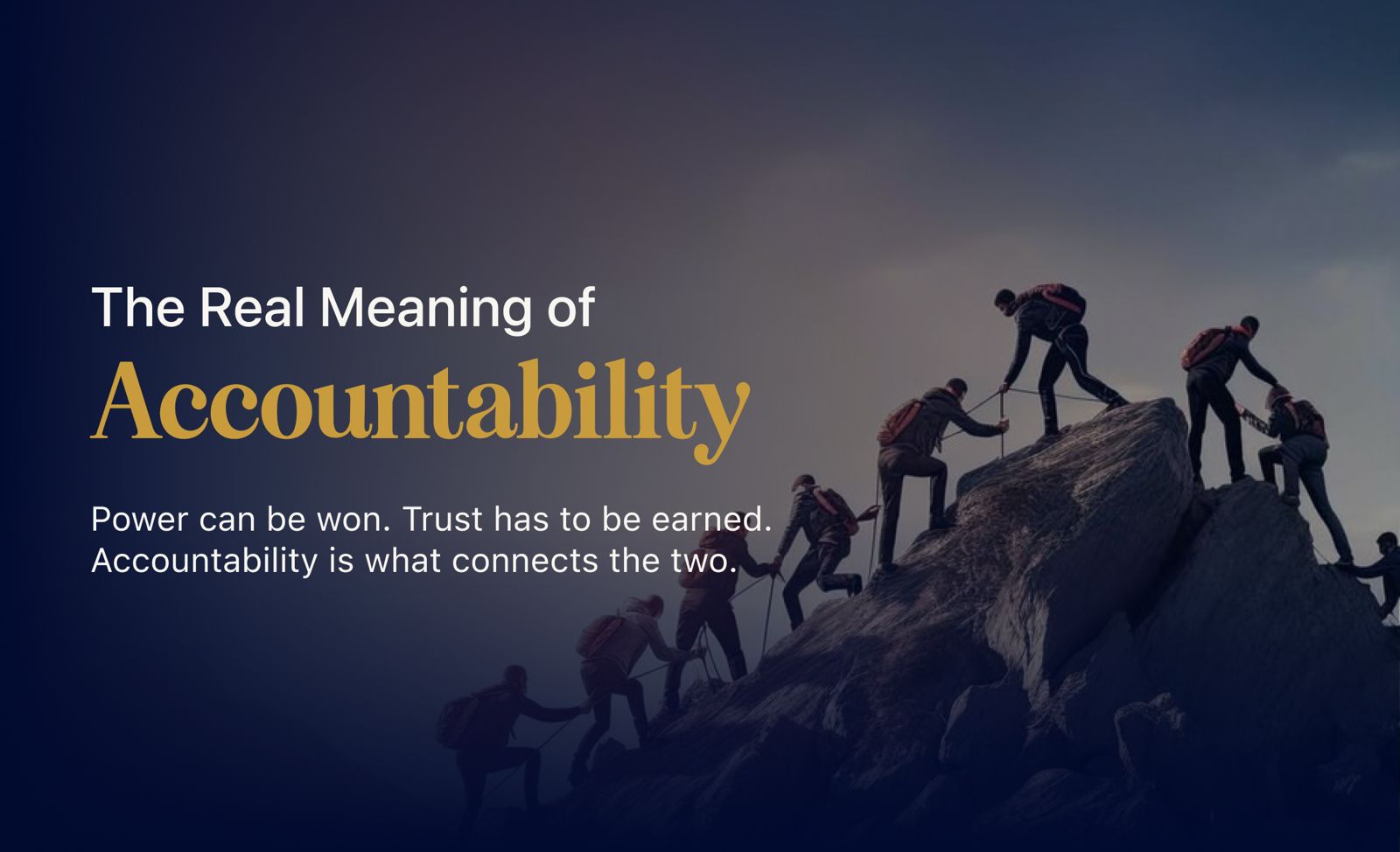
Power can be won. Trust has to be earned. Accountability is what connects the two.
Few words are thrown around in public life as often as accountability. Politicians promise it during election campaigns. CEOs mention it in shareholder meetings. Activists demand it after every controversy. Television debates revolve around it. Yet despite hearing the word almost every day, we rarely stop to ask what accountability actually means.
For many people, accountability begins when something goes wrong. A bridge collapses. A paper leak disrupts examinations. A government scheme fails to deliver. A company suffers a financial scandal. Almost instinctively, we ask, Who is responsible?
But that question, important as it is, only scratches the surface.
Real accountability does not begin after failure. It begins the moment someone asks for our trust.
The day a government promises to build a highway, accountability begins. The moment a political party releases its manifesto, accountability begins. When a company assures customers that its products are safe, accountability begins. Every promise creates an expectation, and every expectation deserves an answer.
Unfortunately, public life often celebrates announcements more than outcomes. Groundbreaking ceremonies receive headlines. New policies are announced with great enthusiasm. Social media is filled with graphics, speeches, and slogans. But citizens do not live inside announcements. They live inside results.
A new hospital only matters if it has doctors, medicines, and functioning equipment. A school reform only matters if children actually learn better. A welfare scheme only matters if the intended beneficiaries receive its benefits. A road project only matters if people can safely drive on it years after it is built.
For citizens, accountability is never about the press conference. It is about what happens after the cameras leave.
One of the biggest misconceptions about accountability is that it is synonymous with punishment. We often imagine resignations, suspensions, inquiries, or public criticism. While these may sometimes be necessary, they are only one small part of a much larger idea.
True accountability is not about finding someone to blame. It is about creating a culture where people willingly explain their decisions, accept responsibility for outcomes, and learn from mistakes.
Imagine visiting a doctor who prescribes treatment without explaining your diagnosis. Even if the treatment works, you would probably leave with unanswered questions. Now imagine another doctor who patiently explains the condition, discusses possible risks, answers every concern, and follows up after treatment. Both doctors may possess the same medical knowledge, but the second earns far greater trust.
Leadership works in exactly the same way.
People do not simply want decisions. They want explanations.
That is why trust and accountability are inseparable.
Trust cannot be demanded. It has to be earned repeatedly through openness, responsibility, and consistency. Citizens are far more likely to trust leaders who answer uncomfortable questions than those who expect unquestioning loyalty.
This brings us to another concept that is often confused with accountability: transparency.
Transparency means making information available.
Accountability means taking responsibility for what that information reveals.
The difference is important.
A government may publish thousands of pages of reports, budgets, dashboards, and statistics. A corporation may release detailed annual reports filled with financial data. Yet if difficult questions are ignored, poor decisions remain unexplained, or promises quietly disappear, transparency alone achieves very little.
Information without responsibility is simply information.
Accountability begins when leaders are willing to explain why something happened, acknowledge when expectations were not met, and describe how they intend to improve.
Perhaps the hardest test of leadership is admitting mistakes.
In politics, business, and public life, confidence is often mistaken for certainty. Leaders are expected to appear decisive. Admitting an error is frequently portrayed as weakness.
History suggests otherwise.
The leaders who preserve public trust are rarely those who never make mistakes. They are the ones who recognise mistakes early, explain them honestly, and take visible steps to correct them.
Most people understand that governing a country, running a business, or managing a large institution is extraordinarily difficult. Every decision involves uncertainty. Every policy creates trade-offs. Every strategy carries risks.
What citizens struggle to accept is not imperfection.
It is denial.
Blaming others may temporarily protect an image, but it rarely strengthens credibility. Accountability requires humility, and humility is often one of the strongest indicators of confident leadership.
Unfortunately, accountability sometimes becomes little more than a performance.
A controversy erupts.
An inquiry is announced.
A committee is formed.
A press conference is held.
Public attention gradually shifts to the next headline.
If the investigation produces no meaningful reform, if the same mistake happens again, or if nobody learns from the experience, then accountability has not truly taken place.
Real accountability is not measured by how quickly someone responds to criticism.
It is measured by whether the system becomes better afterwards.
Strong institutions understand this better than individuals often do.
No democracy should depend entirely on the character of one leader, however capable they may appear.
That is why independent institutions matter.
Parliament asks questions.
Courts review decisions.
Audit bodies examine public spending.
Election commissions protect electoral integrity.
Regulators oversee compliance.
A free press investigates issues that those in power might prefer to ignore.
These institutions are not obstacles to governance. They are essential parts of good governance.
Their purpose is not to weaken governments.
Their purpose is to strengthen public trust by ensuring that power remains answerable.
But accountability is not the responsibility of governments alone.
Citizens play an equally important role.
Democracy is not something people participate in once every five years before returning home to wait for the next election.
Healthy democracies depend upon informed citizens who continue asking questions long after campaigns have ended.
When voters evaluate governments based on outcomes rather than slogans, accountability becomes stronger.
When citizens reward performance instead of personality, leadership standards improve.
When public debate focuses on evidence instead of emotion, institutions become healthier.
Accountability survives only when citizens remain engaged.
The rise of social media has made this more challenging than ever.
News cycles move at extraordinary speed. Public outrage rises quickly and disappears just as fast. Leaders often feel pressure to manage headlines rather than solve problems. Public relations can sometimes appear more valuable than public service.
Yet perceptions only last for a while.
Reality eventually catches up.
A successful communication strategy cannot permanently hide poor governance, just as weak communication cannot permanently hide effective governance.
Citizens ultimately judge leadership through everyday experiences.
Is the road usable?
Does the hospital function?
Is public transport reliable?
Can businesses operate fairly?
Are institutions trusted?
These questions shape public confidence far more than speeches or hashtags ever will.
The strongest leaders understand that accountability is not a burden placed upon them by critics.
It is the very source of their legitimacy.
Explaining decisions demonstrates confidence.
Sharing progress shows seriousness.
Accepting criticism signals maturity.
Correcting mistakes builds credibility.
Leaders who refuse scrutiny often weaken their own authority.
Leaders who welcome scrutiny demonstrate faith in their own decisions.
Ultimately, accountability reminds us of a simple but powerful truth.
Authority is never permanent.
Every elected office, every executive position, every institutional role exists because people place their trust in someone else.
That trust is never unconditional.
It must be renewed through honesty, responsibility, and performance.
Titles may provide authority.
Power may provide influence.
But only accountability earns lasting respect.
A healthy democracy is not one where governments never make mistakes.
It is one where mistakes are acknowledged, corrected, and used to improve institutions.
A successful organisation is not one that never experiences setbacks.
It is one that learns from them instead of hiding them.
Accountability is therefore not about punishment.
It is about responsibility.
It is about ensuring that promises remain measurable, decisions remain explainable, institutions remain answerable, and citizens never lose their right to question those who exercise power on their behalf.
Because in the end, governments change.
Leaders change.
Political parties change.
But trust, once lost, is far harder to rebuild.
And that is why accountability is not just another principle of good governance.
.It is the foundation upon which every enduring democracy is built

Leave a Reply