
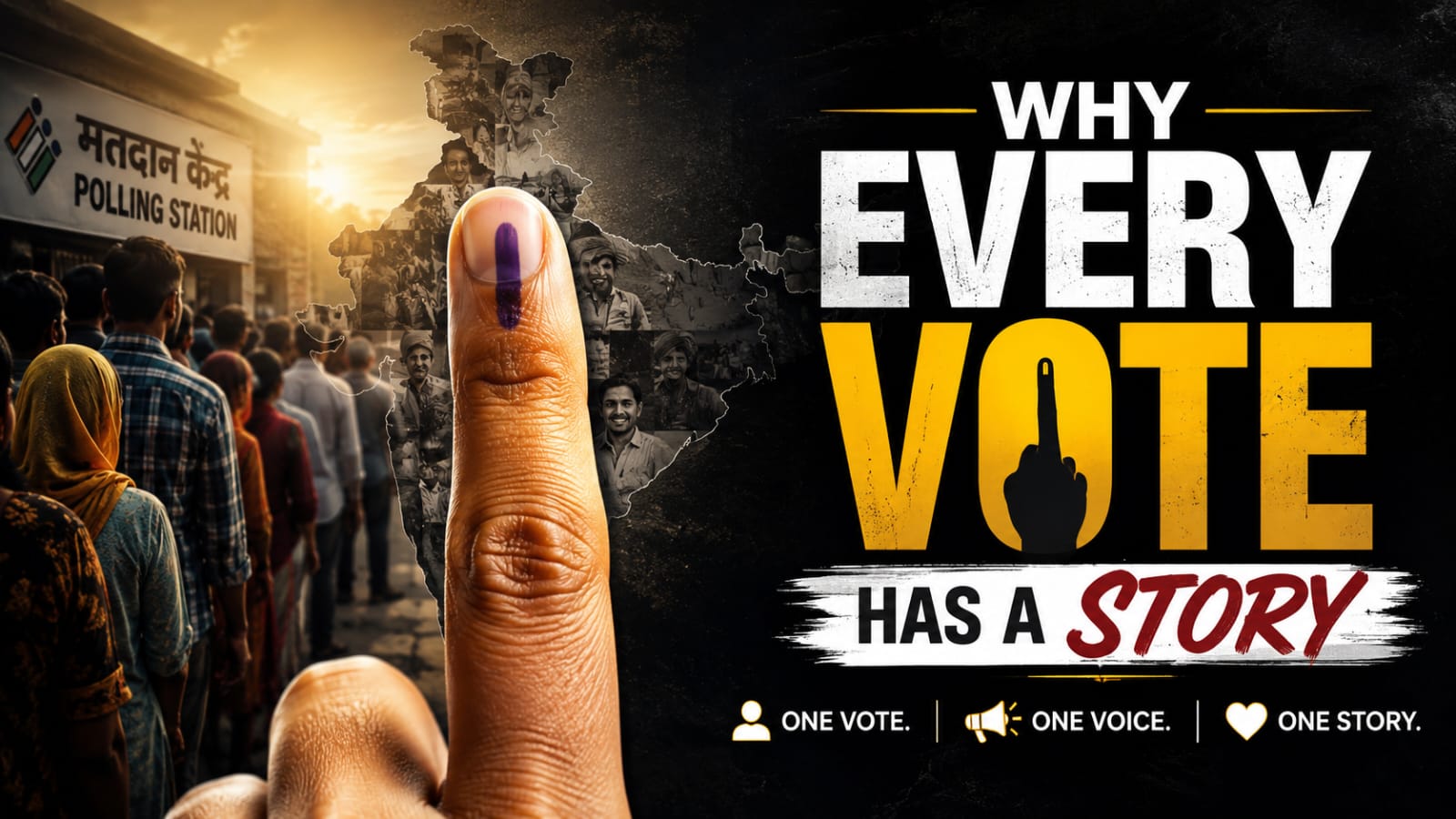
When election results are announced, we usually see numbers.
Seats won.
Vote share.
Margins of victory.
Turnout percentages.
Television studios fill up with charts, maps, and debates over who gained and who lost. Social media celebrates winners, criticizes losers, and moves on to the next headline.
But somewhere in this sea of statistics, we often forget the people behind those numbers.
Every vote has a story.
Every mark on a ballot paper represents a person who stood in a queue, waited patiently, and made a choice they believed mattered. Some voted with hope. Others voted with frustration. Some voted because they wanted change, while others voted because they wanted stability.
The ballot may look identical for everyone.
The reasons behind each vote never are.
Democracy Is Built One Voter at a Time
India is often called the world’s largest democracy, and rightly so.
The 2024 Lok Sabha election was one of the biggest democratic exercises ever conducted. According to the Election Commission of India, nearly 97 crore people were registered to vote, and more than 64.6 crore citizens cast their vote, with an overall turnout of around 65.8%.
These numbers are extraordinary.
But they become even more meaningful when we stop looking at them as numbers.
Instead of saying 64.6 crore votes, imagine 64.6 crore individual decisions.
Each vote belonged to someone.
A college student voting for the first time.
A farmer hoping for better crop prices.
A small business owner worried about rising costs.
A government employee thinking about stability.
A young woman who wanted safer public spaces.
A retired teacher who hasn’t missed an election in decades.
None of them walked into the polling booth carrying the same story.
Elections Are Personal
Political analysts often explain elections using broad categories.
Urban versus rural.
Young versus old.
Rich versus poor.
North versus South.
These classifications help us understand trends, but they never tell the whole story.
Two neighbours living in the same apartment building may vote differently.
Two brothers raised in the same family may support different political parties.
A husband and wife may cast votes for opposing candidates.
Why?
Because voting is deeply personal.
It reflects our experiences, priorities, beliefs, and hopes for the future.
Some people vote based on employment.
Others vote based on national security.
Some prioritize education.
Others care most about healthcare, infrastructure, inflation, or local development.
For many, voting is not simply about choosing a politician.
It is about choosing the future they want to live in.
A Ballot Is More Than a Piece of Paper
A ballot paper carries no emotions.
People do.
One person may vote after spending years searching for employment.
Another may vote after seeing a new highway transform their town.
Someone may vote because electricity finally reached their village.
Another may vote because they believe more still needs to be done.
Neither story is wrong.
Both are real.
This is why democracies can never be understood through election results alone.
To understand an election, we must first understand people.
The First Election Was Built on Hope
India’s first general election in 1951-52 remains one of the greatest democratic achievements in history.
At the time, around 173 million people were eligible to vote, and nearly 85% of them were unable to read or write. To make voting accessible, ballot boxes carried election symbols instead of relying only on written names.
Many around the world doubted whether a newly independent country of such immense diversity could successfully conduct elections.
India proved them wrong.
Millions voted.
Not because democracy was perfect.
But because they believed it was worth participating in.
Their votes were stories of hope.
Stories of independence.
Stories of people who believed they finally had a voice in deciding the country’s future.
When Votes Became a Voice for Democracy
History also reminds us that votes can express something much bigger than political preference.
The 1977 General Election, held after the Emergency, became one of the defining moments in Indian democracy.
For many citizens, that election was about more than choosing between political parties.
It became an opportunity to express their views on democracy, civil liberties, and governance.
The result demonstrated a timeless lesson.
Sometimes people vote for change.
Sometimes they vote for continuity.
Sometimes they vote to protect principles they believe should never be compromised.
Every election carries its own context.
Every generation writes a different chapter.
Democracy Travels to Every Citizen
One of the most remarkable things about Indian elections is the effort made to ensure that every eligible citizen can vote.
Election officials cross rivers, climb mountains, travel through forests, and reach remote villages to set up polling stations.
One of the best-known examples is Banej, inside Gujarat’s Gir Forest.
The polling station has repeatedly been established for a single eligible voter.
Think about that for a moment.
An entire polling booth.
Election staff.
Electronic voting machines.
Security arrangements.
All for one citizen.
From a financial perspective, it may seem inefficient.
From a democratic perspective, it is priceless.
It sends a simple but powerful message.
No citizen is too remote.
No vote is too small.
Trust Makes People Vote
People often ask what strengthens democracy.
Many answers come to mind.
Strong institutions.
Independent courts.
Free media.
Responsible political parties.
All of these matter.
But democracy also depends on something less visible.
Trust.
Citizens must believe that their vote will be counted fairly.
During the 1990s, T.N. Seshan, as Chief Election Commissioner, introduced stricter enforcement of election rules and the Model Code of Conduct. His reforms strengthened public confidence in the electoral process and reminded political parties that elections are governed by rules, not merely by competition.
People participate more willingly when they trust the process.
Why People Vote Differently
One of the biggest mistakes we make after elections is assuming we know why people voted the way they did.
We often reduce millions of voters to a single explanation.
“They voted because of the economy.”
“They voted because of identity.”
“They voted because of welfare.”
Reality is much more complicated.
A first-time voter may be thinking about jobs.
A parent may think about education.
A shopkeeper may think about taxes.
A soldier’s family may think about national security.
A farmer may think about rainfall, irrigation, and MSP.
An entrepreneur may think about regulations.
A pensioner may think about healthcare.
The same election can mean completely different things to different people.
That is the beauty of democracy.
Listening Matters More Than Guessing
The easiest way to understand elections is by reading data.
The better way is by listening to people.
Travel through India during election season and you will hear thousands of conversations.
At tea stalls.
On buses.
In markets.
At railway stations.
In university campuses.
In villages.
People discuss roads, jobs, corruption, inflation, education, identity, healthcare, local issues, and national issues.
Every conversation adds another piece to the larger picture.
This is why good political leadership begins with listening.
Not assuming.
Beyond Winning and Losing
Election night creates heroes and headlines.
But democracy continues long after the celebrations end.
The real question is not who won.
It is whether citizens feel heard.
Whether promises become policies.
Whether policies become outcomes.
Whether trust grows stronger.
Because elections are not merely competitions.
They are conversations between citizens and those who seek to represent them.
Behind Every Number Is a Human Being
Political discussions often become obsessed with percentages.
Vote share.
Swing.
Margins.
Seats.
But no percentage can capture the emotion of an elderly woman who walks two kilometres to vote because she has never missed an election.
No statistic can fully describe the excitement of a young citizen voting for the first time.
No chart can measure the hope of a family that believes this election might improve their future.
Statistics explain elections.
Stories explain democracy.
The Story Continues
Every election produces winners and losers.
But every election also produces millions of untold stories.
Stories of hope.
Stories of disappointment.
Stories of gratitude.
Stories of aspiration.
Stories of ordinary people who believe their voice deserves to be counted.
That is the true strength of democracy.
It reminds us that governments are formed through numbers, but nations are shaped by people.
The next time election results flash across our television screens, it is worth remembering that every percentage point represents millions of individual lives.
Behind every vote is a citizen.
Behind every citizen is a story.
And together, those stories become the story of India.
What do you think influences a person’s vote the most: personal experience, public policy, leadership, identity, or something else entirely?
Leave a Reply