
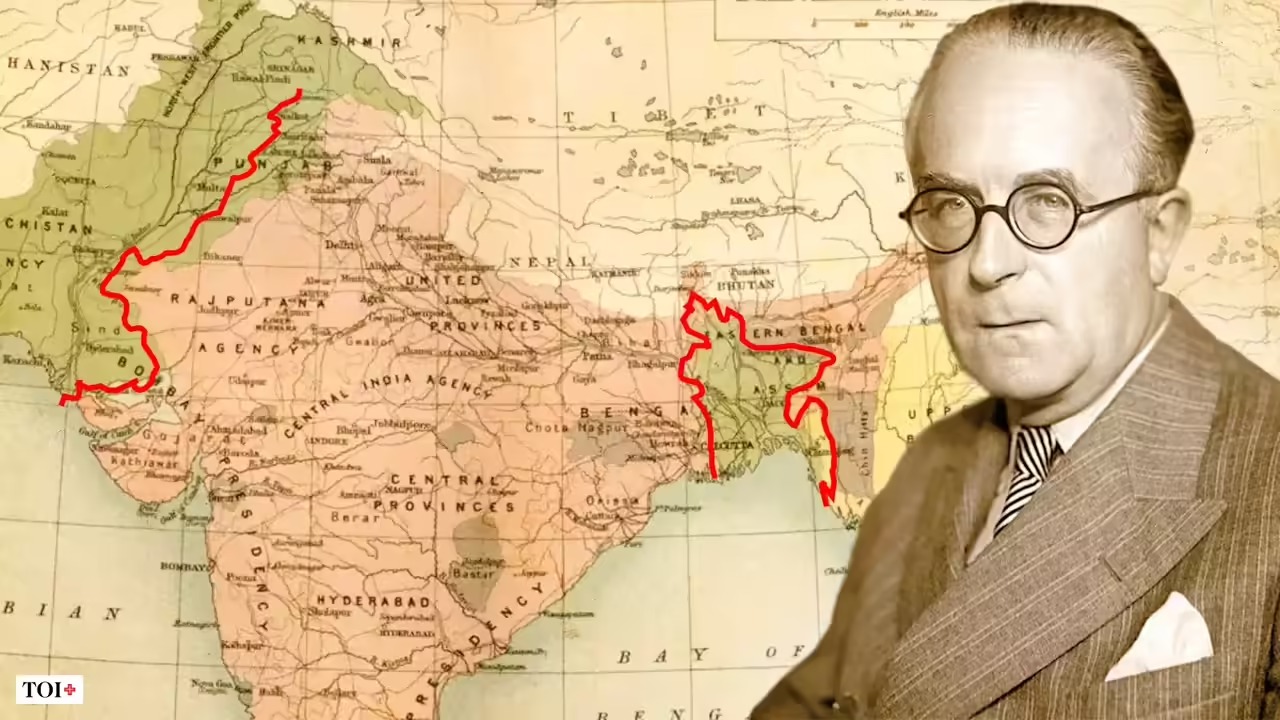
Two days after independence, the map finally arrived.
India had raised its flag.
Pakistan had raised its flag.
The British Empire had formally begun its departure.
Speeches had been delivered. Crowds had celebrated. The old imperial order was being replaced by two new dominions.
And then, on 17 August 1947, the boundary was finally made public.
Sir Cyril Radcliffe’s awards for Punjab and Bengal were announced.
A line on paper would now determine where millions of people belonged.
The line did not care about ancestral homes.
It did not care about friendships.
It did not care about markets, rivers, railway tracks, farms or graveyards.
It simply divided territory.
And millions of human beings had to live with the consequences.
That is the story of 17 August 1947.
Not the celebration.
The aftermath.
The man who was asked to draw a continent’s future
Sir Cyril Radcliffe was a British barrister who had never previously worked in India.
In July 1947, he was brought into the centre of one of the most extraordinary administrative tasks in modern history.
He was appointed chairman of two Boundary Commissions, one for Punjab and one for Bengal.
His job was to recommend the boundaries between India and Pakistan.
The scale was enormous.
The political timetable was not.
India was due to become independent in August.
Radcliffe had only weeks to complete work that involved enormous populations, complicated district boundaries, competing political claims and communities already living through extraordinary communal tension.
He was not simply drawing a line between two empty territories.
He was dividing inhabited land.
Punjab was a landscape of villages, irrigation canals, railways, markets and farms that had developed over generations.
Bengal had its own complicated geography of rivers, districts and densely populated communities.
A line that looked perfectly simple on a map could be devastating on the ground.
A canal could suddenly cross an international boundary.
A railway station could find itself in one country while the railway line connecting it ran into another.
A village could be divided from the fields that sustained it.
A family could find itself on one side of a border while relatives lived on the other.
The map was two-dimensional.
The lives underneath it were not.
The clock was already running
The British had announced that power would be transferred in August 1947.
The timetable was extraordinarily compressed.
Radcliffe arrived in India in July.
He worked through the summer.
He consulted maps, census information and representations from the political parties and Boundary Commission members.
But there was no realistic way for one man, working in a few weeks, to personally understand every village, road, river, railway line, irrigation system and social relationship affected by the final boundary.
He later reflected that the time available had been extraordinarily short.
And that matters.
Because every day of delay increased uncertainty.
But every day of haste increased the possibility of mistakes.
There was no perfect solution.
There was, however, a choice about how much time and care would be given to the process.
The British chose speed.
And the people living on the ground would bear the consequences of that speed.
The boundary existed before the public knew it
Here is where the story becomes particularly strange.
The boundary decisions were completed before independence.
But the public did not immediately receive them.
India celebrated independence on 15 August.
Pakistan had celebrated on 14 August.
Yet the Radcliffe Awards were not publicly announced until 17 August.
For two days, millions lived in a strange political limbo.
Their countries were independent.
Their governments were changing.
But the exact location of the international boundary was still not publicly known.
Imagine the uncertainty.
You live in Lahore.
Will Lahore be in India or Pakistan?
You live in Amritsar.
Where exactly will the border fall?
Your village is near a district boundary.
What happens if that district goes one way and your nearest market goes the other?
You hear rumours.
You wait.
You listen to political speeches.
You watch people packing.
And you still don’t know.
Then, finally, the answer comes.
17 August: The line becomes real
When the Radcliffe Awards were published, uncertainty became geography.
Punjab was divided.
Bengal was divided.
Districts were allocated.
Villages and towns suddenly acquired a new political identity.
The people living there had not moved.
The land had not moved.
But the country had changed around them.
And for many people, that meant they had to move.
The migration had actually begun before 17 August in several areas, particularly in Punjab, as communal violence and fear pushed people from their homes.
But the publication of the boundary transformed uncertainty into a much more definite reality.
For families who suddenly found themselves on the “wrong” side of the border, the question became brutally practical:
Stay or leave?
There was no orderly queue for Partition
Partition is sometimes described as a “transfer of population.”
That phrase is dangerously clean.
It sounds administrative.
Almost peaceful.
But there was nothing clean about what happened to millions of people.
People left in carts.
They walked.
They travelled by train.
They travelled in trucks.
Some were escorted.
Many were not.
They carried whatever they could.
Jewellery.
Clothes.
Religious objects.
Documents.
Photographs.
Cooking utensils.
Family records.
Sometimes just a small bundle.
And sometimes nothing.
The Library of Congress estimates that 10 to 18 million people crossed the new borders, with migration continuing beyond 1947 into the early 1950s. (Library of Congress Blogs)
That is an almost incomprehensible number.
Ten million people is larger than the population of many countries.
Eighteen million is larger still.
And these were not tourists.
They were refugees.
Punjab became the centre of the catastrophe
The consequences were particularly devastating in Punjab.
Communal violence had already been spreading.
By the summer of 1947, the province was experiencing extraordinary instability.
The government itself was struggling.
Communal militias were active.
People were fleeing.
And the administrative structure was undergoing a fundamental transformation.
The final boundary therefore arrived in an environment where fear was already extreme.
Once people knew where the border would fall, many concluded that remaining where they were could be dangerous.
The movement accelerated.
Columns of refugees began filling the roads.
Entire families moved together.
Sometimes entire villages moved.
Others were attacked before they could escape.
The result was one of the largest forced migrations of the twentieth century.
And unlike a normal migration, there was often no expectation of returning.
The trains became symbols of Partition
No image of Partition has become more haunting than the refugee train.
The railway system was one of the few mechanisms capable of moving enormous numbers of people quickly.
But it could not guarantee their safety.
Trains became targets of communal violence.
Some trains arrived carrying wounded survivors.
Others arrived with the dead.
The phrase “ghost trains” entered the vocabulary of Partition because some trains reached their destination with almost nobody alive inside.
The railway had been built as an instrument of empire.
In 1947, it became one of the main arteries of the refugee crisis.
There is something deeply tragic about that transformation.
A railway carriage that once carried workers, traders and families between neighbouring towns was suddenly carrying people fleeing the destruction of the world they knew.
A border can destroy a life without moving a person
This is the part of the Radcliffe story that is easiest to overlook.
A border is invisible.
You cannot necessarily see it.
But its consequences are very real.
Imagine a farmer whose land lies on one side of the new boundary while the nearest market is on the other.
Imagine a family whose ancestral home is now across an international border.
Imagine a railway line that used to connect two neighbouring towns suddenly crossing from one sovereign country into another.
Imagine a graveyard where your grandparents are buried becoming inaccessible.
Imagine leaving your house believing you might return.
Then discovering that you never will.
That is what Partition did to millions.
It did not merely move populations.
It broke continuity.
And then there were the women
Partition’s violence had another horrifying dimension.
Women were abducted, raped, forcibly converted and separated from their families.
Many families were destroyed.
Many women disappeared permanently.
The governments of India and Pakistan would later undertake recovery operations to locate abducted women and return them to their families.
But even that process was complicated by questions of identity, consent, family honour and the trauma of what had happened.
The violence of Partition therefore cannot be understood simply through death tolls.
A person could survive physically and still lose almost everything.
Home.
Family.
Security.
Identity.
Memory.
How many people died?
There is no single universally accepted figure.
That itself tells us something about the scale of the catastrophe.
Records were incomplete.
Bodies were not always recovered.
Many people disappeared.
Some deaths were never recorded.
Estimates of deaths during Partition range widely, from several hundred thousand to around a million or more depending on the methodology and period considered.
The exact number will continue to be debated.
But the disagreement over the number should never become an excuse to minimise the tragedy.
Even the lower estimates represent an extraordinary human catastrophe.
And millions more survived but were displaced.
The Library of Congress describes the period as involving 10 to 18 million people crossing borders, demonstrating the enormous scale of the upheaval. (Library of Congress Blogs)
The Radcliffe Line was not the only cause
This distinction matters.
It would be historically wrong to blame one British lawyer’s boundary for all the violence of Partition.
The communal violence had begun before the final boundary was published.
Political tensions had been escalating for years.
The Congress-Muslim League conflict had become increasingly bitter.
The demand for Pakistan had transformed the constitutional debate.
The British decision to accelerate the transfer of power created enormous pressure.
Communal organisations mobilised populations.
Governments struggled to maintain order.
And fear became self-reinforcing.
The Radcliffe Line did not create all of this.
But it formalised the division at the precise moment when the subcontinent was already burning.
And the secrecy surrounding the final award meant that millions did not know where the new international boundary would be until after independence.
That is what makes 17 August so significant.
What did the British leave behind?
The British departure represented the end of colonial rule.
That should not be minimised.
India’s independence was the achievement of generations of struggle.
But the manner in which Partition was executed deserves scrutiny.
The British had ruled the subcontinent for nearly two centuries.
They had the administrative machinery.
They had extensive records.
They had governed the territory.
Yet the final transfer was executed at extraordinary speed.
The new dominions were expected to inherit enormous responsibilities almost immediately.
Borders had to be settled.
Armies had to be divided.
Civil services had to be divided.
Assets had to be divided.
Railways had to be reorganised.
Refugees had to be housed.
Food had to be distributed.
Law and order had to be maintained.
And all of this was happening while people were dying.
The British were leaving.
But the crisis they were leaving behind was enormous.
Mountbatten and the decision to delay publication
The decision not to publish the Radcliffe Awards before independence has remained controversial.
One explanation is that announcing the boundaries before independence could have disrupted the ceremonies and created an even more dangerous atmosphere.
Another interpretation is that delaying publication allowed the transfer of power to proceed with less immediate political fallout for the departing British administration.
Whatever interpretation one adopts, the result was the same.
People celebrated independence before they knew the final shape of the countries they were becoming citizens of.
That is an extraordinary historical fact.
And it deserves more attention.
Radcliffe left. The refugees stayed.
Sir Cyril Radcliffe completed his task and left India soon afterwards.
He did not remain to administer the new border.
He did not have to organise refugee camps.
He did not have to rebuild a village.
He did not have to search for a missing relative.
He did not have to board a refugee train.
He did not have to cross a border carrying everything he owned.
The people who lived with the consequences did.
And that is not an accusation against Radcliffe personally.
It is a reminder of the distance between drawing a boundary and living inside it.
A line can take minutes to draw.
A society can spend generations living with it.
The border did not end the story
The Radcliffe Line eventually became the international boundary between India and Pakistan in the west and between India and East Pakistan in the east.
But the consequences continued.
Refugees had to rebuild their lives.
Governments had to rehabilitate millions.
Cities changed.
Delhi changed dramatically as refugees arrived and rebuilt communities.
Punjab changed.
Bengal changed.
Family histories changed.
Languages, food, businesses and neighbourhoods changed.
The Partition generation carried memories of lost homes for decades.
And their children inherited stories of places they had never seen.
For some families, a village across the border became almost mythical.
A place remembered through one photograph.
One address.
One story told repeatedly at family gatherings.
The border still lives in memory
This is why Partition is not simply an event that happened in 1947.
It is still alive in family histories.
In refugee colonies.
In old photographs.
In letters.
In surnames.
In recipes.
In songs.
In stories told by grandparents.
A person born decades after Partition can still know the name of a village they have never visited because their grandparents were born there.
That is the power of displacement.
You can move a person.
You cannot necessarily move their memory.
17 August was the day the abstract became physical
Before 17 August, Partition existed largely as political negotiation.
After 17 August, it existed as geography.
The line was now official.
The uncertainty had ended.
And for millions, a new uncertainty began:
Where do I go?
That is why the date deserves to be remembered.
Not because Cyril Radcliffe’s pencil magically created Partition.
It didn’t.
Not because the boundary alone caused the violence.
It didn’t.
But because 17 August 1947 transformed an enormous political decision into a physical reality for millions of ordinary people.
A border became a checkpoint.
A district became a foreign country.
A home became inaccessible.
A journey became an escape.
A neighbour became a citizen of another state.
A family photograph became the only remaining evidence that a particular house had ever belonged to them.
The irony of the dates
There is something almost unbearably ironic about the sequence.
14 August: Pakistan celebrates independence.
15 August: India celebrates independence.
17 August: the Radcliffe Awards are published.
The flags went up before the final map was revealed.
The celebrations came before the full geography of Partition was known.
And behind the ceremonies were millions of people waiting for an answer that would determine whether they could remain where they were born.
That is the contradiction at the heart of August 1947.
Freedom and displacement arrived together.
For some, independence meant finally becoming citizens of a free country.
For others, it meant becoming refugees.
For many, it meant both.
Remembering 17 August
There is no need to romanticise Partition.
There is no need to turn it into a simple story of one community versus another.
Hindus suffered.
Muslims suffered.
Sikhs suffered.
There were victims, perpetrators, rescuers and bystanders across communities.
There were people who protected neighbours at enormous personal risk.
There were people who participated in horrifying violence.
There were families who refused to leave.
There were families who had no choice.
The human story is complicated.
But the suffering is not.
The suffering was real.
And the responsibility of remembering history is not to make it comfortable.
It is to make it honest.
A line on a map, a lifetime of consequences
On 15 August 1947, India became independent.
On 17 August, the boundary awards were published.
The dates are separated by only two days.
But between them lies an enormous human story.
A story of freedom.
A story of fear.
A story of migration.
A story of violence.
A story of survival.
And a story of millions of ordinary people whose lives were transformed by decisions made far above them.
The Radcliffe Line exists today as a political boundary.
But its deepest legacy is not geographical.
It is human.
It lives in the refugee who rebuilt a life in Delhi.
In the family in Lahore that still remembers a house in Amritsar.
In the Bengali family that remembers a village across a border.
In the old photograph kept carefully inside a drawer.
In the story a grandparent tells about the home they left behind.
The men who drew the line went home.
The people who lived beside it had to live with it.
That is why 17 August 1947 should never be reduced to a technical date in a textbook.
Because the Radcliffe Line was drawn in ink.
But its consequences were carried in human beings.
And some borders remain long after the people who drew them are gone. 🇮🇳

Leave a Reply