
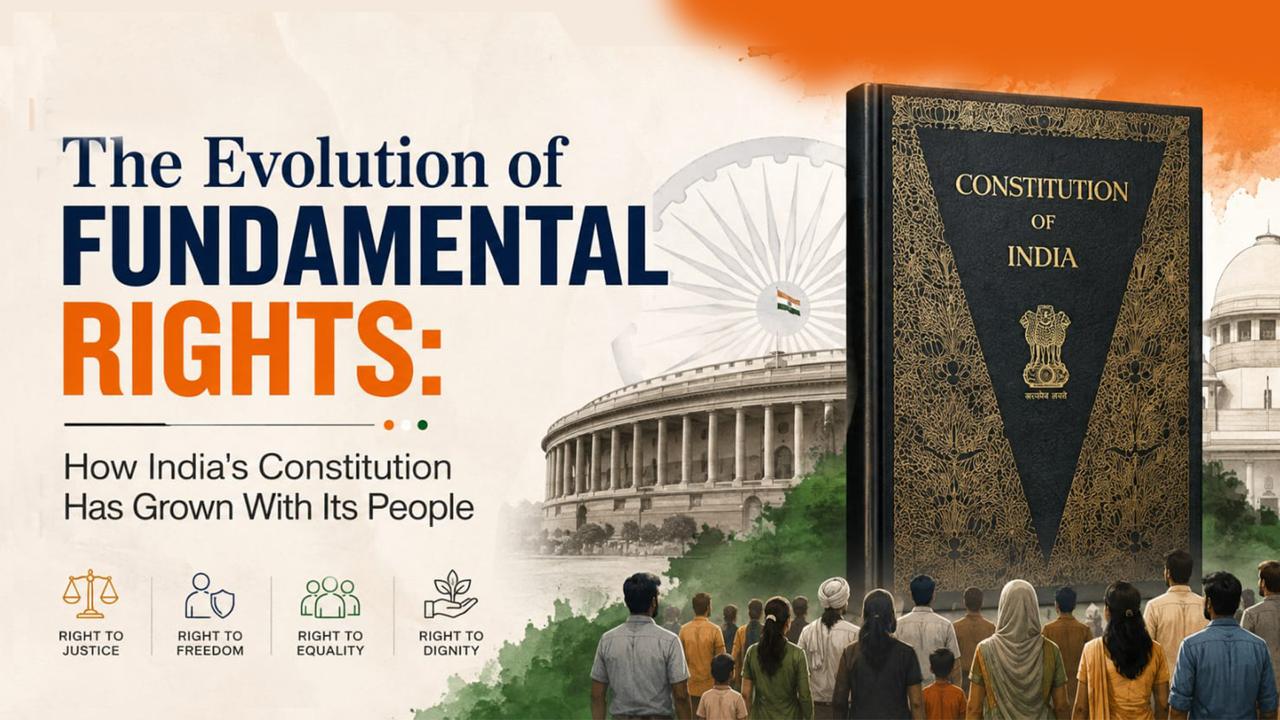
“The Constitution is not a mere lawyer’s document. It is a vehicle of life, and its spirit is always the spirit of the age.”
Dr. B. R. Ambedkar said that.
On 26 January 1950, India gave itself more than a Constitution. It gave every citizen a promise. A promise that no matter who formed the government, every Indian would have certain freedoms that could not be taken away easily. These freedoms became our Fundamental Rights. They form Part III of the Constitution. They were meant to protect the individual from the misuse of power. They ensured that democracy was not just about elections but about dignity, equality and liberty.
More than seven decades later, India has changed a lot. We are a nation of over 1.4 billion people. We are the world’s largest democracy and one of its fastest growing economies. Technology has transformed how we live, communicate and work. Society has evolved. So has our understanding of justice.
Yet the Constitution has continued to adapt without losing its core values.
The story of Fundamental Rights is in many ways the story of modern India itself.
The Foundation of Freedom
When the Constitution came into force, it guaranteed seven Fundamental Rights:
Right to Equality.
Right to Freedom.
Right against Exploitation.
Right to Freedom of Religion.
Cultural and Educational Rights.
Right to Property.
Right to Constitutional Remedies.
These rights were revolutionary for a country coming out of colonial rule. They ensured that every citizen, regardless of caste, religion, language or background, stood equal before the law.
Dr. B. R. Ambedkar described Article 32 as the heart and soul of the Constitution. That article allows citizens to directly approach the Supreme Court when their rights are violated.
Rights were not meant to remain words on paper. They were meant to be enforceable.
The Constitution Began Changing Almost Immediately
India was only a year old as a Republic when Parliament passed the First Constitutional Amendment in 1951.
The government wanted to protect land reforms. It wanted to introduce provisions for affirmative action. It also wanted to clarify reasonable restrictions on freedom of speech in the interest of public order, security and other constitutional grounds.
The amendment sparked an important debate that continues even today.
How should a democracy balance individual liberty with the larger public interest?
It was the beginning of a Constitution that would evolve with changing times.
When Property Stopped Being a Fundamental Right
One of the biggest constitutional changes came nearly three decades later.
Originally the Right to Property was a Fundamental Right under Article 31. Disputes over land reforms and compensation led to repeated legal battles between governments and property owners.
Through the 44th Constitutional Amendment in 1978, Parliament removed the Right to Property from the list of Fundamental Rights.
Today property remains protected under Article 300A as a constitutional legal right. But it is no longer a Fundamental Right.
This reduced the number of Fundamental Rights from seven to six. That is where the number stands today.
The Emergency Changed How India Thought About Rights
Between 1975 and 1977, India witnessed one of the most debated periods in its democratic history.
During the Emergency, civil liberties were restricted. Opposition leaders were arrested. Press censorship was imposed.
The period became a reminder that constitutional rights depend not only on what is written in law but also on the strength of democratic institutions.
In response, the 44th Constitutional Amendment introduced safeguards to better protect individual freedoms during future emergencies.
It became one of the most significant lessons in India’s constitutional journey.
The Supreme Court Expanded the Meaning of Freedom
Perhaps the most remarkable part of India’s constitutional story is that many of today’s rights were never written explicitly by the Constituent Assembly.
They were recognised through judicial interpretation.
Take Article 21 for example.
It simply states that no person shall be deprived of life or personal liberty except according to procedure established by law.
Over the decades the Supreme Court interpreted this article to include the right to live with dignity. The right to privacy. The right to legal aid. The right to a speedy trial. The right to clean air and a healthy environment. The right to shelter.
The landmark Justice K. S. Puttaswamy versus Union of India judgment in 2017 declared privacy to be a Fundamental Right. It showed how constitutional principles can remain relevant even in the digital age.
Education Became a Right
For many years education was only a Directive Principle of State Policy.
That changed through the 86th Constitutional Amendment in 2002. It introduced Article 21A and made free and compulsory education a Fundamental Right for children between 6 and 14 years of age.
The amendment later led to the Right to Education Act of 2009.
Today, according to the latest UDISE+ data for 2025-26, India has about 14.67 lakh schools with around 24.72 crore students enrolled from foundational to secondary levels. It remains one of the world’s largest education systems.
It is one of the clearest examples of how constitutional rights can directly improve everyday lives.
Equality Continues to Evolve
The Constitution prohibited discrimination from the very beginning.
However equality has never been a finished chapter.
Over the decades, constitutional amendments and court judgments have expanded opportunities through reservations and affirmative action.
The 103rd Constitutional Amendment in 2019 introduced 10 percent reservation for Economically Weaker Sections in education and public employment.
The methods may change. The constitutional goal remains the same. To build a society where opportunity is available to all.
Rights in the Digital Age
When the Constitution was written, there were no smartphones. No internet. No artificial intelligence.
Yet today debates about freedom of speech often revolve around online platforms, misinformation, digital privacy and internet shutdowns.
The Constitution continues to guide these discussions even though its framers could never have imagined today’s technological world.
That is the beauty of constitutional interpretation.
The words remain the same. Their meaning grows with society.
The Constitution in Numbers
Some numbers tell an interesting story.
26 January 1950. The Constitution came into force.
Originally it contained 395 Articles and 8 Schedules.
Today it has grown to around 448 Articles grouped into 25 Parts and 12 Schedules. Some counts that include all inserted provisions go higher, closer to 470.
As of 2026, 106 Constitutional Amendments have been enacted. The most recent is the 106th Amendment of 2023 on women’s reservation in legislatures.
Fundamental Rights reduced from 7 to 6 after the 44th Amendment.
India continues to have the longest written national Constitution in the world.
These changes show that while the Constitution evolves, its democratic foundation remains intact.
A Living Constitution
Some people think constitutional amendments mean the Constitution was imperfect.
The framers thought differently.
They knew India would change. New technologies would emerge. New challenges would arise. New generations would interpret justice differently.
A Constitution that never changes risks becoming outdated. A Constitution that changes too easily risks becoming unstable.
India’s Constitution has tried to find a careful balance between continuity and change.
The Promise That Still Matters
Fundamental Rights are often discussed in classrooms and courtrooms.
But their real importance is seen in everyday life.
Every time someone speaks freely.
Every time a citizen approaches a court for justice.
Every time a child enters a classroom because education is their right.
Every time a person is protected from discrimination.
The Constitution quietly fulfils the promise it made in 1950.
India’s Fundamental Rights have evolved through amendments, landmark judgments and changing social realities.
Yet their purpose has never changed.
They exist to remind every government that power has limits. And every citizen that freedom comes with constitutional protection.
That is why the Constitution remains more than just a legal document.
It remains the living foundation of the world’s largest democracy.
What do you think?
As India enters an increasingly digital era, do our Fundamental Rights need further constitutional changes, or is judicial interpretation enough to keep them relevant?


Leave a Reply