
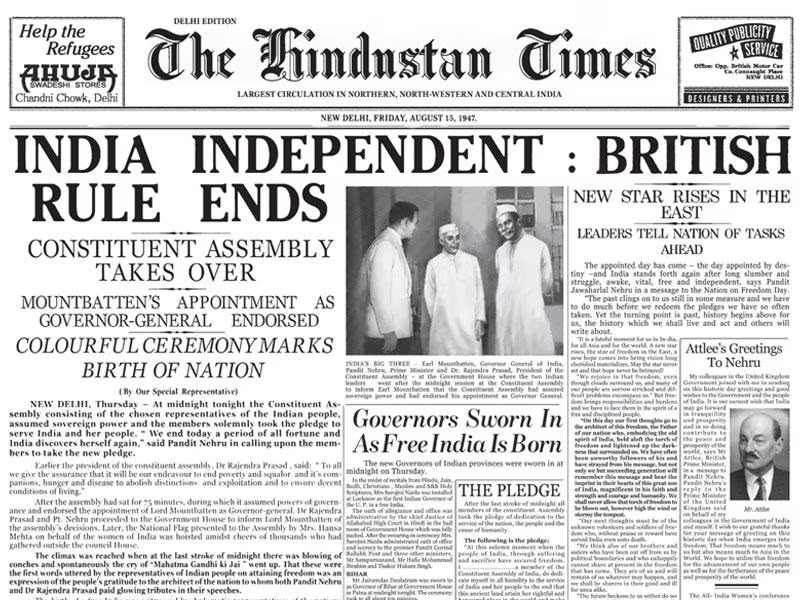
Today the flag rises.
The same flag that was once a crime to raise.
The same colours that men and women died for.
The same land that refused to stay conquered forever.
Independence Day is not a holiday.
It is a reminder.
This civilisation did not beg for freedom.
It fought for it.
Sometimes with petitions.
Often with blood.
Always with the refusal to accept that foreign rule was permanent.
The story we are usually told is neat and comfortable.
Non violence.
Moral force.
The British left because they were shamed.
There is truth in that story.
Gandhi and the mass movements mattered.
The jail going.
The boycotts.
The salt marches.
The quiet courage of ordinary people who filled the prisons.
All of it counted.
But it is not the whole truth.
And repeating only half the truth year after year has made us softer than we should be.
1857 was not a small mutiny over greased cartridges.
That was the spark the British preferred to talk about.
The real fire was deeper.
A century of annexation.
Economic ruin.
Racial arrogance.
The slow strangling of Indian industry and self respect.
Sepoys, peasants, queens, landlords and old warriors rose together across large parts of North India.
They put the Mughal emperor back on the seat in Delhi.
They fought in Kanpur, Lucknow, Jhansi and Bihar.
They failed on the battlefield because the Company had better weapons and organisation.
But they succeeded in something permanent.
They showed that India would not accept foreign domination forever.
The British answered with pure terror.
Villages burned.
Prisoners blown from cannons.
Mass hangings.
Delhi turned into a slaughterhouse.
Then they wrote the history books and called themselves civilised.
Later came the revolutionaries.
Young men who looked at the slow pace of constitutional politics and decided waiting was no longer enough.
Khudiram Bose walked to the gallows at eighteen.
Bhagat Singh, Rajguru and Sukhdev faced the noose with open eyes.
Chandrashekhar Azad died with a gun in his hand rather than be taken.
Surya Sen and the Chittagong revolutionaries.
The many nameless boys who threw bombs or faced the firing squad.
Their courage was not misguided.
It was the hard edge of a people who had decided that freedom was worth dying for.
The empire called them terrorists.
History remembers them as freedom fighters.
The difference is only in who holds the pen after the empire falls.
Then came 1947.
Freedom arrived.
So did Partition.
The motherland was cut with a hurried line drawn by a man who barely knew the land.
Millions walked.
Hindu and Sikh families from the west.
Muslim families from the east.
Carts.
Trains.
Foot columns.
Children crying.
Old people collapsing on the road.
Trains that left full of the living and arrived full of the dead.
Homes that had stood for generations emptied overnight.
Women who never reached the other side.
The celebrations in Delhi and Karachi happened while the roads of Punjab and the trains of Bengal ran with fear and blood.
That wound is still part of our story.
Ignoring it does not make us progressive.
It makes us forgetful.
A nation that refuses to look at its deepest scar cannot claim to be strong.
A strong nation remembers both the victory and the cost.
It does not turn Independence Day into a soft festival of forgetfulness.
It does not apologise for its own civilisation.
It does not treat its majority culture as something to be managed or diluted or permanently put on the defensive.
It does not pretend that every internal challenge is just diversity when some of those challenges openly reject the idea of this nation itself.
Bharat is not a new country invented in 1947.
It is an ancient civilisation that absorbed shocks, survived invasions, resisted conversions, outlasted colonial rule and still stands.
The fact that we still speak our languages.
Still light our lamps.
Still remember our epics.
Still raise a flag that carries the memory of that long resistance.
This itself is a civilisational victory.
Many other peoples were broken completely.
We were not.
Today we honour the fighters.
The ones who picked up the gun and the ones who picked up the salt.
The ones who went to the gallows and the ones who filled the jails.
The ordinary people who kept the idea of this land alive when power belonged to others.
The mothers who sent their sons.
The families who lost everything in 1947 and still rebuilt.
But honour is not enough.
The real tribute is strength.
Borders that are secure and not permanently negotiated.
A society that does not bend every time pressure is applied from inside or outside.
A people who refuse to be made ashamed of their history, their temples, their gods, their festivals or their identity.
A state that treats its civilisation as the foundation, not as an embarrassment to be managed by clever slogans.
The British left.
Good.
They left behind a divided land and a complicated freedom.
The work of turning that freedom into lasting civilisational confidence is still ours.
Raise the flag today.
Stand straight.
Remember the full price that was paid.
Teach the next generation the whole story, not the comfortable half.
And never again allow this land to be weak, apologetic or unsure of itself.
This is Bharat.
It did not begin in 1947.
It will not end with the anxieties of any single generation.
Vande Mataram.
Jai Hind.

Leave a Reply