
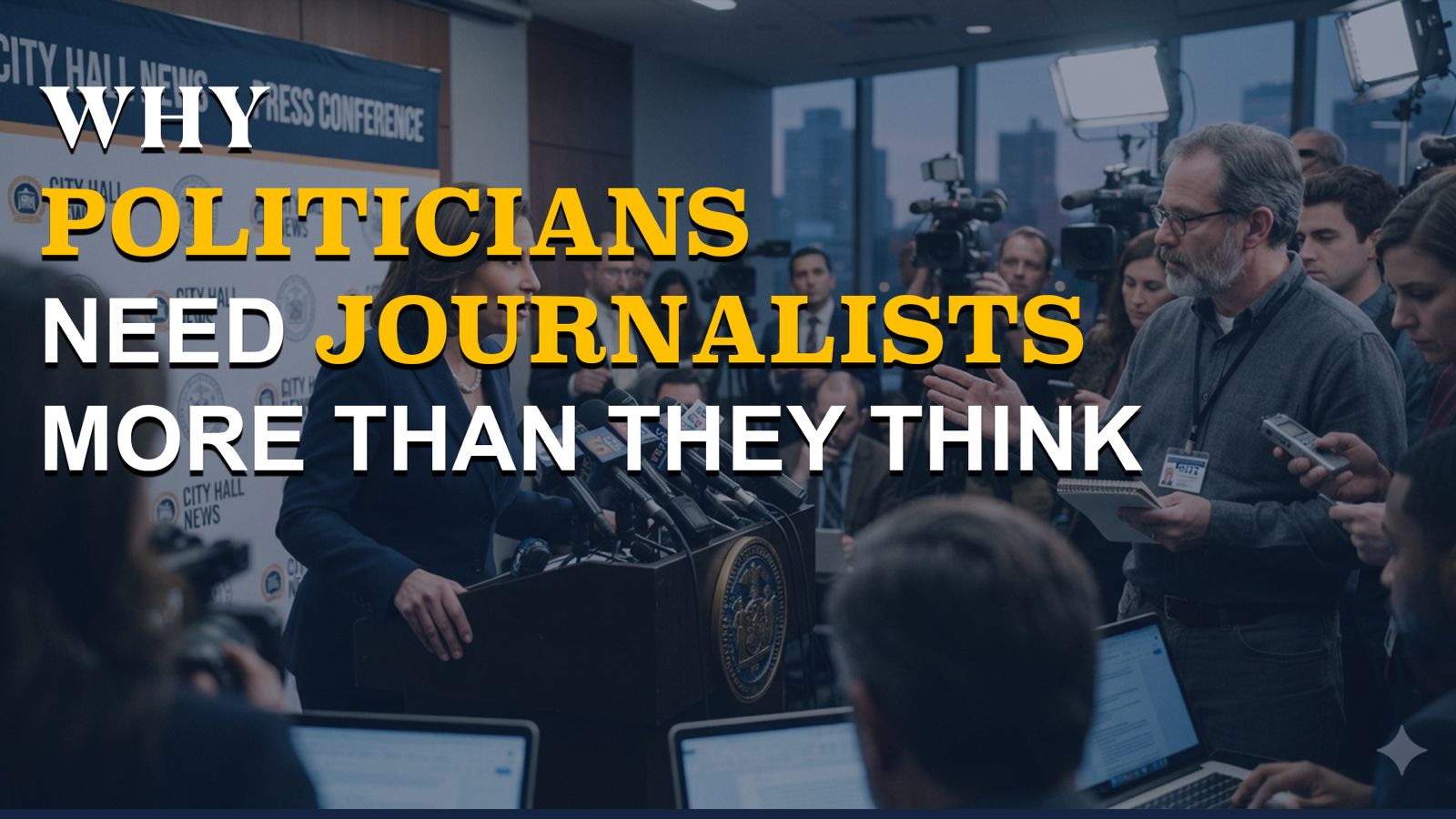
Politics has changed dramatically.
A politician no longer needs to wait for tomorrow’s newspaper to communicate with the public. A statement can be posted instantly. A speech can be livestreamed. A government announcement can reach millions within minutes. A short video can travel across the country before a newsroom has even finished writing its first paragraph.
That should have made journalism less important.
Instead, it has made good journalism more important than ever.
Because there is a fundamental difference between being able to speak to the public and being willing to answer the public.
Politicians communicate.
Journalists question.
Politicians present their vision.
Journalists examine it.
Politicians announce achievements.
Journalists ask whether those achievements match reality.
That relationship can be uncomfortable.
It is also essential.
Politics needs more than applause
Every politician eventually develops a circle around them.
Advisers.
Party workers.
Supporters.
Communication teams.
Social media managers.
Friends.
Donors.
Well-wishers.
People who genuinely believe in the leader.
There is nothing wrong with having loyal people around you.
The problem begins when loyalty becomes agreement with everything.
A political leader who hears “yes” often enough can eventually stop noticing the questions outside the room.
Every speech becomes successful.
Every announcement becomes historic.
Every social media post becomes a breakthrough.
Every criticism becomes a conspiracy.
And every uncomfortable question becomes an attack.
That is when a political bubble begins to form.
And political bubbles are dangerous.
Because elections are not fought inside party offices.
Governments are not judged inside press conferences.
And citizens do not live inside social media timelines.
They live in the real world.
Journalists often spend considerable time in that world.
They talk to people politicians may never meet.
They visit places politicians may visit only during campaigns.
They hear complaints that never make it into official briefing notes.
They hear praise that never appears in government reports.
They hear frustration before it becomes a headline.
And sometimes, they notice a political problem before a political organisation does.
That is valuable.
A journalist can ask the question your team won’t
Imagine a political leader preparing for an election.
The internal team presents research.
The communication team presents campaign numbers.
The social media team presents engagement figures.
The party workers report enthusiasm.
Everything looks positive.
Then a journalist covering the constituency asks:
“But why are people still angry about unemployment?”
That question can be uncomfortable.
But it is useful.
It forces the campaign to investigate something it may have overlooked.
Maybe the concern is exaggerated.
Maybe it is concentrated in one demographic.
Maybe it is genuine.
Maybe the government has addressed it but failed to communicate the response.
Maybe the policy itself needs improvement.
Whatever the answer, the question has created an opportunity to understand reality.
That is what good journalism can do.
It doesn’t necessarily provide the answer.
It can help politicians discover the question they should have been asking.
Journalism is not public relations
This distinction is crucial.
Political communication has a legitimate purpose.
Governments need to explain policies.
Political parties need to communicate their programmes.
Leaders need to defend their decisions.
Citizens need information about what their representatives are doing.
But communication begins with a message.
Journalism begins with a question.
A government might say:
“We have launched a major new programme.”
A journalist asks:
“How much will it cost?”
The government says:
“Millions of people will benefit.”
The journalist asks:
“How many have actually benefited so far?”
The government says:
“The economy is performing strongly.”
The journalist asks:
“Which indicators support that claim?”
Neither side is necessarily wrong for doing its job.
The government is communicating.
The journalist is scrutinising.
The public needs both.
The most useful journalist may be the one who disagrees with you
Politicians naturally appreciate positive coverage.
Everyone does.
But positive coverage is not always useful coverage.
A journalist who writes flattering stories may make a politician feel good.
A journalist who asks difficult questions may make a politician better prepared.
There is an important difference.
Suppose a journalist points out a weakness in a policy.
The politician has several choices.
Ignore it.
Attack the journalist.
Dismiss the criticism.
Or investigate it.
The fourth option is the most productive.
Maybe the criticism is wrong.
Fine.
Then explain why.
Maybe it is partially correct.
Then fix the weakness.
Maybe it exposes a serious problem.
Then address it before it becomes bigger.
Criticism is information when you know how to use it.
Politicians need information, not just favourable headlines
One of the biggest mistakes in political communication is measuring success by the number of positive stories generated.
That can create a dangerous illusion.
Ten favourable headlines do not necessarily mean ten problems have been solved.
A hundred thousand views do not necessarily mean a hundred thousand people agree.
A trending hashtag does not necessarily represent public opinion.
A packed rally does not necessarily predict an election result.
A viral speech does not necessarily translate into votes.
Political strategy requires something deeper.
It requires understanding.
What are voters actually thinking?
What are they worried about?
What are they discussing with their families?
What issues matter enough to influence their vote?
Which promises do they remember?
Which ones do they distrust?
Which groups feel represented?
Which groups feel ignored?
And perhaps most importantly:
What has changed since the last election?
Journalists can be an important part of finding those answers.
Not the only part.
But an important one.
The ground often speaks before the data does
Political organisations increasingly depend on data.
And they should.
Polling, surveys, constituency research, demographic analysis and digital analytics can reveal important patterns.
But numbers have limits.
A survey can tell you that public dissatisfaction has increased.
A journalist who has spent weeks in that constituency may be able to tell you why.
The difference matters.
Maybe the issue isn’t unemployment in general.
Maybe it is the closure of one local factory.
Maybe the issue isn’t healthcare spending.
Maybe the problem is that the local hospital has no specialist doctor.
Maybe voters aren’t angry about a national policy.
Maybe they are angry because their road has been broken for three years.
Numbers identify patterns.
People explain them.
And journalism often sits between those two worlds.
Local journalists may know more than national headlines suggest
Political leaders often focus on national media.
Television.
National newspapers.
Major digital platforms.
But some of the most valuable political information can come from journalists working locally.
A district reporter may know which villages are angry.
A city reporter may know which neighbourhoods are changing politically.
A regional journalist may know which issue is suddenly dominating conversations.
A local reporter may know the history behind a political dispute that never makes it into a national headline.
This is especially important during elections.
National politics can create one narrative.
Local politics can create another.
A voter can admire a national leader and still reject the local candidate.
A voter can dislike a national party and still support its local representative.
Politics is rarely as simple as the national headline suggests.
Social media has created a new political problem
The rise of direct political communication is one of the biggest changes in modern politics.
Politicians can now bypass traditional media.
That has many benefits.
It reduces dependence on gatekeepers.
It allows leaders to communicate directly with citizens.
It enables rapid responses during crises.
It allows governments to explain policies without waiting for editorial cycles.
But there is a downside.
Every political organisation now has the ability to create its own media environment.
A party can publish only positive information.
A government can highlight only successful programmes.
A campaign can amplify only favourable reactions.
Supporters can repeat the same message thousands of times.
Algorithms can then create an illusion of consensus.
A politician can look at their social media feed and genuinely believe everyone agrees.
Meanwhile, people outside that digital ecosystem may be discussing something completely different.
That is why independent journalism matters.
It can provide another window.
Sometimes the window shows something politicians don’t want to see.
That’s precisely why they need it.
Journalists can challenge the political narrative
Every successful political movement develops a narrative.
Perhaps it is about development.
Perhaps nationalism.
Perhaps welfare.
Perhaps corruption.
Perhaps jobs.
Perhaps security.
Perhaps change.
Narratives are powerful because politics is not just about policies.
It is also about meaning.
But every narrative should be tested.
A journalist’s job is partly to ask whether the story matches the evidence.
If a party says it represents young people, journalists can examine youth unemployment and political participation.
If a government says a policy has transformed rural life, journalists can visit rural communities.
If an opposition party claims a system has failed, journalists can examine whether the evidence supports that claim.
This is where journalism becomes more than reporting.
It becomes a mechanism for testing political narratives against reality.
Political leaders should learn to distinguish hostility from scrutiny
This is not always easy.
Journalists can make mistakes.
They can get facts wrong.
They can misinterpret statements.
They can produce unfair coverage.
They can have ideological preferences.
They are human beings, not machines.
But that does not mean every journalist who criticises a politician is biased.
Nor does a journalist’s criticism automatically make it correct.
The mature response is to separate the journalist from the argument.
Ask:
Is the fact correct?
Is the criticism fair?
Is there evidence?
What am I missing?
What does the public actually think?
If the criticism is wrong, correct it.
If it is right, learn from it.
If it is complicated, investigate further.
The worst response is to reject the criticism simply because it is uncomfortable.
Politicians need journalists during crises
This becomes even more important during a crisis.
Natural disasters.
Communal tension.
Public safety incidents.
Economic shocks.
Political controversies.
During such moments, governments need to communicate quickly.
But they also need accurate information coming back from the ground.
Journalists can sometimes reach places before officials.
They speak with affected communities.
They document what is happening.
They identify gaps between official statements and reality.
A government that listens to credible reporting can sometimes respond faster.
A government that dismisses every critical report as hostile propaganda risks losing valuable time.
In a crisis, that difference can matter enormously.
Journalism also protects politicians from misinformation
There is another side to this conversation that is often ignored.
Independent journalism does not only hold politicians accountable.
It can also protect them from false claims.
In a political environment filled with edited videos, fake screenshots, manipulated statistics and misleading narratives, politicians themselves can become targets of misinformation.
A credible journalist can investigate.
Verify.
Provide context.
Correct the record.
That benefits everyone.
Good journalism therefore does not simply make politicians uncomfortable.
Sometimes it prevents political misinformation from becoming political reality.
Politicians should not try to control journalists
There is an important line here.
Building relationships with journalists is healthy.
Trying to control journalism is not.
A politician should be able to call a journalist.
Have tea with them.
Explain a policy.
Share background information.
Correct an error.
Offer access.
Have a disagreement.
And then accept that the journalist may still write something critical the next morning.
That is how it should work.
The journalist does not owe the politician favourable coverage because they had coffee together.
And the politician should not expect it.
If anything, the journalist’s independence is what makes the relationship valuable.
If a politician only wants journalists who agree with them, they aren’t looking for journalism.
They are looking for public relations.
The relationship should be built on professional trust
Trust does not mean agreement.
A journalist can trust a politician to provide information and still write a critical article.
A politician can trust a journalist to report accurately and still strongly disagree with the final piece.
That is professional trust.
It means:
The journalist knows the politician will answer difficult questions.
The politician knows the journalist will not deliberately distort the answer.
The journalist can challenge the politician.
The politician can challenge inaccuracies.
Neither side expects the other to surrender independence.
That is a much healthier relationship than political friendship.
Why politicians should meet journalists outside election season
Another mistake is contacting journalists only when an election is approaching.
Suddenly everyone wants interviews.
Everyone wants coverage.
Everyone wants a headline.
Everyone wants “relationships with the media.”
By then, it is already late.
Good political relationships are built before they are needed.
A conversation over tea.
A discussion about a policy.
An exchange of views about the changing political landscape.
A journalist sharing what they are seeing.
A politician explaining what they are working on.
No cameras.
No prepared statement.
No immediate demand for coverage.
Just conversation.
Those relationships can become incredibly valuable during a campaign or a crisis because there is already a foundation of professional familiarity.
Politicians should ask journalists one simple question
There is one question I believe politicians should ask more often:
“What are you hearing that I am not?”
Not:
“What are people saying about me?”
Not:
“Why didn’t you cover my achievement?”
Not:
“Who is giving you this information?”
But:
“What are you hearing that I am not?”
That question changes the entire conversation.
It turns journalism from a publicity channel into a source of intelligence.
It acknowledges that no political organisation has complete visibility.
And it recognises something every serious leader eventually learns:
You can never know your own political environment completely from inside your own organisation.
The politician who fears every question eventually stops learning
A leader who cannot tolerate criticism becomes surrounded by people who avoid giving it.
The problem grows quietly.
First, the leader stops hearing bad news.
Then the team learns not to bring bad news.
Then mistakes become harder to identify.
Then problems become crises.
And finally, everyone asks:
“How did we not see this coming?”
Often, the warning signs were there.
Someone just wasn’t listening.
Sometimes that warning came from a journalist.
Sometimes it came from a voter.
Sometimes it came from an opposition leader.
The source doesn’t matter.
The lesson does.
Leadership requires the ability to hear information that challenges your assumptions.
The future of political journalism will be different
The media landscape will continue changing.
Artificial intelligence will change news production.
Social media will continue reshaping political communication.
Podcasts will compete with traditional television.
Independent creators will compete with established newsrooms.
Citizens will increasingly become both consumers and producers of political information.
That makes the journalist’s role more complicated.
But it does not make it obsolete.
In fact, the abundance of information makes verification more valuable.
When everyone can publish, someone still needs to investigate.
When everyone can make a claim, someone still needs to ask for evidence.
When everyone can create a narrative, someone still needs to test it.
**The future does not need less journalism.
It needs better journalism.**
Politics and journalism need each other
The relationship will never be comfortable.
Nor should it be.
A journalist should sometimes make a politician uncomfortable.
A politician should sometimes challenge a journalist’s reporting.
A journalist should demand evidence.
A politician should provide it.
A journalist should investigate.
A politician should respond.
The public should watch both.
That tension is healthy.
Because the alternative is far worse.
Politics without scrutiny becomes self-congratulation.
Journalism without independence becomes public relations.
And democracy without either becomes dangerously fragile.
The strongest politician is therefore not the one who has the most flattering headlines.
It is not the one who has the largest social-media following.
It is not even necessarily the one who receives the loudest applause.
It is the politician who can sit across from a journalist, hear a difficult question, resist the urge to become defensive, and say:
“That’s a fair question. Let me answer it.”
That is not weakness.
That is confidence.
And perhaps the greatest political advantage a leader can have is not a newsroom that always agrees with them.
It is a media ecosystem they are willing to listen to.
Because sometimes the person asking the most uncomfortable question is the person giving you the most valuable information.
Politicians don’t need journalists to make them look good.
They need journalists to help them see clearly.
And in politics, clarity is worth far more than applause.
Leave a Reply