
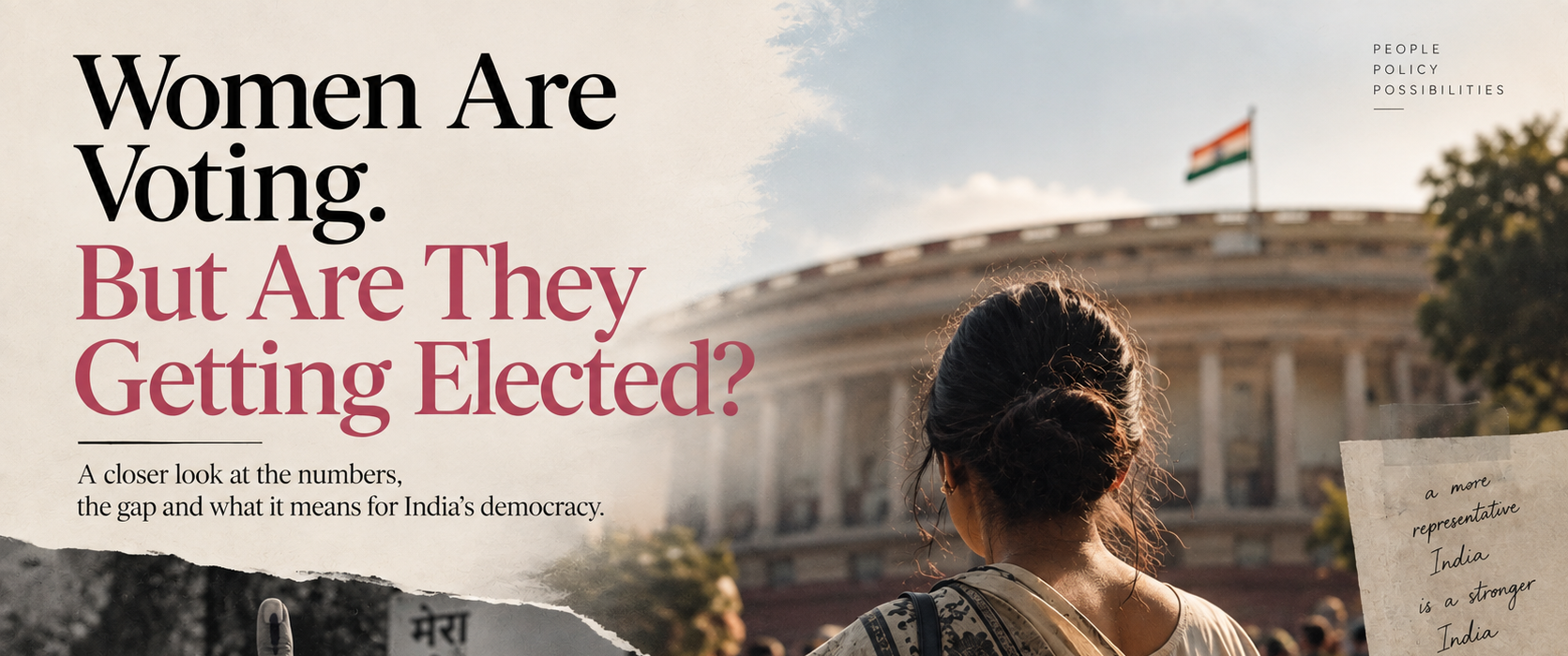
India’s women are showing up at the ballot box.
The bigger question is: Are political parties showing up for them when it is time to give tickets?
Look at the numbers from the 2024 Lok Sabha election.
Women made up 48.62% of India’s registered electors. That means almost half of the country’s voters were women. And they did not stay home.
In fact, 65.78% of female electors voted, compared with 65.55% of male electors. For only the second time in the history of Lok Sabha elections, women actually turned out to vote at a higher rate than men.
That is a remarkable change.
But then comes the uncomfortable part.
Out of 8,360 candidates who contested the 2024 Lok Sabha election, only 800 were women.
That is just 9.6% of all candidates.
And when the results came in, only 74 women were elected.
Out of 543 seats, that is just 13.6%.
So here is the strange picture Indian democracy presents today:
Women are almost half the voters.
Women vote in numbers comparable to, and sometimes higher than, men.
But women are still a small minority among the people making the laws.
Why?
That is the question worth asking.
The voter has changed. Has politics changed with her?
For a long time, Indian politics was built around the assumption that the male voter was the primary political actor.
That assumption is becoming harder to defend.
In 2024, India had around 47.63 crore registered female electors. The number of female electors per 1,000 male electors also reached a new high of 946, compared with 926 in 2019.
And women are not simply registering.
They are voting.
In several states, the difference is particularly striking. Bihar, for example, recorded female voter turnout of 59.45%, compared with 53% for men. In Jharkhand, it was 68.66% for women compared with 63.58% for men. In Kerala, female turnout was 71.86%, compared with 70.34% for men.
This tells us something important.
Women are not politically passive.
They are making choices. They are participating. They are influencing elections.
So perhaps the problem is not whether women are interested in politics.
Perhaps the problem is whether the political system is giving them enough opportunities to participate as leaders.
From voter to candidate
There is a huge difference between asking a woman to vote for a party and asking a woman to represent that party.
The first requires a vote.
The second requires a ticket.
And this is where the numbers become interesting.
In 2024, there were 800 female candidates.
That was an improvement from 726 in 2019.
But look at the longer picture.
In 2009, women made up only 6.9% of Lok Sabha candidates.
In 2014, the number rose to 8.1%.
In 2019, it reached 9%.
And in 2024, it reached 9.6%.
There is progress.
But it is slow.
Very slow.
We have spent years talking about women’s political participation, yet women still made up less than one in ten Lok Sabha candidates in the 2024 election.
And representation after the election was only 13.6%.
The gap between participation and power is difficult to ignore.
The problem is not simply winning elections
It would be easy to say, “But elections are competitive. If women are capable candidates, they should win.”
That argument misses something.
Before a candidate can win an election, someone has to decide that candidate deserves the opportunity to contest.
Political parties decide who gets tickets.
Parties decide which constituencies a candidate is given.
Parties decide how much organisational support that candidate receives.
Parties decide who gets access to senior leaders, campaign machinery and resources.
So the conversation cannot stop at:
“Why aren’t more women winning?”
We also need to ask:
“Why aren’t more women being given serious opportunities to contest?”
The Election Commission’s data shows that there were 152 Lok Sabha constituencies with no female candidate at all in 2024.
That is not a small number.
It means there were constituencies where voters did not even have a woman among the candidates to choose from.
And that brings us to an uncomfortable question for political parties.
If women are almost half of the electorate, why are they still such a small part of the candidate pool?
Representation matters, but not just for symbolism
This is not about putting more women in Parliament simply because it looks good.
Representation matters because political priorities are shaped by who gets to sit at the table.
Women experience public policy differently in many areas.
Safety.
Public transport.
Healthcare.
Education.
Employment.
Childcare.
Property rights.
Digital harassment.
Local infrastructure.
These are not “women’s issues” in some narrow sense. They are national issues.
But people who have lived different experiences can bring different questions into political decision-making.
That is the value of representation.
And there is another point that is often missed.
Women do not need to enter politics only to speak about women.
A woman politician can be an expert on agriculture, defence, finance, urban development, foreign policy, technology or anything else.
The goal should not be to put women into a political box.
The goal should be to make the political space large enough for them to compete across every issue.
India has already taken a major step
There is an important development that cannot be ignored.
In 2023, Parliament passed the Constitution (One Hundred and Twenty-Eighth Amendment) Bill, commonly known as the Women’s Reservation Bill.
The law provides for reserving one-third of seats in the Lok Sabha and state legislative assemblies for women.
But there is an important catch.
The reservation is linked to a future delimitation exercise following the relevant census, meaning it was not in effect for the 2024 Lok Sabha election. (Parline)
So the 2024 election gives us an interesting baseline.
Before the new reservation system takes effect, women won 74 seats.
That is actually lower than the 78 women elected in 2019.
In other words, progress is not always a straight line.
Sometimes the numbers move forward.
Sometimes they move backwards.
That is exactly why political participation needs more than good intentions.
What should political parties do?
The easiest response would be to say, “Give women more tickets.”
Yes.
But that is only the beginning.
Political parties also need to build a pipeline.
A woman should not first hear from a political party when an election is six months away.
If parties want serious female leaders, they need to identify and develop them years before an election.
That means local leadership programmes.
Mentorship.
Political communication training.
Constituency work.
Public speaking.
Policy understanding.
Campaign management.
Digital communication.
Fundraising.
Organisation building.
And most importantly, actual responsibility.
Give young women the chance to run local campaigns.
Let them work on constituency issues.
Let them sit in political meetings.
Let them speak to voters.
Let them make mistakes and learn.
You cannot create an experienced political leader overnight.
And voters have a role too
Political parties respond to incentives.
If voters reward competent women candidates, parties notice.
If voters reject them simply because they are women, parties notice that too.
So the conversation cannot only be about parties.
It has to include society.
Would we judge a woman candidate by the same standards as a male candidate?
Would we question her ambition differently?
Would we call a confident male politician “strong” but describe a confident woman as “aggressive”?
Would we ask a male candidate about his family responsibilities in the same way?
These biases may not appear in election statistics, but they can influence who enters politics, who survives in politics and who eventually gets a ticket.
The real question
India does not have a participation problem when it comes to women voters.
The numbers make that increasingly clear.
In 2024, women were 48.62% of registered electors.
They turned out to vote at 65.78%, slightly higher than men.
Yet only 800 of 8,360 Lok Sabha candidates were women, and only 74 women were elected.
That is the gap we need to discuss.
Because democracy is not only about who votes.
It is also about who gets the opportunity to stand for election, who gets heard, who gets trusted with responsibility and who gets to make decisions.
Women have already demonstrated that they are willing to participate in India’s democracy.
Now political institutions need to answer a harder question:
Are we willing to give them an equal chance to lead it?
The next chapter of Indian politics should not be about convincing women to enter politics.
They are already there.
The challenge is to make sure that when they arrive at the door, the door actually opens. 🇮🇳
Election Commission of India: 2024 Lok Sabha Statistical Reports


Leave a Reply