
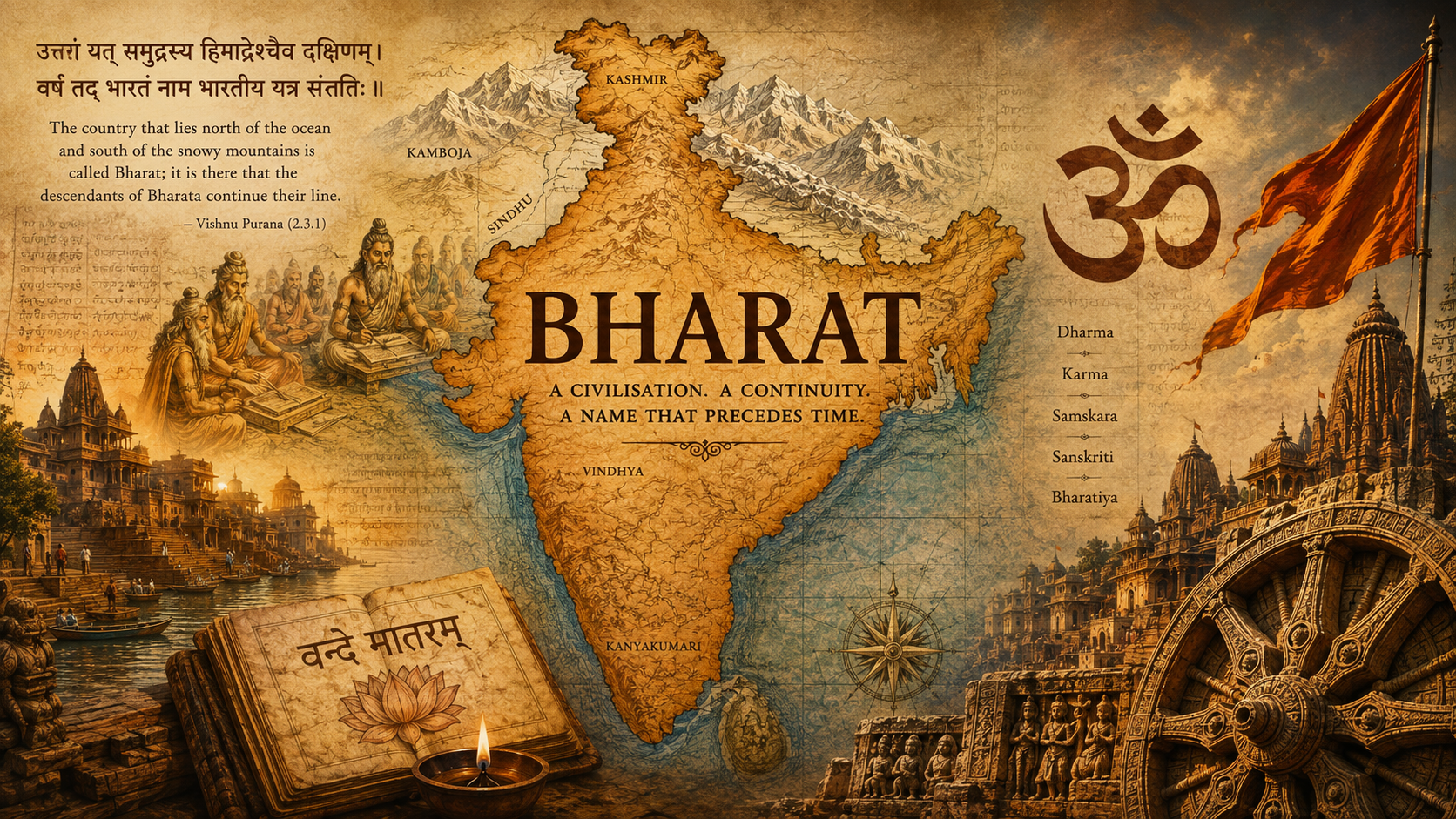
There is a reason the Constitution begins with Bharat.
Article 1(1) of the Constitution of India states clearly:
“India, that is Bharat, shall be a Union of States.”
This is not a poetic flourish added for decoration.
It is a deliberate civilisational claim placed at the very opening of the republic’s founding document. The men and women who drafted the Constitution could have chosen only the internationally familiar name. They did not. They insisted on retaining Bharat alongside India, and they placed it in the first article so that no future generation could treat it as optional.
Bharat is older than the republic. Older than the freedom movement. Older than the maps drawn by colonial surveyors and the borders fixed in the last century. It carries memory, continuity, and a sense of self that no purely administrative or external name can fully replace.
The Name in the Old Texts
The Vishnu Purana gives one of the clearest classical definitions. In Book 2, Chapter 3, Verse 1 it states:
“Uttaraṃ yat samudrasya himādreś caiva dakṣiṇam
varṣaṃ tad bhārataṃ nāma bhāratī yatra saṃtatiḥ”
The meaning is direct:
The country that lies north of the ocean and south of the snowy mountains is called Bhārata; it is there that the descendants of Bharata continue their line.
This is not vague poetry. It is a geographical and civilisational description. Similar formulations appear across multiple Puranas. Bharatavarsha is repeatedly described as the land of karma — the place where human action carries real consequence, where the four yugas unfold in sequence, and where the possibility of liberation through effort remains open. Other regions in the classical geography are described as places of enjoyment. Bharatavarsha is described as the land of works.
The Mahabharata and related traditions link the name to the lineage of Bharata. Whether one follows the account of Bharata as the son of Dushyanta and Shakuntala, or the older associations with the Bharata people in Vedic memory, or the Jain tradition that connects the name to the son of Rishabhanatha, the civilisational self-designation remains consistent. The precise legendary ancestor may differ across tellings. The name of the land does not.
Bharat is the name the civilisation used for itself long before modern political vocabulary existed.
Hindustan Was a Description from Outside
Hindustan has a different origin and a different character.
It comes from Persian. “Hindu” was the Persian rendering of the Sanskrit Sindhu, the name of the Indus River. The land around and beyond the Indus became known to Persian and later Arabic speakers as Hind or Hindustan — the country of the Hindus, or simply the land of the Indus. The suffix “-stan” meaning place or country was added in the Persian linguistic tradition.
This was a practical geographical term. It helped travellers, traders, administrators and armies approaching from the northwest describe the territory they encountered. Over centuries the term expanded to cover larger parts of the subcontinent. It appears regularly in medieval Persian and Arabic sources and later entered wider usage, including under the Delhi Sultanate and the Mughals.
None of this makes the term false. It simply makes it external. It describes the land as seen from outside. It does not carry the same internal civilisational memory that the name Bharat carries. It is a label applied by others, later adopted and naturalised, but never the original self-name of the civilisation.
When the Constitution retained both names — India and Bharat — it performed a careful balancing act. It acknowledged the modern international name required for diplomacy and global interaction. At the same time it deliberately preserved the older civilisational name. The phrasing “India, that is Bharat” is significant. It presents Bharat as the clarifying truth of the political entity called India.
Why the Distinction Still Matters
Names are not neutral. They shape memory and self-understanding.
A people that consistently prefers only the external description risks slowly distancing itself from the internal one. A people that continues to speak its own civilisational name keeps a thread of continuity alive across centuries of political change. Empires rose and fell. Languages shifted. Borders were redrawn. The civilisational name remained available as a source of continuity.
This is not an argument for rejecting any community that lives in the land. Bharat has always contained many languages, many faiths, many customs and many ways of life. The civilisational name does not erase that diversity. It provides the longer historical and cultural frame within which that diversity has existed and continues to exist.
When someone insists that only Hindustan is the acceptable or neutral term, they are not standing above politics. They are elevating the external description and treating the internal civilisational name as somehow optional, emotional or communal. When someone says Bharat without hesitation or apology, they are choosing continuity over a cultivated amnesia.
The freedom movement understood the power of the older name. Bharat Mata was not a bureaucratic slogan invented for pamphlets. Vande Mataram was not addressed to an administrative category. The emotional and civilisational energy of the struggle drew deeply from the older self-understanding. The republic that followed chose to keep that name in the Constitution rather than discard it.
The Republic and the Civilisation
The Indian republic is still young in historical terms.
The civilisation whose name it carries is not.
By placing Bharat in the first article, the Constitution refused to allow the new political form to float free of the longer civilisational reality. It insisted on a connection. That connection is not a matter of nostalgia. It is a matter of honesty about what this land has been and what it continues to be.
Using the name Bharat is not an act of exclusion. It is an act of recognition. It says that this territory is not only a modern state created by the events of 1947 and 1950. It is also the continuation of a much older self-understanding that predates those events by many centuries.
A country can and should have many languages, many regions and many communities. It still requires one civilisational spine that is not subjected to constant renegotiation or treated as an embarrassment. Bharat is that spine.
The republic is young.
The civilisation is not.
The name that carries the longer memory deserves to be spoken clearly, without hesitation and without apology. It deserves to be taught as more than a translation or an alternative. It deserves to be understood as the civilisational claim that the Constitution itself chose to preserve at the very beginning.
Call it Bharat.
Not as a political slogan.
As recognition of what has always been here.

Leave a Reply