
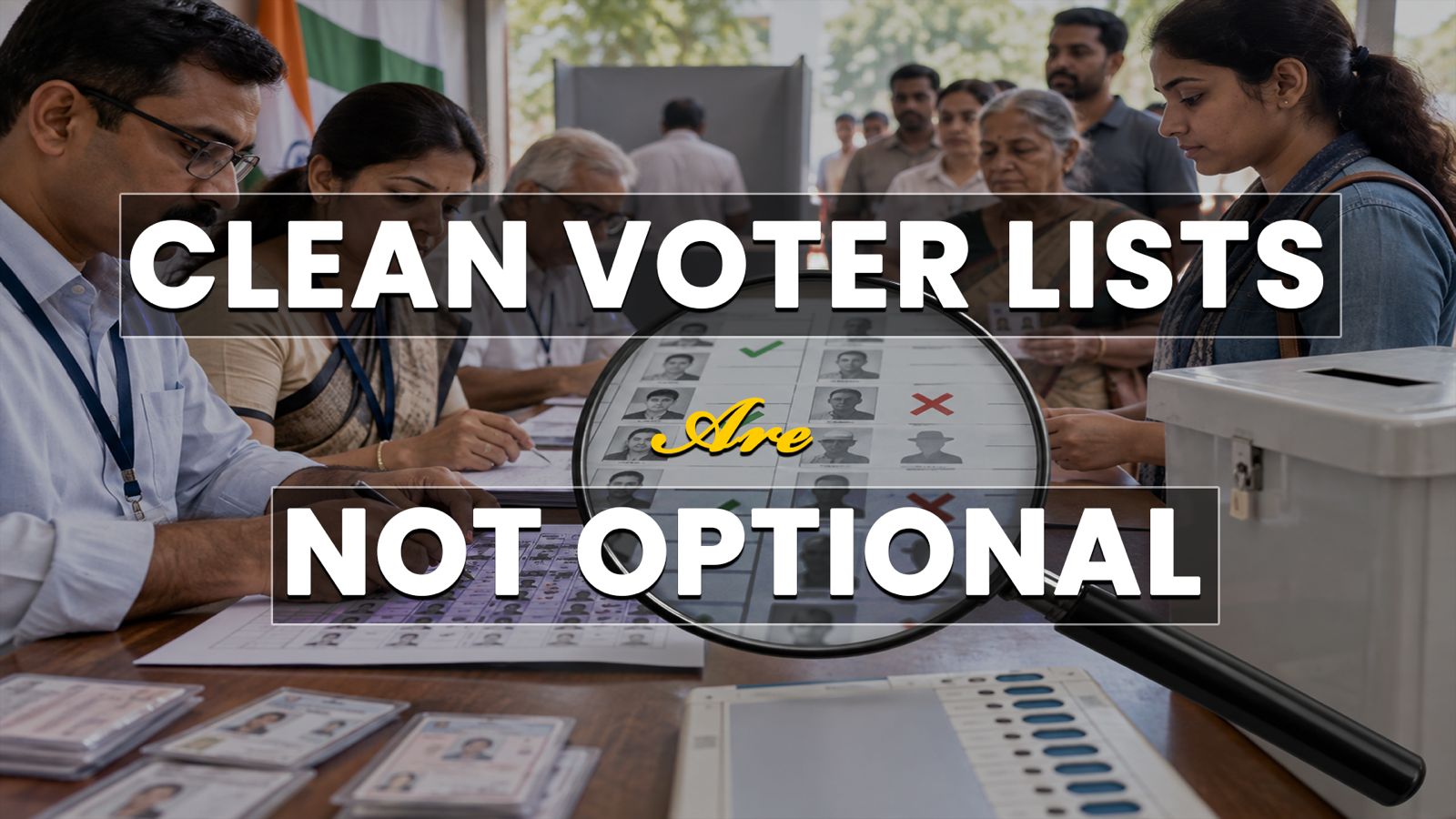
A clean voter list is the foundation of any real election.
Everything else comes after it.
Campaigns mean little if the list itself is unreliable.
Speeches mean little if unverified names dilute real votes.
Manifestos mean little if the electoral roll is treated as flexible.
Turnout numbers look impressive until someone asks how many entries cannot actually be found.
When names that cannot be verified stay on the rolls, every genuine vote loses weight.
When large scale deletions are met with immediate cries of targeting, the real priority becomes obvious.
Protecting the numbers matters more than protecting the integrity of the list.
This is not a complicated idea.
If the person cannot be located, the name should go.
If the address does not exist, the name should go.
If the age or documents do not match, the name should go.
If the same person appears in multiple places without explanation, the extras should go.
Verification is not harassment.
Verification is not exclusion.
Verification is the minimum requirement of any system that calls itself democratic.
A list that cannot survive basic checking is not inclusive.
It is compromised.
Yet every time a serious revision drive begins, the same pattern repeats.
Doubtful entries start getting identified in significant numbers.
The political temperature rises within days.
The language shifts from cleanup to conspiracy.
It becomes an attack on a community.
It becomes an attempt to disenfranchise.
It becomes a dark design against the poor and the marginalised.
The areas that show the highest concentration of weak or unverifiable entries suddenly become the most sensitive zones in the state.
Scrutiny itself is treated as the problem.
That reaction is revealing.
A political side that trusts its genuine support base does not panic when names are checked.
A side that reacts with alarm and mobilisation is showing what it has grown comfortable relying on.
The loud protest is rarely about the sacred right to vote.
It is about the arithmetic that a padded list quietly provides.
Remove the padding and the comfort shrinks.
That is why the resistance is so fast and so coordinated.
Equal citizenship has a very clear test in this matter.
The same standard of verification must apply in every ward and every constituency.
No area receives a quiet exemption because of who holds influence there.
No set of names is declared too politically delicate to examine.
No party gets to decide which part of the list is sacred and which part can be questioned.
The moment special pleading is entertained, the list stops being a democratic record.
It becomes a political asset to be defended.
This is not theoretical.
Across different states, revision exercises have repeatedly thrown up the same issues.
Duplicate entries that no one can explain.
People who shifted residence years ago but remain listed at the old address.
Names that appear to have no matching physical presence when officials actually go looking.
In some pockets the gap between the listed number and the verifiable number is large enough to change the character of the contest.
When officials begin the work of cleaning these discrepancies, the focus moves with remarkable speed.
Attention shifts away from the quality of the list.
It moves towards the motives of those ordering the cleanup.
The process is put on trial before the names are.
The genuine voter is the one who loses in this game.
Every unverified name that remains is a small theft from the value of a real vote.
One or two may seem minor.
Scale it to thousands and then to lakhs and the theft becomes structural.
Elections begin to reflect the strength of organisation around the list rather than the actual preference of citizens who live and vote in that place.
Democracy does not begin on the morning of polling.
It begins with the preparation of the list.
If that list is treated as negotiable, everything that follows inherits the defect.
High turnout figures become harder to read with confidence.
Margins of victory become harder to accept without suspicion.
The losing side gets a permanent ready made excuse.
The winning side inherits a legitimacy problem it did not ask for.
Those who resist thorough cleanup often claim the highest motives.
They say they are defending the poor.
They say they are defending the migrant worker.
They say they are defending the marginalised who may not have perfect paperwork.
In practice they are defending opacity.
A poor citizen who has genuine documents has nothing to fear from verification.
A migrant who has properly updated registration has nothing to fear.
The people who benefit from sustained resistance are those whose organisational machinery has grown used to weak checks and slow corrections.
They have learned to treat the electoral roll as territory rather than as a factual record of citizens.
There is a deeper and longer cost.
When large sections of the public begin to believe that voter lists in certain areas are systematically unreliable, trust in the electoral process itself starts to erode.
People begin to assume that outcomes are shaped as much by the management of the rolls as by the quality of the campaign or the mood of the electorate.
That cynicism is corrosive.
It weakens the authority of whichever side wins.
It makes every close result open to permanent doubt and permanent grievance.
The solution is not mysterious and it is not new.
Continuous and honest updating of the rolls.
Door to door verification in areas where the data looks weak.
Clear and sufficient time for claims, objections and corrections.
Publicly available information on how many names were added and how many were deleted so that the process can be examined by anyone.
And above all, a complete refusal to create political exceptions.
The same rules in every district.
The same seriousness in every constituency.
The same standard for every party.
Clean voter lists are not a gift given by the Election Commission.
They are not a concession granted by the government of the day.
They are the basic condition for the vote of an ordinary citizen to mean anything at all.
Those who fight the cleanup are not expanding democracy.
They are protecting an advantage that a dirty list gives them.
They are asking the system to look the other way so that the old arithmetic can continue.
That request should be rejected without hesitation every single time.
Verify the names properly.
Delete what cannot be verified.
Publish the numbers and the process.
Apply the standard without fear and without favour.
Anything less is not inclusion.
It is the quiet acceptance of fraud dressed up in the language of concern.
A democracy that accepts that bargain slowly stops being a democracy.
It becomes a contest over who can better manage the imperfections of the list.
The citizen deserves better than that.
The list must be clean.
That demand is not optional.
It is the starting point.
Leave a Reply