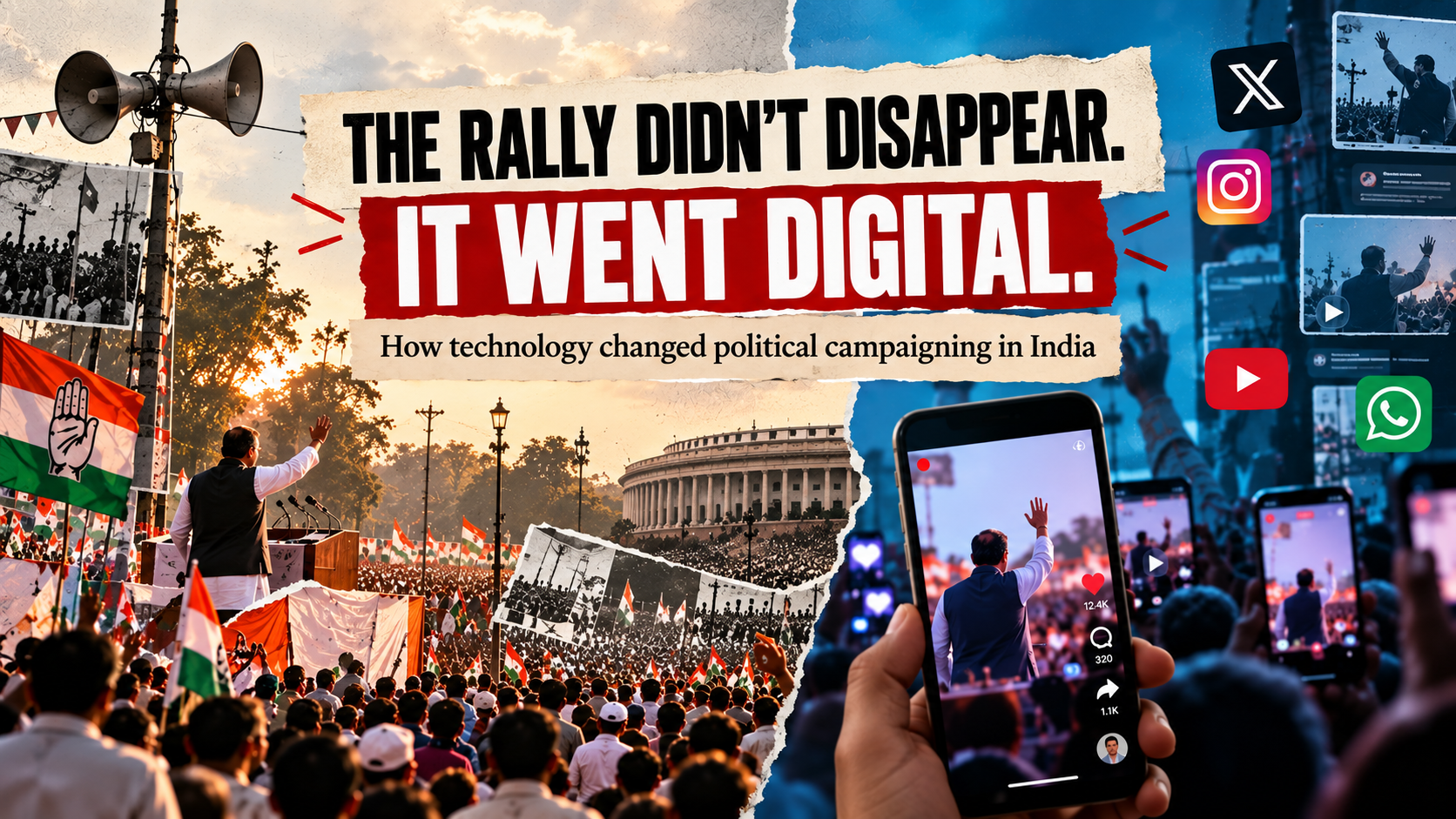
For decades, Indian politics had a familiar picture.
A politician standing on a stage.
Thousands of people gathered in a maidan.
Party flags moving through the crowd.
Loudspeakers carrying speeches across the neighbourhood.
Workers going door to door.
Posters on walls.
Newspapers the next morning telling everyone what happened.
For a long time, this was what political campaigning looked like.
Today, the picture is very different.
A political speech can reach millions without the politician travelling to every city. A rally can happen in one location and continue circulating on Instagram, YouTube, WhatsApp and X for days. A short video recorded on a phone can reach people who were nowhere near the original event.
But has digital politics actually replaced the old political campaign?
Not quite.
The more interesting story is that Indian politics has built a new layer on top of the old one.
The rally did not disappear.
It got a digital afterlife.
The campaign used to have a physical limit
A political rally has an obvious limitation.
There are only so many people who can physically attend it.
A candidate can speak to 20,000 people in a ground, perhaps 50,000 or more at a large event, but the physical audience remains limited by geography, transport, security and time.
Digital platforms changed that equation.
In 2014, India’s digital ecosystem was still relatively small. DataReportal estimated that fewer than one in five Indians were internet users in July 2014, while social media penetration was around 8%.
Yet political parties were already experimenting with Twitter, Facebook, SMS and other digital tools.
One academic study examining the 2014 election analysed 98,363 tweets from 11 political parties during the campaign period. The researchers described 2014 as an important early experiment in social media campaigning in India.
The important thing was not simply that politicians had started using Twitter.
It was that political communication had started becoming continuous.
The campaign was no longer confined to the rally ground.
Then the numbers changed dramatically
Fast forward to the 2024 Lok Sabha election.
India had almost 98 crore registered electors, and 64.64 crore votes were polled. The Election Commission recorded more than 10.52 lakh polling stations across the country.
At the same time, the digital audience had become enormous.
According to DataReportal’s 2026 India report, India had approximately 1.03 billion internet users at the end of 2025, equivalent to around 70% of the population. It estimated around 500 million social media user identities in October 2025.
That is a completely different political communication environment from 2014.
A campaign today isn’t speaking to one audience.
It is speaking to several audiences at once.
There is the person attending the rally.
The person watching the rally on television.
The person watching a 45-second clip from the speech.
The person receiving a WhatsApp message.
The person seeing a meme about the speech.
The person reading a newspaper’s interpretation of it the next morning.
And the person who never watched the speech but encounters five different reactions to it on social media.
The political event is the same.
The information environment around it is not.
The rally did not die. It became content.
This is probably the biggest change.
Research by Carnegie Endowment found that around 35% of tweets containing partisan political content in its study contained rally-related material, and almost 70% of that rally content was posted after the rally itself.
That tells us something fascinating.
A rally is no longer just an event.
It is also a content factory.
The speech produces clips.
The crowd produces photographs.
The candidate produces quotes.
The opposition produces criticism.
Supporters produce edits.
News organisations produce headlines.
Influencers produce reactions.
And ordinary users create their own versions of the event.
One physical gathering can therefore generate hundreds or thousands of digital pieces of content.
The campaign doesn’t end when the politician leaves the stage.
In some ways, that is when another part of the campaign begins.
The smartphone changed the political worker too
Political communication used to require infrastructure.
A party needed newspapers, posters, printing presses, loudspeakers, local workers and physical events.
Today, a smartphone can become a miniature campaign office.
A local party worker can record a speech.
Edit a short video.
Add subtitles.
Post it online.
Share it in WhatsApp groups.
And potentially reach people outside the immediate constituency.
This doesn’t mean every post goes viral. Most don’t.
But the barrier to producing and distributing political content has become much lower.
That matters.
Politics is no longer only about who gets access to the biggest stage.
It is increasingly also about who can produce, package and distribute information consistently.
But here is where the “digital replaced rallies” argument falls apart
The 2024 election gives us an important reality check.
Research based on voter surveys found that in-person campaigning remained highly important.
In a survey of roughly 4,000 voters in Uttar Pradesh, 73% of respondents considered in-person campaigning, including door-to-door campaigning and mass rallies, the most important campaign activity for smaller regional parties.
Even among voters considering larger national parties such as the BJP and Congress, nearly 54% considered in-person campaigning the most important form of outreach.
Another Lokniti-CSDS post-poll survey of nearly 20,000 respondents found that about 23.9% said they had attended election meetings or rallies during the 2024 campaign.
So the physical campaign is clearly not dead.
People still want to see politicians.
They still attend meetings.
They still respond to local workers.
They still care about what happens in their neighbourhood.
And this makes sense.
A social media post can tell you what a politician says.
A conversation with a candidate or party worker can tell you something different.
A rally gives visibility.
A door-to-door conversation can provide feedback.
A WhatsApp message can provide speed.
Each medium does something different.
Politics has become hybrid
This is perhaps the best way to understand the change.
Old politics was not simply:
Rally → Vote
New politics isn’t:
Instagram → Vote
It is much messier.
It looks more like:
Rally → Video → Social Media → News → WhatsApp → Conversation → Counter-narrative → Local campaign → More content
The physical and digital worlds constantly feed each other.
Carnegie’s research makes this particularly clear. It found that political parties used photographs and videos from rallies on platforms such as WhatsApp and Facebook, while smartphone users were frequently exposed to this rally content online.
The rally creates the content.
The internet distributes it.
The audience reacts.
The reaction becomes another piece of content.
And the cycle continues.
The biggest change may not be reach. It may be speed.
This is where digital politics has fundamentally changed the campaign.
Earlier, political communication moved comparatively slowly.
A speech happened.
A journalist reported it.
A newspaper printed it.
People read about it the next day.
Today, the gap can be measured in seconds.
A statement can be clipped, uploaded, translated, edited, criticised and reshared almost immediately.
That creates opportunities.
But it also creates problems.
A politician’s full 45-minute speech may be less important online than a 20-second clip.
Context can disappear.
A statement can travel much further than the original audience ever intended.
And by the time a clarification arrives, the original clip may already have reached millions.
Digital politics therefore doesn’t just make political communication faster.
It makes the political news cycle faster.
And then came the algorithm
There is another major difference between the old campaign and the new one.
In a physical rally, everyone broadly sees the same stage.
Online, two citizens can live in the same constituency and experience completely different political information.
One person’s feed may be filled with speeches.
Another’s may be filled with policy discussions.
Another may mostly see memes.
Another may see criticism of the same politician.
The campaign is therefore no longer one single conversation.
It is a collection of overlapping conversations.
That creates a new challenge for political research.
A loud conversation online does not automatically represent the entire electorate.
India’s digital population is enormous, but even DataReportal estimates that around 440 million people were still offline at the end of 2025.
So if political researchers look only at social media, they are looking at a huge population.
But they are still not looking at everyone.
The voter who never posts still matters
This may be one of the most important lessons of digital politics.
Some citizens post political opinions every day.
Some share political videos.
Some argue in comment sections.
Some run political pages.
And some never post anything political at all.
They still vote.
They still have opinions.
They still care about roads, jobs, prices, education, healthcare, local infrastructure, identity, security and hundreds of other issues.
A political researcher who only studies online conversation can therefore mistake visibility for importance.
What trends online is measurable.
What matters to people offline can be much harder to see.
That is why fieldwork, surveys, conversations and local political networks have not become irrelevant.
If anything, the growth of digital politics makes understanding the offline voter even more important.
So what has actually changed?
Quite a lot.
Political communication has become faster.
The audience has become larger.
Content can travel far beyond the location where it was created.
Campaigns can remain active between physical events.
Political workers can communicate directly with citizens at much lower distribution costs.
Citizens can respond publicly rather than simply consuming political messages.
And political parties now have to think about what happens to every major speech, photograph and event once it enters the digital ecosystem.
But some things have not changed.
People still want personal contact.
Local issues still matter.
Candidates still need organisational networks.
Rallies still create visibility.
Door-to-door campaigning still matters.
And millions of voters remain outside the most visible corners of social media.
So perhaps the story isn’t mass rallies versus digital politics.
It is mass rallies plus digital politics.
The political campaign has become hybrid.
The new political campaign has two stages
The first stage happens in the physical world.
A politician meets people.
A rally takes place.
A worker visits homes.
A local issue is raised.
A speech is delivered.
The second stage happens online.
The speech becomes a clip.
The rally becomes a photograph.
The local issue becomes a hashtag.
The politician’s answer becomes a graphic.
The opposition responds.
Supporters respond to the opposition.
Journalists report the exchange.
And citizens discuss it all over again.
The campaign now moves in both directions.
Offline creates online.
Online changes offline.
That is the real transformation.
The question for political research
For political researchers, this creates a completely different challenge.
It is no longer enough to ask:
“What are people saying online?”
We also have to ask:
“Who isn’t speaking online?”
It is no longer enough to measure:
views, likes, shares and followers.
We also need to understand:
conversations, turnout, local networks, field feedback and voter priorities.
And it is no longer enough to study the rally.
We need to study what happens to the rally after it enters the phone of someone who wasn’t there.
That is where modern political research gets interesting.
India’s political campaign hasn’t moved from the ground to the screen.
It has built a bridge between the two.
The rally is still there.
The loudspeaker is still there.
The party worker is still there.
The voter is still there.
But now, sitting beside them, is a smartphone.
And that little screen has changed how politics travels.
The real question isn’t whether digital politics has replaced traditional campaigning.
It is how the two are changing each other.
What do you think has changed the most in Indian political campaigning: reach, speed, voter engagement, or the way political narratives are created?
Leave a Reply