
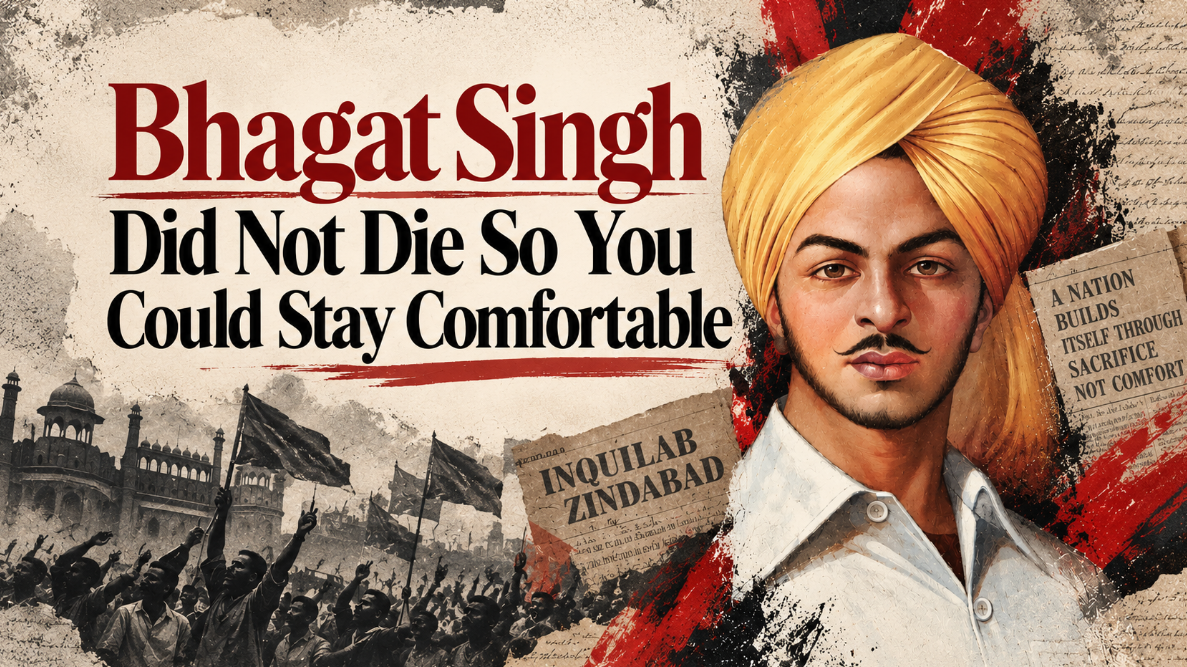
28 September 1907.
A boy is born in Banga village, Lyallpur.
His name is Bhagat Singh.
He will not live to see forty.
He will not live to see thirty.
He will not even live to see twenty four.
At twenty three the British put a rope around his neck and dropped the floor.
They thought that would end him.
They were wrong.
Today the same people who once feared his name try to soften it.
They turn the man who threw bombs into a harmless poster.
They turn the man who mocked empty prayers into a secular mascot.
They turn the man who demanded complete independence into someone who would have been happy with polite negotiations.
This will not stand.
Bhagat Singh was not gentle.
He was not patient.
He was not interested in making the empire comfortable.
He was a Hindu revolutionary who saw the British for what they were and decided to hit back.
The Making of a Revolutionary
He came from a family that already knew the cost of resistance.
His father Kishan Singh and uncle Ajit Singh had faced the British before he was even born.
The house he grew up in breathed defiance.
He watched the Jallianwala Bagh massacre unfold when he was only twelve.
British troops under General Dyer trapped unarmed Indians in a garden and opened fire until the ammunition ran low.
Hundreds died.
Thousands were wounded.
The empire called it necessary.
Bhagat Singh called it murder.
That day something hardened inside him.
He finished school.
He read voraciously.
Marx. Lenin. Mazzini. The Gita. The histories of revolutions.
He joined the Hindustan Republican Association.
Later it became the Hindustan Socialist Republican Association.
The name changed.
The goal did not.
Complete freedom.
No dominion status.
No polite sharing of power with the same people who had looted the country for two centuries.
He meant every word.
The Death of Lala Lajpat Rai and the Answer That Followed
In 1928 Lala Lajpat Rai led a protest against the Simon Commission.
The British had sent a group of white men to decide India’s future.
No Indian members.
Lala Lajpat Rai stood against it.
Police lathi charged the crowd.
Lala Lajpat Rai was beaten so badly he died of his injuries.
The empire barely shrugged.
Bhagat Singh did not shrug.
He and his comrades decided the police officer responsible must answer.
They planned to kill James Scott.
In the darkness and confusion they killed J.P. Saunders instead.
Saunders was also a British officer.
The message remained the same.
You will not beat our leaders to death and walk away unharmed.
The British called it murder.
Bhagat Singh called it justice.
He went underground.
The net closed in.
The Assembly Bomb and the Choice to Stay
On 8 April 1929 Bhagat Singh and Batukeshwar Dutt walked into the Central Legislative Assembly in Delhi.
They threw bombs.
The bombs were designed to make noise, not corpses.
No one died.
They could have run.
They stayed.
They shouted Inquilab Zindabad.
They threw leaflets.
They waited for the police.
This was not an act of someone trying to escape consequences.
This was an act of someone forcing the empire to look him in the eye.
In court he used the dock as a platform.
He spoke of revolution.
He spoke of the right to resist tyranny.
He turned the British legal system into a stage for the freedom struggle.
The empire had no answer except the noose.
The Hunger Strike That Exposed the Jailers
In prison Bhagat Singh and his comrades demanded to be treated as political prisoners.
The British refused.
So they stopped eating.
The hunger strike lasted for weeks.
Jatin Das died.
The news spread across the country.
The empire that claimed to be civilised was starving young men who asked only for dignity.
Bhagat Singh survived that strike.
He did not survive the sentence that followed.
The Final Morning
23 March 1931.
Lahore Central Jail.
Bhagat Singh, Rajguru and Sukhdev were hanged.
The British moved the execution forward by several hours because they feared the public reaction.
They were right to fear it.
Even in death Bhagat Singh refused to let them control the narrative.
He walked to the gallows with his head high.
No last minute conversion.
No plea for mercy.
Just the same resolve that had guided him from the beginning.
The Attempt to Soften the Revolutionary
After independence the same forces that once kept their distance from his methods tried to claim him.
They turned the man who threw bombs into a gentle icon suitable for textbooks.
They turned the atheist who wrote “Why I Am an Atheist” into a figure who fits every political campaign.
They turned the revolutionary who wanted complete independence into someone who would have been satisfied with polite negotiations and gradual reform.
This will not stand.
Bhagat Singh was not a moderate.
He was not a follower of non violence as an absolute principle.
He believed that when a foreign power rules by force, force is a legitimate reply.
He believed that slavery of the mind is as dangerous as slavery of the body.
He believed that a free country must also be a just country, free from the hierarchies that keep people divided and weak.
He was a son of this soil who refused to accept that Indians must remain subjects forever.
The Selective Amnesia of Convenience
Today some voices try to claim him as a pure Marxist icon while ignoring the deep nationalism that drove him.
Others try to turn him into a harmless schoolbook sketch while ignoring the armed struggle he chose.
Both are forms of theft.
Bhagat Singh belonged to the Indian people who wanted the British gone. He belonged to the young who were no longer willing to wait. He belonged to those who understood that empires do not leave because they are politely requested to leave.
He did not die so that later generations could use his face while rejecting his methods.
He did not die so that his name could be reduced to a convenient slogan during election season.
He died because he believed Bharat deserved to be free and was willing to kill and be killed for that belief.
What His Life Still Demands
Look at the country today.
Leaders who speak of non violence when it is convenient and stay silent when their own people are slaughtered.
Activists who discover free speech only when it suits their politics.
Intellectuals who can write entire books on colonial injustice but cannot open their mouths when Hindus are driven from their homes in their own land.
Bhagat Singh would not have recognised this cowardice.
He understood that freedom is not a gift given by the powerful. It is taken by those who refuse to remain subjects.
He understood that a nation that cannot defend its own people will not remain a nation for long.
He understood that empty moral lectures mean nothing when the other side is holding the gun.
That is why they hanged him.
That is why his name still makes the comfortable uneasy.
The Unfinished Work
Bhagat Singh did not die so that we could hold seminars about him.
He died so that this land could stand upright.
Every time a government fails to protect its citizens, his sacrifice is insulted.
Every time selective history is used to divide the very people who need to stand together, his memory is diminished.
Every time young Indians are taught to be ashamed of strength and proud of endless patience, the rope that killed him is tightened again in a different form.
He was twenty three years old.
He had already lived more fully than many who reach eighty in safety and silence.
The British hoped the noose would end the story.
It only began it.
On his birth anniversary the least we can do is refuse the softened version of his life.
He was not a gentle icon for textbooks.
He was a revolutionary who believed that tyranny must be met with resistance.
He still asks the same question of every generation:
What are you willing to risk for the freedom you claim to love?
The answer determines whether his death meant something or whether it was just another name on a long list of the forgotten.
Remember him properly.
Or do not pretend to remember him at all.

Leave a Reply