
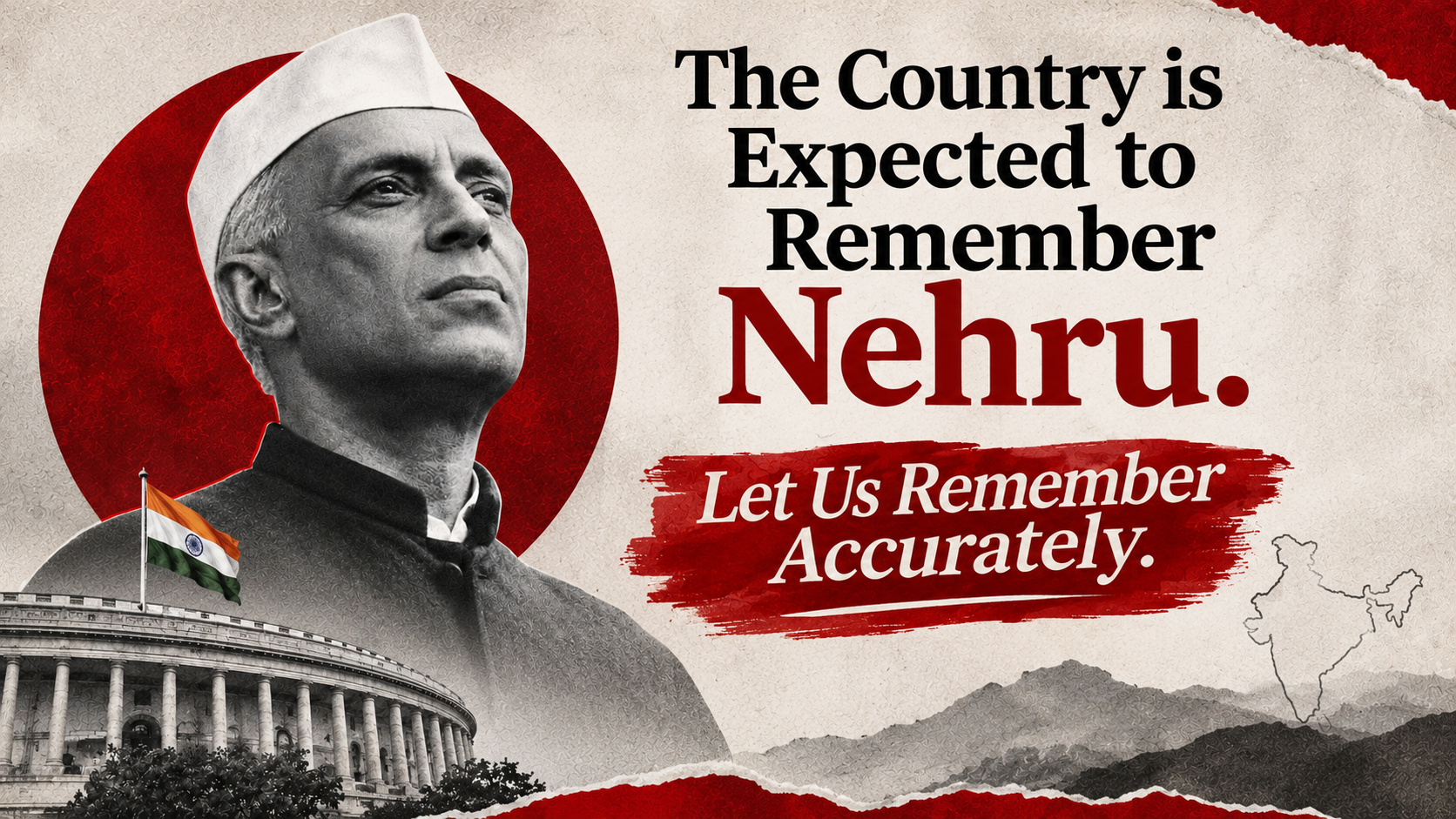
14 November arrives every year with the same expectation.
Remember Nehru.
Speak softly.
Stay grateful.
Do not examine too closely.
That demand itself is the problem.
Nehru was the first Prime Minister of independent India. He held office for seventeen long years. He shaped institutions, foreign policy, the education system, and the early political culture of the republic. These are facts. They do not require denial. They also do not require worship.
A country that cannot examine its founding figures without fear is not a confident country. It is a country still living inside a carefully protected story.
The story that was sold
For decades the official memory insisted on a single approved version. Nehru as the sole architect of modern India. Nehru as the permanent moral reference. Nehru as the man who gave the country its scientific temper, its global standing, and its democratic instincts. Anyone who pointed to the costs of his decisions was accused of hatred, narrowness, or communal thinking.
That tactic worked for a long time. It works less well now.
The generation that still demands reverence for every decision of that era is often the same generation that calls any scrutiny “hatred.” The word has been used so freely that it has lost its force. Scrutiny is not hatred. Refusal to scrutinise is not maturity.
What actually took root
Under Nehru the idea hardened that the Hindu majority should practice permanent self-restraint while other identities could assert themselves without similar caution. The word secular began its long drift from equal distance to selective protection. Civilisational confidence was treated as a risk. Minority sentiment was treated as a veto.
This was not a small stylistic preference. It became structure.
It entered textbooks.
It entered administrative habit.
It entered the reflexes of the political class.
The majority was trained to feel that its own cultural continuity required constant justification. The minority was trained to feel that any strong assertion of the majority identity was a threat by definition. That asymmetry did not produce harmony. It produced permanent negotiation over the basic character of the country.
The decisions that still shape the present
Look at the choices that did not remain in the past.
Kashmir was given special status. Full integration was postponed. The consequences of that postponement are not theoretical. They were paid in blood, in displacement, and in decades of distorted politics. The early softness on the issue was not forced by circumstances alone. It was a political choice rooted in a particular worldview.
The elevation of dynasty as a natural feature of politics began in that period. What started as the overshadowing presence of one family hardened into an expectation that leadership would remain within a bloodline. The damage of that expectation is still visible in the inability of an entire political tradition to renew itself.
The discomfort with any strong assertion of Hindu civilisational continuity was not hidden. It was expressed through policy, through rhetoric, and through the selection of which histories would be emphasised and which would be softened. A country with a continuous civilisation was taught to speak of itself as if that continuity were a problem to be managed rather than a foundation to be owned.
These were not accidents.
They were choices.
Consequential is not the same as correct
A leader can be consequential and still be wrong on fundamental questions. Consequential is not the same as correct. The refusal to accept this distinction is what turns history into propaganda.
Nehru’s international standing, his personal elegance, his command of language, and his role in the early years of the republic are part of the record. So is the cost of the strategic and civilisational choices made under him. A mature memory holds both. An immature memory demands that the second be treated as bad manners.
The school textbook version was never the complete one. It was the version required by a particular political project. That project needed a founding father who stood above serious criticism. It needed the early years to be remembered as a time of pure idealism rather than a time of contested decisions with long consequences.
The habit of selective memory
Every society remembers selectively. The problem arises when the selection is enforced as moral duty. When examination of Kashmir policy is treated as communal. When discussion of dynasty is treated as personal attack. When any attempt to restore civilisational confidence is treated as a threat to the idea of India.
The idea of India was never meant to be a permanent exercise in majority self-erasure. It was meant to be a functioning republic that could hold its diverse population without requiring the largest community to treat its own heritage as optional.
That requirement was not written in the Constitution. It was cultivated in the political culture that followed.
What a confident country does
A confident country does not need its first Prime Minister to be perfect. It needs the freedom to examine his choices without fear of being called names. It needs the ability to say that some foundations were laid well and some were laid crookedly. It needs the maturity to separate respect for the office from reverence for every decision taken in that office.
The generation that still polices the memory of Nehru is not protecting history. It is protecting a political inheritance. The anger that greets any critical examination is not the anger of the historian. It is the anger of the heir.
The question that remains
How long will examination of those choices be treated as hatred while the choices themselves are treated as sacred?
The answer will decide whether the country continues to live inside a protected story or finally steps into an adult relationship with its own past.
Nehru deserves to be remembered.
He does not deserve to be protected from the full record.
The textbook version was neat.
The actual version is more complicated, more costly, and far more relevant to the problems that still refuse to leave.
Remember him.
But remember accurately.
That is not hatred.
That is adulthood.
And adulthood is the one thing a living civilisation cannot keep postponing.
Leave a Reply