
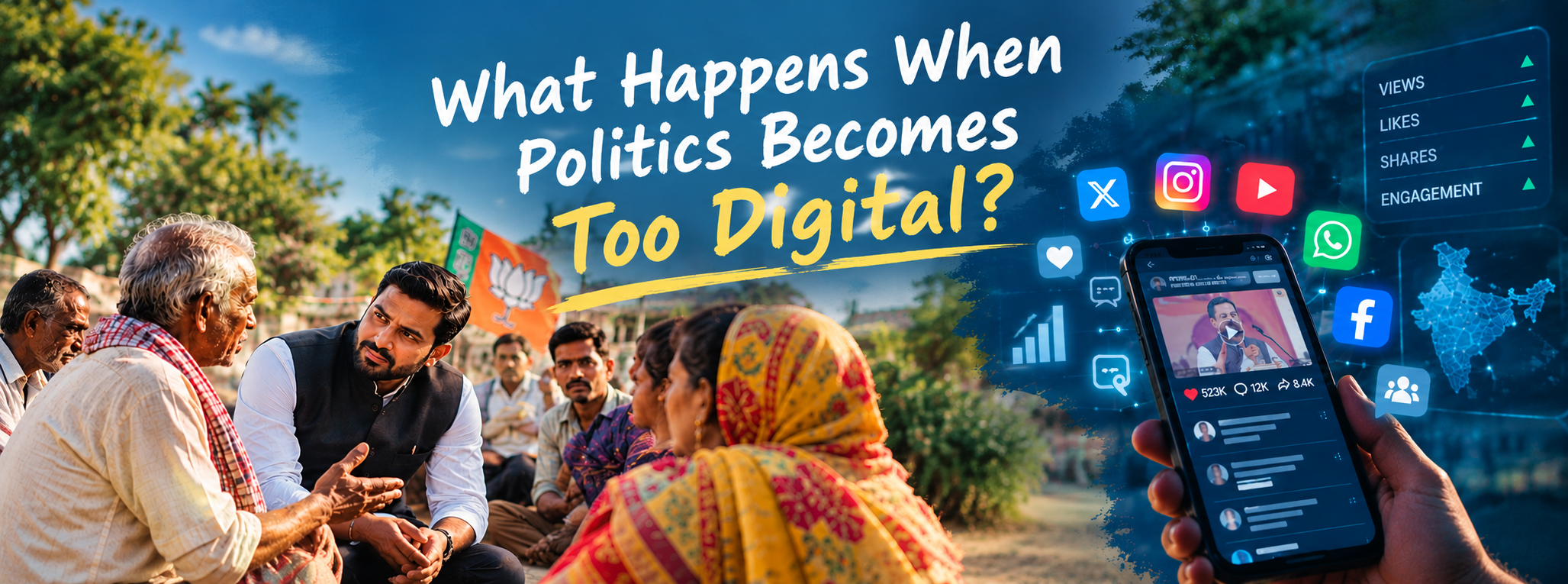
There was a time when a political worker knew his constituency because he knew the people.
He knew which local issue was creating anger.
He knew which village had a water problem.
He knew which neighbourhood had not seen its councillor in months.
He knew which family had always supported the party but was now unhappy.
He knew who would actually bring ten people to a meeting and who would only say, “Don’t worry, I am with you.”
A lot of that knowledge came from walking around.
Meeting people.
Sitting with them.
Having tea.
Attending weddings and funerals.
Listening to complaints that would never make it into a newspaper.
Politics was slow, but there was a certain kind of understanding that came with that slowness.
Today, politics moves very differently.
A speech can reach lakhs of people within minutes.
A local issue can become a national discussion.
A candidate can communicate directly with voters without depending entirely on television or newspapers.
Political workers can run WhatsApp groups, analyse social media conversations, track engagement and communicate with supporters throughout the day.
There is no doubt that technology has changed political campaigning.
But I think we need to ask a slightly uncomfortable question:
Have we become better at understanding people, or simply better at reaching them?
Because these two things are not the same.
The internet can tell you what people are watching. It cannot always tell you what they are thinking.
Imagine a candidate posts a video.
It gets 500,000 views.
Thousands of people like it.
Hundreds comment.
Supporters share it across WhatsApp.
The campaign team looks at the numbers and says, “This is working.”
Maybe it is.
But what exactly do those numbers tell us?
They tell us that people watched the video.
They tell us that the content travelled.
They tell us that the candidate received attention.
They do not automatically tell us that those people will vote for the candidate.
Someone can watch a political speech because they agree with it.
Someone else can watch it because they disagree with it.
Someone may share it because they find it funny.
Someone may comment just to argue.
And someone may watch the entire thing and forget about it five minutes later.
This is one of the biggest challenges of digital politics.
We have become very good at measuring attention. We are still learning how to measure political commitment.
That difference is extremely important.
A campaign can have excellent digital numbers and still have weak support on the ground.
It can also happen the other way around.
A local leader may have very little presence on Instagram or X, but may have strong relationships with thousands of families across a constituency.
If we only look at the screen, we can completely miss that person.
Social media is not the problem. Believing that social media is the whole picture is.
I am not arguing that political parties should go back to the old way of doing things.
That would make no sense.
Digital communication has brought enormous advantages to politics.
A candidate can explain a policy directly.
A citizen can raise an issue publicly.
A political worker in a small town can communicate with senior leaders instantly.
A campaign can reach specific groups of voters with specific information.
And political organisations can stay connected with workers even when they are physically far apart.
Research on political campaigning in Uttar Pradesh has shown just how deeply platforms such as WhatsApp and Facebook have entered campaign organisation. In a study of party functionaries during the 2022 Uttar Pradesh Assembly election, almost all surveyed functionaries reported using smartphone apps for party work. Around 66% said they had formed new political WhatsApp groups during the campaign. Interestingly, many of those groups were connected to offline political activity and door-to-door contact. Carnegie Endowment
That last part is important.
The technology worked because there were people behind it.
A WhatsApp group did not replace the political worker.
The political worker used WhatsApp to stay connected.
That is a very different thing.
The problem starts when the screen becomes more important than the street
This is where political organisations need to be careful.
Suppose a campaign team sees that a particular issue is trending online.
The immediate reaction may be:
“We need a post on this.”
Maybe.
But before making the post, another question should come first:
Why is this issue getting attention?
Is it actually affecting people?
Is it affecting a particular locality?
Is it being discussed only by politically active people online?
Is the issue important to voters who are not on social media?
Is there another concern that people are talking about offline but nobody is posting about?
These questions cannot always be answered from a dashboard.
Sometimes the best political research still looks very old-fashioned.
Go there.
Meet people.
Ask questions.
Listen.
Then compare what you heard with what the digital data is telling you.
That is where technology becomes genuinely useful.
It gives you another layer of information.
It should not become the only layer.
There is another problem with digital politics: everything starts looking bigger than it actually is
This is something political workers and leaders should think about very seriously.
Online, everything can look huge.
A video with millions of views can create a sense of momentum.
A hashtag can make an issue look like the biggest issue in the country.
A few thousand very active supporters can create the impression that “everyone” is talking about something.
But every constituency has its own reality.
A national conversation and a local conversation can be completely different.
A person sitting in Delhi may spend the whole day discussing one political controversy online.
Meanwhile, a voter in a constituency may be thinking about a road outside his house, a government office that is not responding, the price of something he needs every week, a school, a hospital or a local dispute.
Neither conversation is necessarily fake.
They are simply different.
This is why political strategy cannot be built only around what is trending.
A trending issue is not automatically a constituency issue.
And a constituency issue does not have to trend on social media to matter.
The rise of misinformation makes the problem even more complicated
The digital political space has another challenge.
Information travels extremely fast.
So does misinformation.
During the 2024 Lok Sabha election, the Election Commission of India repeatedly issued clarifications on misleading claims circulating through social media and WhatsApp. Its Myth vs Reality register includes examples involving EVMs, voter lists, polling, voting procedures and old videos being presented as if they were connected to the ongoing election. Election Commission of India
The Commission also issued directions to political parties in May 2024 for responsible and ethical use of social media, including directions concerning fake content and misinformation. Elections 24
More recently, the Election Commission has also specifically addressed AI-generated and synthetic content used in political campaigning, asking political parties to clearly label such material. Election Commission of India
This tells us something important.
The challenge is no longer simply getting information to voters.
The challenge is also helping voters understand which information deserves their trust.
That is a much harder job.
A false message can take thirty seconds to create.
Correcting it may take hours.
And even after the correction reaches people, some may continue believing the original message.
This is why political communication needs responsibility.
A campaign should not only ask, “Can this message go viral?”
It should also ask:
“What happens if people believe it?”
That is a very different question.
Digital politics can also create a strange distance between leaders and people
There is something else I worry about.
A politician can now spend an entire day communicating with the public without actually meeting the public.
A post goes out.
A video is uploaded.
A live session is conducted.
Comments are read.
Messages are forwarded.
The numbers are reviewed.
At the end of the day, it can feel like there has been a lot of public interaction.
But how much listening actually happened?
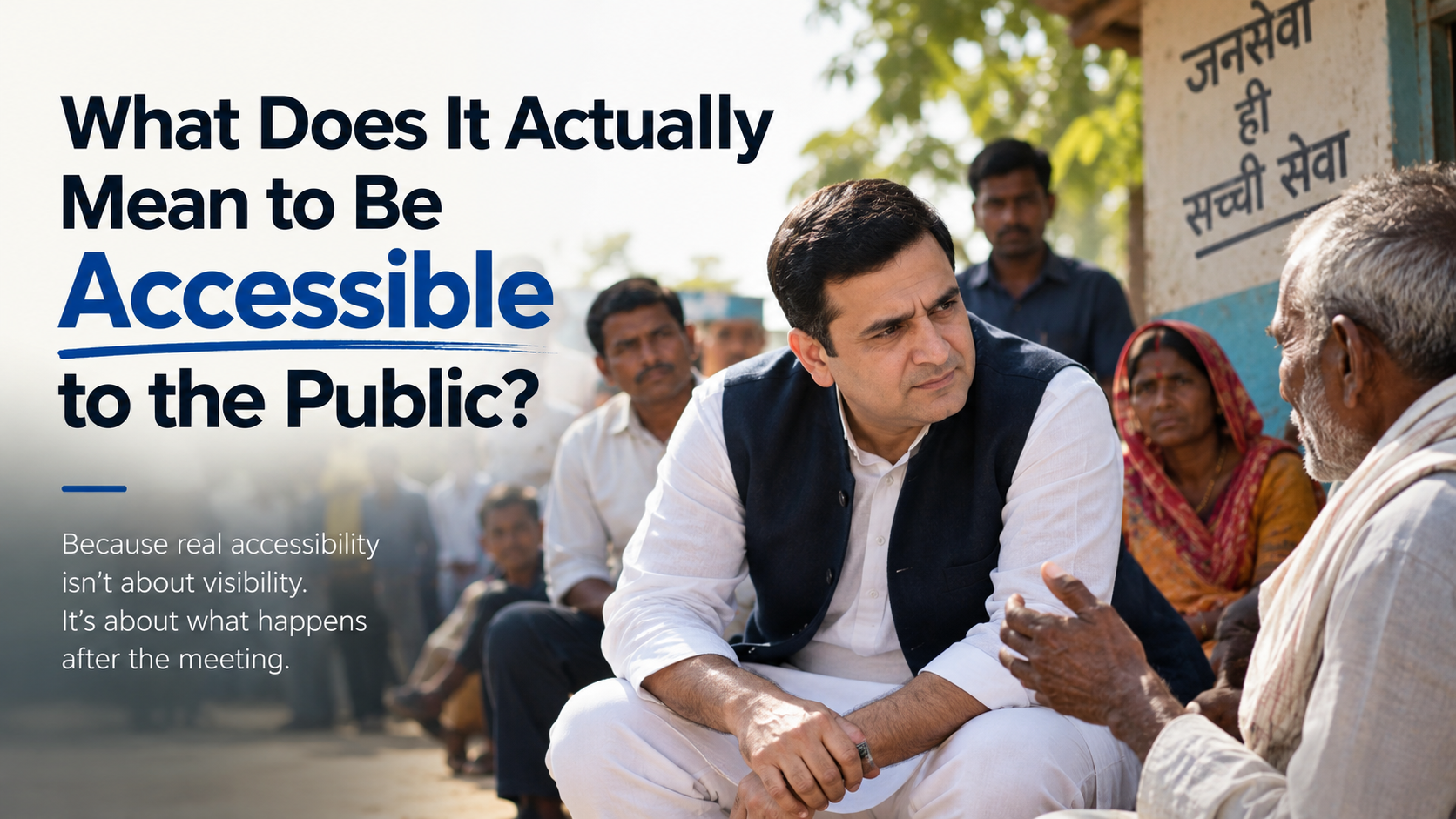
There is a difference between communicating to people and communicating with people.
A video is communication.
A speech is communication.
A tweet is communication.
But sitting with someone who disagrees with you and hearing them out is also communication.
In fact, sometimes it is the more valuable kind.
Because people do not always tell you the truth in a public comment.
They may not want to criticise a politician openly.
They may not want their neighbours to know.
They may not want to say something in front of ten people at a meeting.
But over a cup of tea, they might tell you exactly what they think.
That conversation may never produce a photograph.
It may never get a thousand likes.
But it may tell you more about the constituency than a week of social media monitoring.
There is a temptation to turn every political problem into a content problem
This is perhaps one of the biggest changes I have noticed in political communication.
Something happens.
The first question becomes:
“What should we post?”
Instead, sometimes the first question should be:
“What should we understand?”
If people are unhappy, the answer is not always another video.
If a government scheme is not reaching people, the answer is not always another infographic.
If young people are disengaged, another motivational reel may not solve the problem.
If a constituency has lost trust in a representative, better social media graphics will not automatically rebuild that trust.
Communication matters.
But communication cannot permanently cover a gap between perception and reality.
At some point, politics comes back to the ground.
The smartest use of technology is to make politics more informed
I don’t think the future of political campaigning is digital versus traditional.
That is the wrong debate.
The real opportunity is to combine the two.
Imagine a campaign notices through digital monitoring that people in a particular area are repeatedly talking about a local issue.
Instead of immediately producing ten posts about it, the campaign sends its field team to understand what is happening.
They speak to residents.
They speak to local workers.
They check the facts.
They understand who is affected and how.
Then the communication team uses that information to create something meaningful.
Now technology has done something useful.
It has helped the organisation find the question.
The ground team helped find the answer.
That is a much healthier relationship between politics and technology.
The same applies to surveys and data.
Data can tell you that something is happening.
Good political research should then ask:
Why?
And after that:
What do we do about it?
That is where political intelligence begins.
The political worker of the future may need both a smartphone and a notebook
I say this only half jokingly.
The political worker of the future will probably need to understand digital platforms, data, social media and technology.
But he or she will also need to know how to sit with people.
How to ask questions.
How to listen without interrupting.
How to identify when someone is giving a polite answer instead of an honest one.
How to understand local relationships.
How to distinguish between what people say publicly and what they say privately.
Technology can help with the first set of skills.
The second set still requires people.
And politics, ultimately, is still about people.
We should also be careful about what we call “public opinion”
This is another area where digital politics can confuse us.
The loudest voices online are not necessarily representative of the entire electorate.
People who are politically active are more likely to post.
People who are angry are more likely to comment.
People who are highly partisan are more likely to argue.
But millions of voters say nothing online.
They don’t post political content.
They don’t join political debates.
They don’t necessarily follow political influencers.
Some may not even discuss politics very often.
Yet they vote.
And their vote matters exactly as much as the vote of the person who posted fifty times during the campaign.
This is why social media sentiment should be treated as one source of information, not as a perfect mirror of society.
A political campaign that only listens to its digital supporters can slowly end up living inside its own echo chamber.
And that is dangerous.
So, what happens when politics becomes too digital?
We don’t necessarily get better politics.
We get faster politics.
That is not the same thing.
We get faster communication.
Faster reactions.
Faster campaigns.
Faster outrage.
Faster misinformation.
Faster counterattacks.
Faster narratives.
But speed does not automatically create understanding.
Sometimes, politics needs to slow down.
To go back to the constituency.
To sit with people.
To ask a question and actually wait for the answer.
To speak to the person who did not come to the rally.
To meet the voter who did not follow the campaign account.
To understand the person who disagrees.
To listen to the person who has no interest in posting anything online.
That is where some of the most useful political information still exists.
And perhaps this is the real role of technology in politics.
Technology should help us get closer to people, not make us feel that we already know them.
A good campaign should know its numbers.
It should know its digital reach.
It should understand social media.
It should use data.
But it should also know its people.
Because at the end of the day, a voter is not an impression.
A voter is not an engagement rate.
A voter is not a follower.
A voter is a person.
And no dashboard, however sophisticated, can completely replace a conversation with that person.
The future of politics will certainly be digital.
But I hope it never becomes only digital.
Because politics may happen increasingly on our screens.
Trust still happens between people.

Leave a Reply