
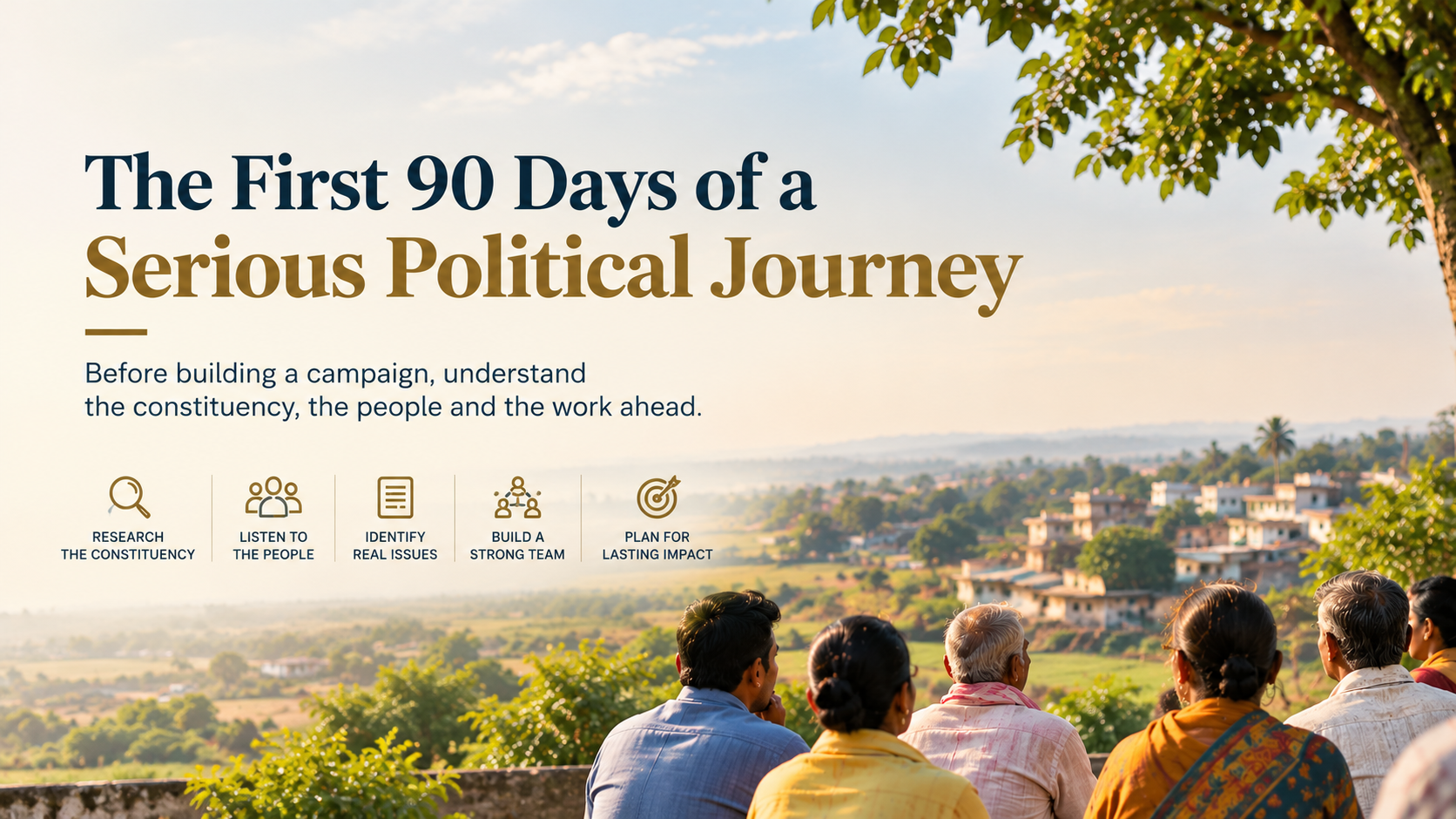
Before building a campaign, understand the constituency, the people and the work ahead.
Entering politics is a big decision. For many aspiring MLA and MP candidates, the first instinct is to become more visible. They start attending public events, meeting party leaders, posting on social media and building a team.
These activities can be useful. But there is an important question to ask first.
Do you have a clear understanding of the constituency you want to represent?
Who are the people you want to serve? What problems do they face? What work have previous representatives done? What is your own public identity? And what will you bring to the table that people can clearly understand?
Without answers to these questions, political activity can become scattered. A leader may stay busy for months without developing a clear direction.
The first 90 days of a political journey should not be about creating the appearance of progress. They should be about building the foundation for meaningful, organised and responsible public engagement.
Here is how an aspiring political leader can approach those first three months.
Days 1–30: Understand the Constituency Before Making Promises
The first month should be dedicated to listening, observing and gathering information.
A leader cannot understand an entire constituency through a few meetings, conversations with close associates or reports shared by a small group of supporters. Every area has its own concerns, and the priorities of one neighbourhood may be very different from those of another.
Start by understanding the place you want to represent.
1. Map the local issues
Prepare a basic picture of the constituency. Identify its major localities, villages, urban neighbourhoods, public facilities and important economic activities.
Look at issues such as:
- Drinking water, sanitation and drainage
- Roads, transport and connectivity
- Schools, colleges and healthcare facilities
- Employment and local economic opportunities
- Electricity and other essential services
- Public safety and access to government services
These are starting points, not a list of problems that should automatically be assumed to exist everywhere. The actual priorities must emerge from local research and conversations.
Official records, public data, local reporting and previous development work can help establish a starting point. Ground visits and direct conversations can help identify what those records do not show.
2. Talk to people beyond your immediate circle
One of the easiest mistakes in politics is to spend most of your time with people who already support you.
Supporters can provide valuable feedback, but they cannot represent every experience within a constituency.
Speak with residents from different localities, backgrounds, occupations and age groups. Meet shopkeepers, workers, teachers, students, farmers, professionals and community representatives where relevant.
Ask simple questions:
- What is the biggest problem in your area?
- Which public services are working well, and which are not?
- What has changed over the past few years?
- What do you wish local representatives understood better?
- What action would make a practical difference?
The goal is not to promise a solution to every concern. It is to understand the problem before deciding what can realistically be done.
3. Understand the existing political and administrative situation
Study the constituency’s political history, previous election results, public representatives and ongoing development work.
Understand which responsibilities belong to the elected representative, which fall under local bodies, and which are handled by state or central government departments.
This distinction matters. An aspiring leader should know the difference between raising an issue, coordinating with the relevant authority and having the power to make a decision.
By the end of the first month, you should have a preliminary constituency assessment: the major concerns identified so far, the areas that need further research and the questions that remain unanswered.
Do not treat this first assessment as a final verdict. It is a working document that should improve as you learn more.
Days 31–60: Define Your Political Identity and Build Your Team
Once you have started understanding the constituency, the next step is to decide how you intend to approach your political work.
A leader needs more than ambition. There must be clarity about priorities, public communication, organisational responsibilities and the kind of work the leader wants to be known for.
4. Be clear about what you stand for
Ask yourself a difficult question:
If someone asks why you want to enter politics, can you give a clear answer beyond wanting to contest an election?
Your answer should explain the public problems you want to address, the responsibilities you are prepared to take on and the values that will guide your decisions.
You do not need a slogan for every issue. You need a clear sense of purpose.
For example, if access to healthcare is a major concern in the constituency, understand the specific gaps before making it a central promise. Is the problem a shortage of doctors, inadequate facilities, distance from hospitals or difficulty accessing existing services?
A specific understanding of the problem is more useful than a broad statement about improving healthcare.
5. Identify your strengths and areas for improvement
Every aspiring leader brings a different combination of experience, skills, relationships and limitations.
Some may have a strong local presence but limited organisational experience. Others may have professional expertise but little direct engagement with the constituency.
Make an honest assessment of your current position.
Consider:
- Your experience in public service or community work
- Your understanding of local issues
- Your ability to communicate clearly
- Your existing relationships across the constituency
- Your organisational and leadership skills
- The areas where you need more knowledge or support
This assessment is not about presenting yourself as perfect. It is about understanding what you can contribute and what you still need to develop.
6. Build a team with clear responsibilities
A political team should not be judged only by its size or the number of people attending meetings.
It should be able to organise work, collect reliable information, follow up on public concerns and communicate clearly.
In the early stages, even a small team can begin by assigning responsibilities for:
- Constituency research and documentation
- Community meetings and public feedback
- Local issue tracking and follow-up
- Communication and content management
- Scheduling, coordination and record-keeping
Every task should have a responsible person and a clear next step.
It is equally important to build a team where people can disagree respectfully. If everyone simply agrees with the leader, mistakes may go unchallenged and important information may never reach the decision-maker.
A useful team does not just report what the leader wants to hear. It helps the leader understand what is actually happening.
7. Create a realistic communication plan
Social media can help people understand your work, but it should not become a substitute for doing the work itself.
Decide what you want your public communication to achieve. You might share verified information about local issues, explain public services, document community meetings or report the progress of follow-up work.
Keep the communication factual and consistent.
Avoid making claims that cannot be verified, presenting every routine activity as a major achievement or promising results that depend on authorities outside your control.
By the end of the second month, you should have a clearer public identity, a small team with defined responsibilities and a plan for communicating your work.
Days 61–90: Turn Preparation Into Consistent Action
The third month is about putting the groundwork into practice.
By this stage, you should have an initial understanding of the constituency, a set of priorities and a basic organisational structure. Now the challenge is to make the work consistent and measurable.
8. Select a few priorities and work on them properly
It is tempting to speak about every problem at once. But a long list of issues does not automatically produce a useful plan.
Choose a small number of concerns that are supported by your research and that you can realistically help address, investigate or raise with the relevant authorities.
For each priority, document:
- What the problem is
- Which areas and people are affected
- What evidence supports the concern
- Which department or authority is responsible
- What action can reasonably be taken
- How progress will be tracked
Some issues may require direct coordination with public authorities. Others may need further research or sustained advocacy. Some may be outside your immediate ability to influence.
Be honest about these differences.
A leader builds credibility by understanding the problem, taking appropriate action and communicating progress accurately, not by claiming control over every outcome.
9. Create a system for following up
Listening to people is important. Following up is what makes that listening useful.
Maintain a simple record of the issues raised, the location, the relevant authority, the action taken and the current status.
When a resident reports a problem, the team should be able to answer basic questions: Has it been documented? Has it been raised with the right department? Is more information needed? Has any response been received?
Not every issue will be resolved quickly. Some may take time, and others may require decisions beyond the candidate’s authority.
Even so, a transparent follow-up system helps prevent concerns from disappearing after the initial conversation.
It also gives the leader a clearer picture of recurring problems across the constituency.
10. Review what you have learned
At the end of 90 days, do not measure progress only by the number of meetings attended, photographs taken, followers gained or people added to a group.
Ask more useful questions:
- Do we understand the constituency better than we did three months ago?
- Have we spoken with people beyond our existing circle?
- Which issues have emerged repeatedly?
- What assumptions have our conversations challenged?
- Does the team have clear responsibilities?
- Are we recording concerns and following up consistently?
- Which activities are producing useful information or practical results?
- What still needs to be investigated?
The answers should guide the next phase of work.
Some initial assumptions may prove correct. Others may need to be changed. That is not a failure of planning. It is the purpose of research and regular review.
The 90-day plan should help a leader make better-informed decisions, not force the leader to defend decisions simply because they were made earlier.
A Simple 90-Day Roadmap
| Period | Main focus | Expected output |
|---|---|---|
| Days 1–30 | Research and listening | Preliminary constituency assessment |
| Days 31–60 | Positioning and organisation | Clear priorities, defined team roles and communication plan |
| Days 61–90 | Action and review | Issue-tracking system, documented follow-ups and a revised plan |
This is a practical framework, not a fixed formula. The time required will vary depending on the constituency, the candidate’s existing work, available resources and the complexity of local issues.
The objective is to create a disciplined starting point.
Where Political Strategy Makes a Difference
Many aspiring leaders have the motivation to work in public life. The challenge is often deciding where to begin, which information to trust, how to organise people and how to turn a broad ambition into a clear plan.
This is where structured political consulting can help.
Constituency research can provide a more reliable understanding of local conditions. Political strategy can help establish priorities. Candidate positioning can clarify how a leader communicates their work and purpose. Field organisation can bring consistency to ground-level activity, while public communication can help people understand what the leader is doing and why.
These functions work best when they support one another rather than operate as separate activities.
At iPol, our focus is on bringing research, political strategy, candidate positioning, field organisation and public communication together into a structured campaign system for aspiring MLA and MP candidates.
The starting point is not to assume that every candidate needs the same plan. It is to understand the candidate, the constituency and the work required before deciding on the approach.
The First 90 Days Are About Building the Foundation
A serious political journey cannot be reduced to a checklist. It requires time, judgement, patience and a willingness to keep learning.
The first 90 days will not answer every question, solve every local problem or guarantee a particular political outcome. They can, however, help an aspiring leader replace guesswork with research, scattered activity with organisation and broad promises with a clearer understanding of the work ahead.
Before asking how to run a campaign, ask whether you understand the constituency.
Before deciding what to communicate, ask what people actually need to know.
And before measuring progress by visibility, ask what has improved in the way you understand, organise and respond to public concerns.
A political journey becomes more purposeful when ambition is supported by preparation.
The first step is not to look like a leader. It is to begin doing the work that leadership requires.

Leave a Reply