
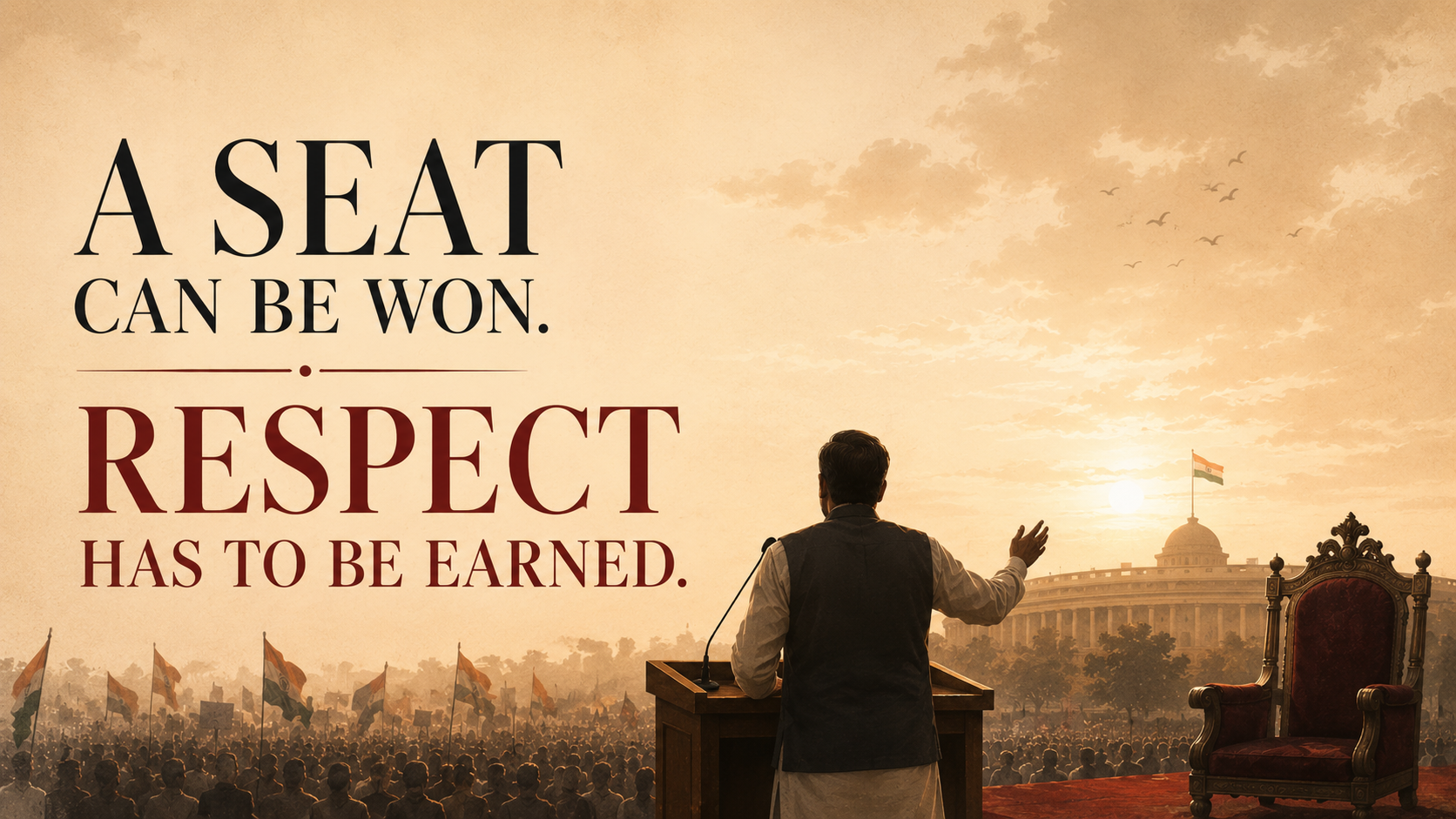
Winning an election transfers power. It does not automatically transfer respect.
Counting day is one of the most emotionally powerful days in a political leader’s life. Months, sometimes years, of preparation culminate in a few decisive hours. Supporters gather outside counting centres. Party workers celebrate. Victory processions fill the streets. The candidate who spent the campaign asking people for their vote is suddenly entrusted with public office.
It can feel like the destination has been reached.
In reality, only the first examination has been cleared.
An election determines who will occupy an office. It does not determine how that person will be remembered.
A seat can be won through strategy, organisation, narrative, mobilisation and disciplined booth management. Respect has to be earned afterwards, through accessibility, integrity, delivery and conduct.
A Vote Is Not a Blank Cheque
When citizens vote for a candidate, they give that person something far more consequential than a position in the legislature. They grant a time-bound mandate to represent their interests.
That mandate contains several expectations.
People expect their representative to remain accessible after polling day. They expect genuine grievances to be heard without repeatedly approaching intermediaries. They expect public resources to be allocated fairly. They expect the leader to speak for the entire constituency, not only for the communities, villages, wards or groups that supported the winning campaign.
Most importantly, they expect the behaviour demonstrated during the campaign to continue after victory.
Trust cannot be deposited safely in a political account and withdrawn again at the next election. It has to be renewed through everyday experience.
After the campaign ends, citizens gradually stop evaluating speeches and begin evaluating evidence.
Are grievances acknowledged?
Are officials being held accountable?
Are projects reaching completion?
Are weaker communities being treated fairly?
Can an ordinary citizen still meet the representative?
Are mistakes admitted and corrected?
These questions determine whether an electoral mandate becomes political credibility, or slowly turns into anti-incumbency.
West Bengal: A Historic Result and a New Examination
The 2026 West Bengal Assembly election produced a major political transformation.
According to the Election Commission of India’s results for 293 declared constituencies, the Bharatiya Janata Party won 207 seats, while the All India Trinamool Congress won 80. Congress and the Aam Janata Unnayan Party won two seats each, while CPI(M) and the All India Secular Front won one each.
The symbolic centre of the election was Bhabanipur. The Election Commission’s constituency data records 73,917 votes for Suvendu Adhikari and 58,812 for Mamata Banerjee, a margin of 15,105 votes.
These figures will remain part of electoral history. But they cannot yet tell us how the new mandate will ultimately be judged.
That judgement will depend on what follows.
Will public institutions become more effective?
Will political violence decline?
Will citizens experience better delivery in education, healthcare, infrastructure, employment facilitation and public safety?
Will opposition voters receive the same dignity and access as government supporters?
Will promises be translated into measurable priorities?
An election result answers the question: Who will govern?
Only subsequent performance can answer the more important question: How well did they govern?
The first verdict is delivered by the Election Commission.
The second is delivered gradually by citizens, and eventually by history.
Election-Winning Architecture Is Not Governing Architecture
One of the most expensive mistakes in politics is assuming that the organisation capable of winning an election is automatically capable of serving a constituency.
It is not.
A campaign and a term in office require two related but distinctly different operating systems.
Election-Winning Architecture
Identifies voter concerns
Develops a persuasive narrative
Mobilises workers and volunteers
Tracks booth-level support
Differentiates the candidate from opponents
Converts public support into votes
Measures reach, persuasion and mobilisation
Mandate-to-Legacy Architecture
Continuously listens to citizen problems
Connects communication with measurable delivery
Coordinates citizens, officials and institutions
Tracks grievances, projects and outcomes
Cooperates across institutions where public interest requires it
Converts political authority into public value
Measures access, responsiveness, delivery and trust
During an election, the central question is: How do we earn enough votes to win?
After the election, the question must become: How do we justify every vote that was entrusted to us?
This transition must begin immediately. Otherwise, the campaign organisation continues producing publicity while the constituency waits for governance.
When Performance Becomes Visible, Voter Behaviour Changes
Political accountability becomes stronger when citizens receive credible information about performance.
A field experiment conducted before the 2008 Delhi Assembly election by Abhijit Banerjee, Selvan Kumar, Rohini Pande and Felix Su distributed constituency-specific report cards containing information about candidate qualifications and legislator performance.
The experiment covered 200 treatment slums and 575 control slums. According to the study, access to the report cards increased turnout from 57.5% to 59.5%. Cash-based vote-buying was 19 percentage points less likely in the treatment polling stations, while poorly performing incumbents experienced an electoral disadvantage.
The researchers also found that moving from attendance at neither of two relevant oversight committees to attendance at both was associated with an increase of more than seven percentage points in the incumbent’s vote share within the study’s context. The complete research is available in “Do Informed Voters Make Better Choices? Experimental Evidence from Urban India.”
One study cannot provide a universal formula for every constituency. But its strategic lesson is important:
When performance information is credible, local and understandable, citizens can distinguish between publicity and actual work.
That is why an elected representative should not fear a public report card. A serious representative should create one.
Visibility Is Not the Same as Performance
Political communication remains important after victory. People cannot appreciate work they never hear about.
But communication must change in character.
Campaign communication is designed primarily to persuade. Post-election communication should be designed to inform, account and invite scrutiny.
A photograph of a foundation-stone ceremony is visibility.
A public dashboard showing the project’s cost, deadline, responsible department, present status and beneficiaries is accountability.
A video of a leader visiting a hospital is visibility.
Data showing improvements in doctor availability, medicine supply, waiting time or patient satisfaction is performance.
The same distinction applies to legislative work.
PRS Legislative Research found that MPs recorded an average attendance of 79% during the 17th Lok Sabha. It also reported that the House held 274 sittings, the lowest for any full-term Lok Sabha up to that point.
Attendance is important, but it is only one measure. A serious MP’s report card should also examine questions asked, debates participated in, committee contributions, policy interventions, constituency coordination and public accessibility.
No single number can define leadership. But leadership that refuses measurement eventually becomes dependent on publicity.
The Mandate-to-Respect Framework
In my work as an Election Campaign Architect, I use a practical distinction between winning political authority and deserving public respect.
I call the post-election system the Mandate-to-Respect Framework.
It rests on five pillars.
1. Accessibility
Citizens should know when, where and how they can approach their representative.
Accessibility should not depend entirely on personal relationships with party workers. The constituency office must publish contact channels, meeting hours, field-visit schedules and procedures for urgent matters.
Possible measurements include:
- Number of constituency days completed every month
- Percentage of citizen requests acknowledged within 48 hours
- Number of structured consultations held across villages and wards
- Representation of women, youth and marginalised communities in consultations
A leader who becomes unreachable after victory begins losing trust long before losing votes.
2. Responsiveness
Listening is meaningful only when it produces follow-through.
Every genuine grievance should receive a reference number, responsible owner, expected response period and closure confirmation. Repeated complaints should be analysed as evidence of a systemic failure rather than treated as unrelated individual cases.
The May 2026 CPGRAMS report recorded 357,755 new user registrations between January and May 2026. Its reporting system tracks grievances received, disposed of, pending and pending beyond defined time periods.
CPGRAMS is not a scorecard for individual MLAs or MPs. But it demonstrates an important administrative principle: citizen grievances can be time-stamped, assigned, monitored and measured.
What is not recorded is easily forgotten.
What is not assigned rarely gets resolved.
3. Visible Delivery
Every representative should identify a limited number of measurable constituency priorities.
The list should distinguish between matters directly within the representative’s authority and those requiring coordination with state departments, local bodies or the Union Government. Honest leadership does not claim powers it does not possess.
For every major priority, the public should be able to see:
- The original problem and baseline
- The authority responsible
- The action being pursued
- The allocated resources
- The completion deadline
- The villages, wards or communities benefiting
- The present implementation status
Announcements create expectations. Completion creates credibility.
4. Integrity and Consistency
A leader must remain recognisable after acquiring power.
Promises should be placed in a public commitment register and reviewed periodically. Delays should be explained with evidence. Incorrect statements should be corrected. Opponents should be treated with constitutional dignity, and public services must never be conditional on political support.
Integrity does not require perfection.
It requires consistency between what a leader asks of others and what the leader practises personally.
5. Institutional Legacy
The highest level of political leadership is reached when a leader builds systems that continue working without constant personal intervention.
A constituency office should have documented procedures, trained personnel, secure records, escalation mechanisms and continuity plans. Development priorities should emerge from evidence rather than whoever has the easiest access to the leader.
If every problem depends on one telephone call from one person, influence may have been created, but an institution has not.
Political authority becomes legacy when better systems survive the individual who created them.
Why Lal Bahadur Shastri Is Still Remembered
The official profile maintained by the Prime Minister’s Office records that Lal Bahadur Shastri served as Prime Minister from 9 June 1964 until 11 January 1966.
His tenure lasted less than two years, yet his place in India’s moral memory extends far beyond its duration.
The same official account recalls that he resigned as Railway Minister because he accepted moral responsibility for a serious railway accident. Jawaharlal Nehru explained in Parliament that the resignation was being accepted because it established an example of constitutional propriety, not because Shastri was personally responsible for causing the accident.
During a period of war and food shortage, Shastri gave India the enduring call: “Jai Jawan, Jai Kisan.”
Historical accounts also record that before asking the country to sacrifice a meal, he tested the practice within his own family. Restaurants later closed voluntarily on Monday evenings, and the observance became known in many places as the “Shastri Vrat.” These events are documented in contemporary historical research published by The Indian Express.
Shastri’s example remains powerful because his personal conduct gave credibility to his public appeal.
Power gave him the right to address the country.
Character gave the country a reason to listen.
The First 100 Days After Victory
The transition from candidate to representative should be planned as carefully as the election campaign itself.
During the first 30 days
The representative should thank every part of the constituency, including areas that voted against them.
The campaign office should be converted into a non-partisan citizen-service office. A constituency needs audit should identify urgent problems, stalled projects, institutional bottlenecks and vulnerable communities.
Campaign data must be handled ethically. Personal voter profiling should never determine access to public service. Only aggregated issue data should be used for development planning, with appropriate privacy safeguards.
Between days 31 and 100
The representative should select five to ten measurable priorities, create a grievance and project dashboard, assign responsibilities and establish regular coordination with relevant officials.
The first 100-day public report should explain:
- What was inherited
- What has been initiated
- What has been completed
- What is delayed
- What lies outside the representative’s direct authority
- What will happen next
Every quarter
A public progress report should compare commitments, expenditure, implementation and citizen feedback.
The purpose is not to manufacture an image of perfection. It is to demonstrate control, honesty and course correction.
Every year
The constituency should receive an annual report card covering legislative participation, development priorities, grievance performance, institutional coordination and measurable outcomes.
This creates a continuous accountability cycle instead of an artificial rush of activity in the final six months before the next election.
The Real Political Report Card
Governance must ultimately be evaluated at the level of people’s lives.
Did children receive better education?
Did patients experience more dependable healthcare?
Did women feel safer?
Did farmers, traders and workers face fewer administrative obstacles?
Did public resources reach neglected areas?
Did young people see greater opportunity?
Did the citizen’s experience of government become more dignified?
An elected representative cannot personally control every outcome. India’s federal, administrative and local-government systems distribute authority across several institutions. But a capable leader can establish priorities, build pressure, coordinate departments, communicate honestly and ensure that unresolved matters do not disappear.
A sophisticated political campaign does not end on counting day. It changes form.
The voter-research system becomes a citizen-listening system.
The campaign war room becomes a public-service monitoring system.
The promise document becomes a performance dashboard.
The political narrative must now be supported by visible delivery.
Power Can Be Acquired Quickly. Respect Cannot.
A successful election can transform a candidate’s life overnight.
Respect develops more slowly.
It grows when a leader remains accessible after the crowds disappear. When promises are tracked instead of forgotten. When opponents are treated with dignity. When mistakes are corrected without searching immediately for someone else to blame.
Popularity is an emotion.
Respect is a judgement.
Power is attached to an office.
Legacy is attached to what was done with it.
Five years may be enough to complete a term. It may also be enough to build institutions, restore trust and permanently improve the relationship between citizens and public authority.
When the title is gone, the convoy has disappeared and the official residence belongs to someone else, the most important question will not be the size of the victory margin.
It will be:
What evidence of your leadership remains in the lives of the people you represented?
A seat can be won through ballots.
Respect can only be earned through service.
One may last for five years.
The other can last for generations.
About the author
Amaresh Rai is an Election Campaign Architect and founder of iPol. He works with serious political aspirants and public leaders to build ethical, research-driven election strategies, constituency operating systems and performance-led political leadership.


Leave a Reply