
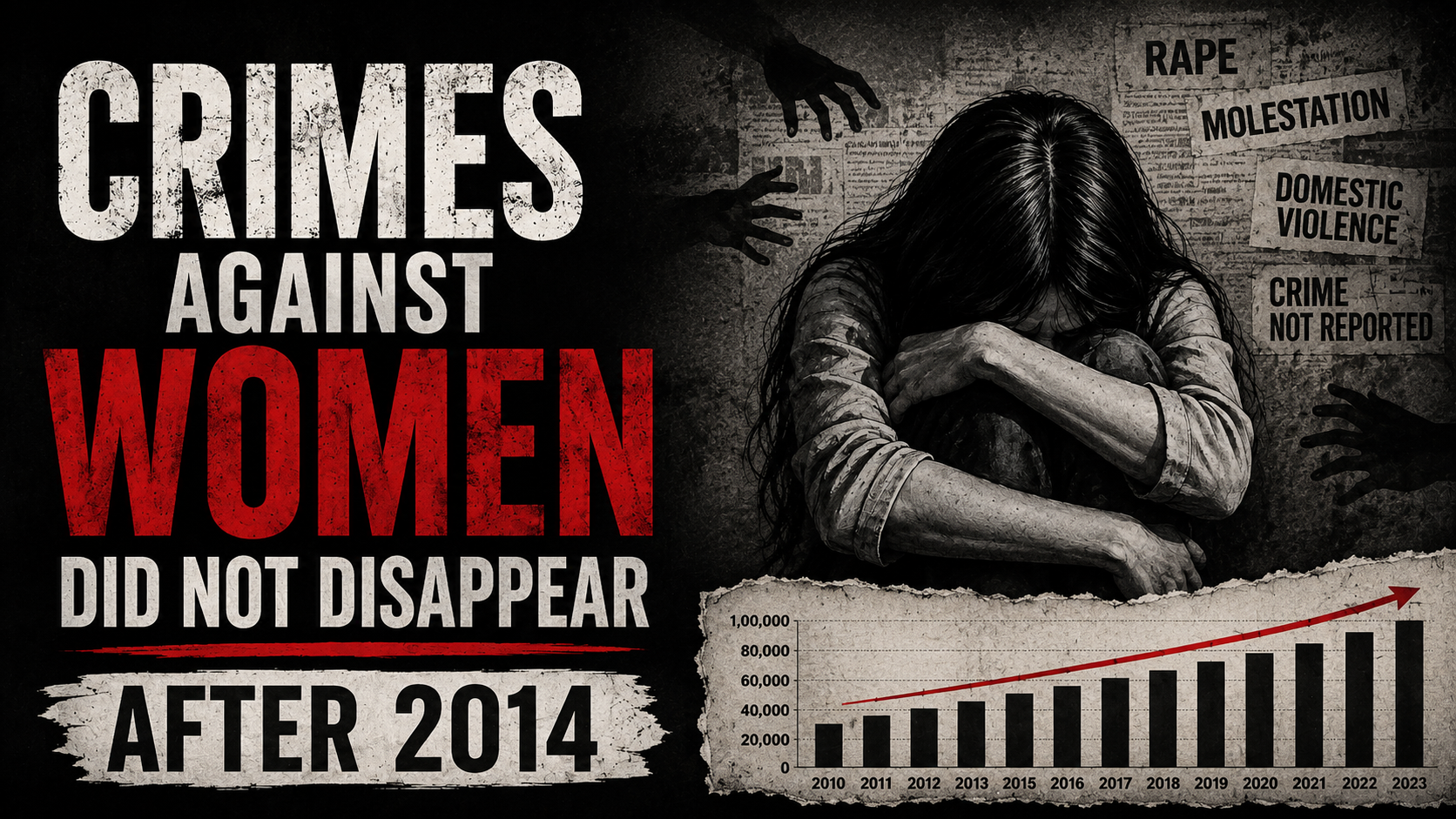
Women are still being raped.
Women are still being murdered.
Women are still being stalked, burned, dumped, and forgotten.
This is happening after years of the same party being in power at the Centre and in several states. The votes came. The slogans came. The promises of safety came. The bodies have not stopped coming.
Enough of the defensive noise.
A government is not judged by how loudly it talks about Nari Shakti on stage. It is judged by whether a girl can board a bus without ending up in a hospital or a morgue. It is judged by whether the police act before the video goes viral. It is judged by whether the same patterns keep repeating while the speeches stay the same.
They do keep repeating.
In city after city the stories look familiar. A young woman trusts the wrong man. Or takes the wrong bus. Or is simply alone at the wrong time. By the time the case reaches the news cycle, the political machinery is already busy with damage control. Statements are issued. Arrests are announced. Hashtags trend for two days. Then the next case arrives and the previous one is buried under fresh outrage.
This cycle is not new.
But the excuse that “at least it is better than before” is wearing thin.
People did not vote only for temples and bullet trains. A large number of voters, including women, also voted for the promise of order and safety. They were told that the previous culture of soft policing and selective outrage would end. They were told that the state would no longer look away. Yet the ground reality in too many places still feels like a lottery. Some areas get rapid response. Many do not. Some cases get political attention. Most become statistics.
The anger is not that crime exists. Crime exists everywhere.
The anger is that after so many years of concentrated power, the basic fear has not reduced in proportion to the rhetoric.
When a 16 year old is gang raped on a moving bus and dumped like garbage, it is not an abstract governance failure. It is a complete collapse of deterrence. When the accused are arrested after the fact, it is not a victory. It is the minimum. The victory would have been a system that made them afraid to try.
That system is still missing in too many districts.
Police vacancies remain. Night patrols remain inadequate. Public transport remains unsafe for women after dark in large parts of the country. Fast track courts exist on paper more than in consistent delivery. The conviction rate in rape cases continues to be a national shame. These are not opposition talking points. These are measurable failures that have continued under the current regime just as they did under previous ones.
The difference is the expectation.
When you campaign on strength and civilisational protection, people expect the streets to feel different. When the streets do not feel different, the disappointment turns into rage.
Do not insult that rage by calling it anti national.
Do not insult it by immediately changing the subject to what the previous government did.
Do not insult it by producing a list of schemes while another family is lighting a funeral pyre.
Schemes do not board the bus with the girl.
Speeches do not stop the knife.
Social media threads do not create deterrence.
Deterrence comes from certainty of punishment, speed of investigation, and visible policing. On those three counts the performance has been uneven at best and indefensible in too many cases.
Yes, some states have improved in certain metrics. Yes, some police units act faster than before. Yes, there are officers who do their job. That does not cancel the cases that keep piling up. It does not cancel the fear that still shapes how women move through cities. It does not cancel the fact that parents still calculate risk before letting their daughters travel alone.
A government that has held power for years cannot keep surviving on the claim that the alternative would be worse. After a point the public stops comparing. It starts demanding. And the demand is simple.
Make the country safer for women in practice, not in press conferences.
Stop treating every new atrocity as an isolated incident that requires only a strong statement. Start treating it as evidence that the system still lacks fear in the minds of predators. When men believe they can rape on a bus and dump the victim forty kilometres away, they are telling you that the system does not scare them enough. That is the only message that matters.
Political power was delivered with the expectation of order.
Order on the streets for women is still incomplete.
The votes can be renewed.
The dead girls cannot.
This is not opposition propaganda.
This is the anger of people who believed the promises and are still waiting for the fear to change sides. Until the predator is more afraid than the victim, every speech about women’s safety will sound like an insult to the last body that was found.
Fix the deterrence.
Fix the policing.
Fix the speed of justice.
Or stop being surprised when the anger refuses to stay polite.


Leave a Reply