
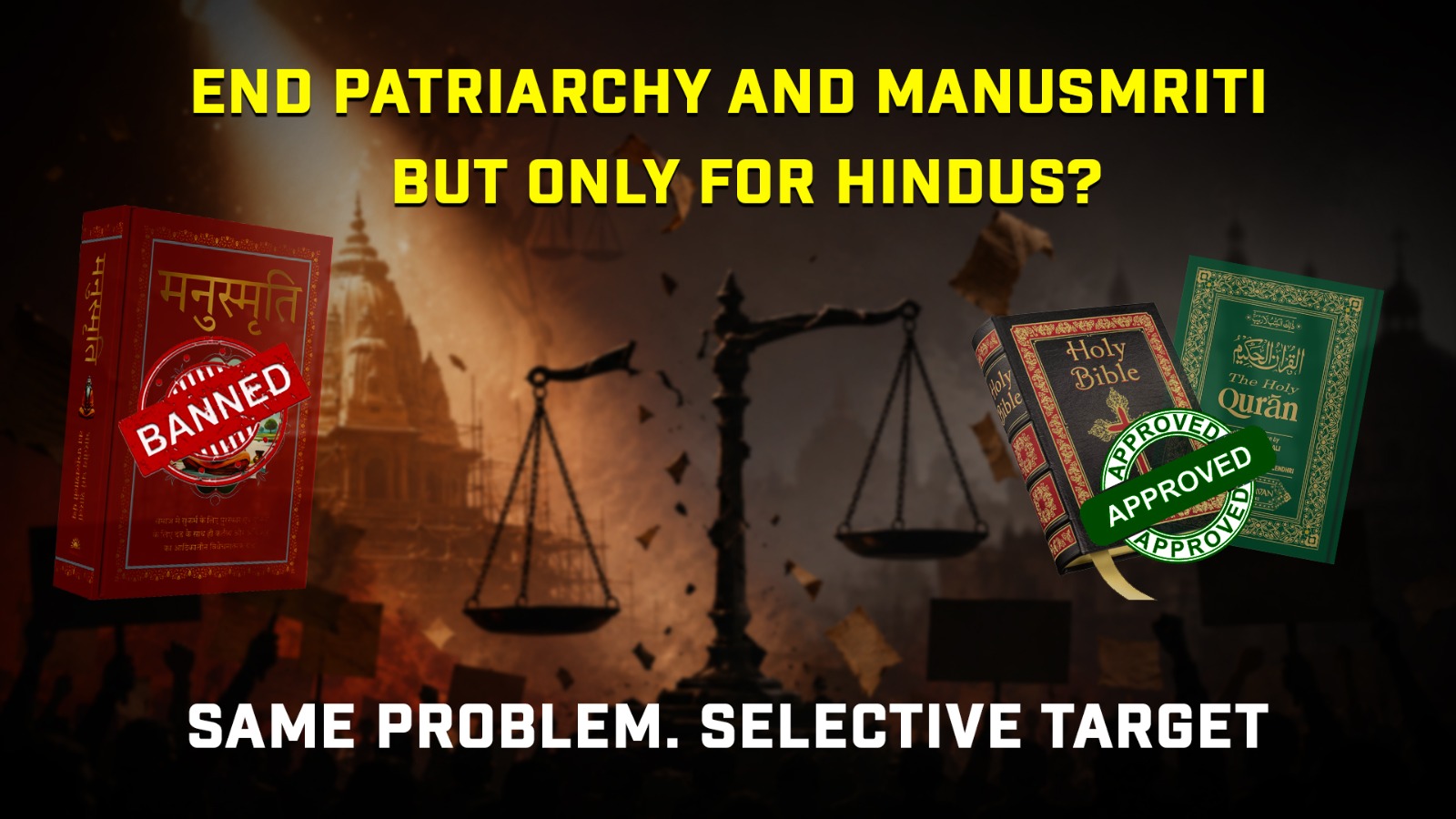
Indian politics has a new fashion.
A new slogan.
A new claim of moral superiority: “End patriarchy.”
The country’s oldest party has decided this is their fresh campaign.
They speak about it with full passion.
They point fingers with full confidence.
And every single time the finger points in only one direction: Hinduism.
Manusmriti.
Hindu society.
Never anywhere else.
I am not here to defend any ancient book.
I am not here to defend any custom.
I am here to ask one direct and uncomfortable question that this old party never wants to answer:
If you truly want to end patriarchy… why do you stop at only one religion?
Let us speak plainly.
Patriarchy is real.
It exists.
It has caused harm.
It should be challenged.
But patriarchy is not a Hindu invention.
It is not the exclusive property of Manusmriti.
It exists in every major religion followed in this country.
In different forms.
At different levels.
In different languages.
Yet somehow, in every speech, only one community’s scriptures are dragged in.
Only one community’s traditions are put on public trial.
Only one community is repeatedly told that their ancient books are the root of all evil.
Why?
Is patriarchy absent everywhere else?
Or is attacking the majority simply safer?
For certain political forces, attacking the majority has always been the easy option.
Low risk.
High applause from selected circles.
A ready-made narrative polished over decades.
This is not reform.
This is selective targeting dressed up as progress.
In a secular republic, the law must apply equally.
Scrutiny must be equal.
Courage must be equal.
When the hammer swings only in one direction, it stops being justice.
It becomes pure politics.
India calls itself a secular republic.
That old party uses the word “secular” every day like a shield.
But secularism has a meaning.
It means the state neither favours nor targets any religion.
Equal distance.
Same rules.
So here is the test:
If a political force claims to fight patriarchy in the name of women’s rights and social justice…
why does that fight begin and end only with Hinduism?
When the same issues appear elsewhere, where is the same aggression?
Why the sudden silence?
Why the sudden restraint?
Either patriarchy is a problem everywhere — and the fight must go everywhere —
or this was never about patriarchy at all.
You cannot claim the moral high ground of “ending patriarchy” while carefully shielding other religious structures from the same examination.
That is not courage.
That is calculation.
And the calculation is simple:
The majority can be criticised endlessly.
The minority vote bank must not be upset.
This is the old formula.
Minority appeasement wrapped in progressive language.
Now let us talk about the one thing this grand old party has forgotten:
reading the pulse of the people.
A very large population of this country follows Hindu traditions.
This is not opinion.
This is demographic fact.
When a political force repeatedly targets the beliefs, scriptures and identity of that majority…
while carefully avoiding the same treatment for others…
the majority notices.
They may not shout.
They may not trend on social media the same way.
But they feel it.
They feel the double standard.
They feel the selective anger.
They feel that their faith is open for attack while others remain protected.
And when that feeling grows, it does not stay quiet forever.
Leaders who fail to understand this are not just out of touch.
They are dangerous.
Because politics that claims moral superiority while systematically alienating the majority does not create harmony.
It creates resentment.
It creates polarisation.
It creates the exact opposite of the social peace they claim to want.
This happens when elected representatives — MLAs, MPs, chief ministers, even those in the highest positions — stop listening to the ground and only listen to their closed circle.
They lose the ability to see reality.
These mistakes do not happen suddenly.
They happen when political leaders operate without honest guidance.
When no one is left who can look them in the eye and say:
“You are reading the mood wrong.”
“You are attacking the wrong target.”
“You are repeating a formula that has already failed.”
Without serious political guidance that understands the real mood of the majority, leaders keep making the same error:
They continue the old policy of minority appeasement.
They keep targeting the faith and traditions of their own majority community.
They dress it up in progressive language.
And they slowly push the country toward deeper division.
The results are not theoretical.
They are already visible.
Trust reduces.
Social cohesion weakens.
Political polarisation deepens.
A secular republic cannot survive on selective morality.
It cannot run forever on double standards.
It cannot survive when its leaders refuse to look at every community with the same eyes.
If the goal is real reform, the fight against patriarchy must be consistent.
If the goal is only electoral arithmetic, then at least stop pretending it is a noble mission.
So I leave you with the same question I started with.
The grand old party wants to end patriarchy.
They have chosen their target.
They have chosen their text.
They have chosen their narrative.
But they have also chosen silence everywhere else.
Why only Hinduism?
Why only Manusmriti?
Why selective targeting in a secular republic?
Real reform does not pick targets based on political convenience.
Real leadership does not claim to heal society while pushing the majority away.
Real political maturity begins when leaders stop walking blind…
and start taking guidance from those who actually understand the ground.
Because when they don’t…
we get exactly these results.
Think about it.
The ground never lies.
And the majority is watching.
Selective anger is not justice.
Leadership without guidance is not strategy.


Leave a Reply