
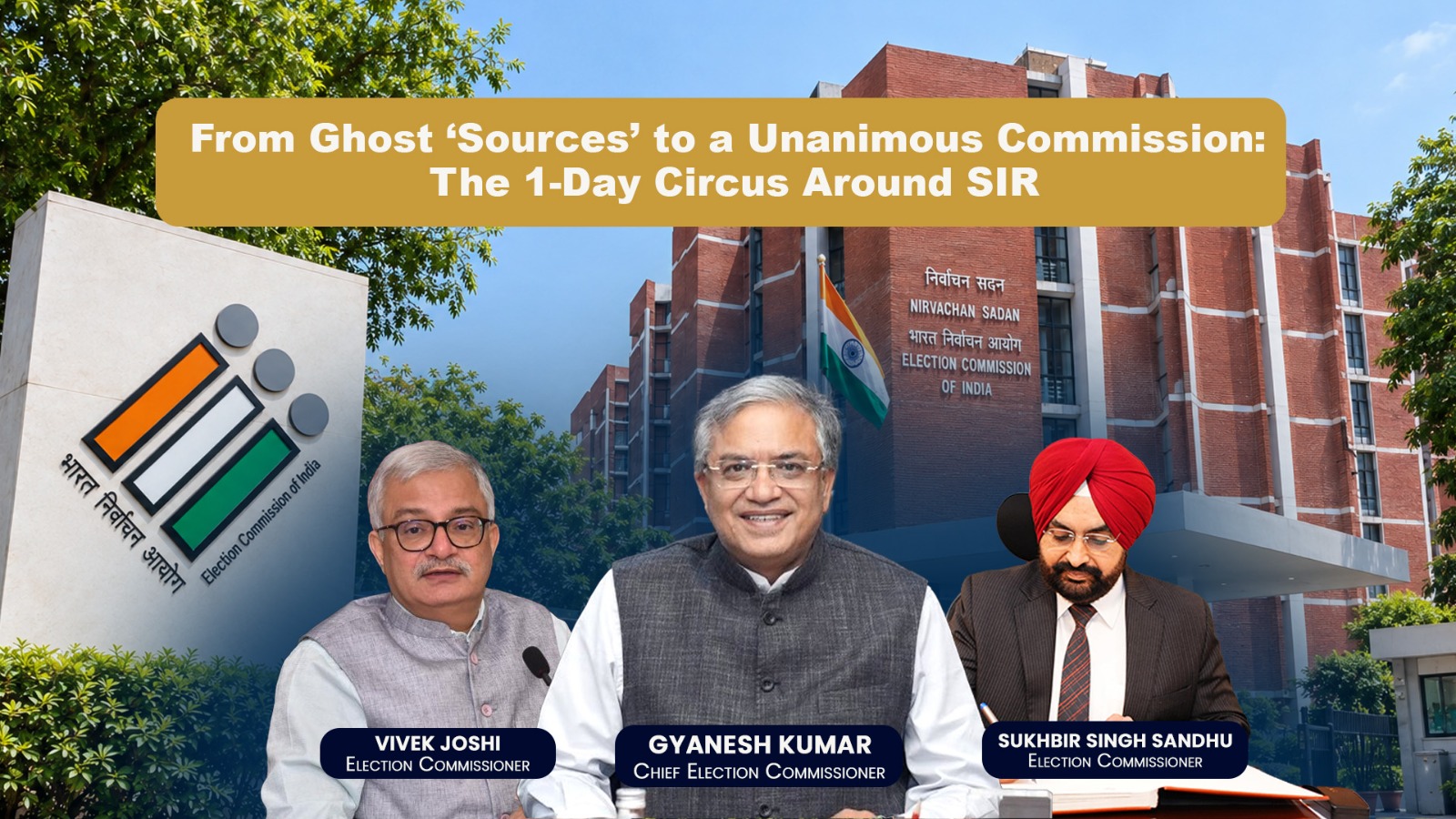
How a Page-1 story, a day of political theatre,
and an afternoon press note put the blocks back where they belonged.
There is a special kind of Indian political morning on 23rd September.
It begins not with a document, not with a signed minute, not even with a named official.
It begins with that oldest character in the newsroom: sources.
Unknown.
Unseen.
Always available.
Ghosts with excellent timing.
On 23 September 2026, The Indian Express put on Page 1 an investigation by Ritika Chopra that said Election Commissioners Sukhbir Singh Sandhu & Vivek Joshi had formally objected, on record, at least 14 times in 10 months to steps around the Special Intensive Revision of electoral rolls.
Some of those notes, the paper said, used words like “unauthorised” and “illegal.” Some alleged that orders had gone out without their knowledge.
Form 6, voter software, deletions, restorations, appeals in West Bengal the whole toolbox of SIR was pulled into the frame.
The Conveyor Belt
By mid-morning the same line, 14 objections, 10 months, two of three Commissioners, had been towed, almost unedited, into opposition press conferences.
The report became not a set of internal process notes but a verdict: the Election Commission was a one-man shop; SIR had no mandate; democracy was being buried before lunch.
Rahul Gandhi called “vote chori” an act of treason and tied the BJP, the RSS and the Election Commission into one charge-sheet.
Congress president Mallikarjun Kharge said Gyanesh Kumar had no right to stay in office.
Party voices went further and said Modi’s “favourite” was running the Commission “as he pleases,” and that Kumar was “ruling like a dictator just like his boss Modi.”
That is how a story about internal notes becomes a demand that the Prime Minister himself answer for the poll panel.
Arvind Kejriwal demanded Kumar’s arrest, a sedition case, cancellation of SIR, restoration of voter lists from three years ago, and fresh elections in Delhi, Maharashtra, Bihar, West Bengal, Haryana, Madhya Pradesh and Chhattisgarh.
Derek O’Brien wanted the old Rajya Sabha impeachment motion dusted off. John Brittas called the Commission a “one-man autocracy.”
Sanjay Raut wanted Kumar suspended, legal action, and if Modi would not act, the President to sack the CEC.
Akhilesh Yadav asked the Supreme Court to take suo motu notice.In a few hours the country was invited to believe that a nationwide roll-revision, already in the Supreme Court, already conducted in phases, already used to run major Assembly elections, had been a private adventure.
The word of the morning was dictatorship.
The method of the morning was photocopying a newspaper headline into a political pamphlet.
This is the bruh-haa-haa. Not the journalism by itself. The conversion of unfinished institutional argument into finished political sentence.
A passing reminder the opposition would rather skip
While New Delhi was discovering, all over again, that India’s Election Commission is a banana republic, it is worth a glance sideways.
Only last month, U.S. President Donald Trump publicly cited Chief Election Commissioner Gyanesh Kumar while praising India’s voter-ID system, 646 million voters, photo identity, almost no mail ballots, and used that example to push the SAVE America Act in his own country.
India’s MEA’s reply was dry and exact: the credibility and robustness of India’s election machinery are well-established facts globally.
That is not a certificate that every SIR deletion was perfect.
It is a reminder that the institution being described at noon as a cartoon dictatorship is, in the same calendar year, the institution a sitting American President pointed to when he wanted more identity discipline in elections, not less.
Keep that in the pocket. We will need it when the adjectives get loud.
What the story actually opened but it did not close
Give the Express report its due.
If two Election Commissioners wrote repeatedly about Form 6, about centralisation of the roll database, about who filed appeals in West Bengal, about work allocation on the IT backbone, that is not trivia.
A three-member Commission is supposed to argue. Article 324 does not require silence. The 2023 law on the CEC and Election Commissioners even says business should be transacted unanimously as far as possible, and by majority if they differ.
Notes on file are how a multi-member body leaves a trail.The leap was elsewhere.
The leap was from “there were written objections during the working-out” to “SIR never had the Commission’s authority.”
Those are not the same sentence. One is about friction inside a process. The other is about whether the process, as finally adopted, existed at all.
Page 1 does not settle that second sentence.
A day of television does not settle it either.
Only the Commission’s own final record does.
Afternoon: the blocks go back
Then came the press note.
It was not poetic.
It did not need to be.
It did the one thing a constitutional body can do when the morning has been spent turning internal notes into a regime-change trailer: it restated how the institution actually works, point by point.
The Commission is a multi-member constitutional body under Article 324.
Written notes, observations, technical suggestions and internal checks are standard practice.
Operational queries at draft stage are ordinary administration aimed at protecting voter rights. Suggestions were for improving the process.
Then the line the whole day had been waiting for and the line the opposition had spent six hours pretending could not exist.
The Point 4 of the Press Communique, in substance: differing views and observations are a normal part of deliberation in any institution.
They are part of the decision-making process before a final decision is taken.
Not only the three Commissioners, every officer of the Commission is authorised to give suggestions to improve the electoral system.
Read that again slowly.
The Commission did not deny that people inside spoke.
It claimed that speaking is the point.
Disagreement over a hard process is not evidence that democracy has fled Nirvachan Sadan.
It is evidence that the people tasked with executing the process were allowed to flag what might blow up later, Form 6, software access, field authority, appeals, before the order was locked.
Then the Commission said the obvious thing that Page 1 had left in the shadows: highlighting selected internal notes over ten months, while ignoring the larger body of approvals, decisions, instructions and initiatives, gives only one part of the picture.
Roll revision, including SIR, and around 40 other initiatives in the past year were the outcome of unanimous decisions of the full Commission.
That is the block going back into the wall. Not “nobody ever argued.”
Not “the Express invented paper.”
But this: argument is a process; SIR as a project was adopted and conducted with the full Commission’s unanimous mandate.
Once that is on record, a large part of the day’s theatre collapses.
You cannot simultaneously celebrate two Commissioners for speaking and declare that nobody was allowed to speak.
You cannot treat internal notes as proof of dictatorship when the same notes are being cited as proof that two of three members were on the file.
Dictatorship is silence.
What the morning’s report described, even on its own terms, was noise, written, repeated, copied to the CEC, in one instance taken as far as the Cabinet Secretary.
If that is autocracy, it is the most talkative autocracy in the manual.
Unanimous is not a slogan
It is the legal picture the Commission has now asserted.
For the public, the only question that mattered by evening was simple.
Did SIR happen because one man typed circulars into the night, or because the three-member Commission, after an internal contest, signed off on the project?
The official answer, as of the afternoon note, is the second.
Sources earlier in the day had already said the same thing in plainer language: individual opinions are not Commission decisions; all decisions including SIR carried the approval of Kumar, Sandhu and Joshi.
The press communique put that into institutional or formal English.
Does that make every deletion gentle? No. SIR has taken more than 13 crore names off draft rolls across dozens of states and UTs.
That scale will produce error, appeal, court scrutiny, and political blood. West Bengal’s appeal numbers already show how messy a “delete first, restore later” machine can look.
The Supreme Court has been in this story for months. None of that vanishes because a press note used the word unanimous.
What does change is the claim that the project itself was illegitimate because two Commissioners wrote notes.
In a serious system, that is how you get to a clean order.
You let people object while the design is still wet.
You do not confuse the wet stage with the final seal.
That is the difference between democracy inside an institution and theatre outside it.
The ghost and the megaphone
Return to the ghosts.“Sources” are not illegal.
Investigative reporting lives on them. But sources are also how a half-story becomes a full riot.
A note that says “this step is unauthorized until the Commission decides” can be sold as “the Commission never decided.”
A Commissioner asking who filed these appeals can be sold as the appeals prove a plot.
A software concern can be sold as a stolen election.
By the time the official record arrives, the adjectives have already done their eight-hour shift.
Look at the escalation ladder of 23 September:
- Newspaper: 14 recorded objections.
- Opposition: dictatorship, treason, puppet CEC.
- Next rung: arrest the CEC, scrap SIR, cancel recent elections, implicate Modi.
- Afternoon: the Commission says the final project was unanimous, and that disagreement before the decision is how a multi-member body works.
Between 1 and 3 there is almost no new fact.
There is only amplification.
That is why the day felt like comedy with a siren on top.
The country was asked to impeach a Chief Election Commissioner before it was asked to wait for the Commission’s own statement.
A mature opposition would have said: publish the 14 notes, publish the signed SIR resolutions, let the country see both.
Instead it reached for resignation, arrest, sedition, and a reset of several Assembly verdicts.
That is not an oversight. That is a wish list written on a headline.
What “real democracy inside the ECI” actually looks like
If Sandhu and Joshi could put objections on record four times in a single day, over months, on the most sensitive machinery in the Republic then the picture is not of two men locked in a cupboard.
It is of a Commission in which process arguments are still possible.
Point 4 of the press note is the adult sentence in a childish day: differing views are normal; they come before the decision; officers are authorised to speak.
And then the other adult sentence: after the argument, SIR went through as a unanimous full-Commission project.
Those two sentences can live together. In fact they must live together.
A Commission that never argues is asleep.
A Commission that argues and never decides is a seminar.
A Commission that argues, records the argument, and then signs a common order is doing the job.
The opposition needed the second half of that sequence to disappear so that the first half could be sold as proof of a coup. The press note put the second half back on the table.
That does not end the debate on SIR’s design, its deletion rate, its software, or its fairness in particular states.
Those fights belong in courts, in Parliament, and in the claims-and-objections window where actual voters live.
It does end, or ought to end, the cartoon that the Election Commission of India spent ten months as a mute dictatorship while two of its three members wrote fourteen letters into a void.
They wrote. The Commission says it heard. The project, it says, still went through together.
That is not “bruh haa haa” because the notes were funny. It is “bruh haa haa” because a republic was invited to set itself on fire over the difference between a working note and a final mandate and because, by late afternoon, the institution that actually runs elections had to come out and explain, in numbered paragraphs, what a multi-member democracy looks like from the inside.
The ghosts had a great morning.
The record got the last Paragraph.

Leave a Reply