
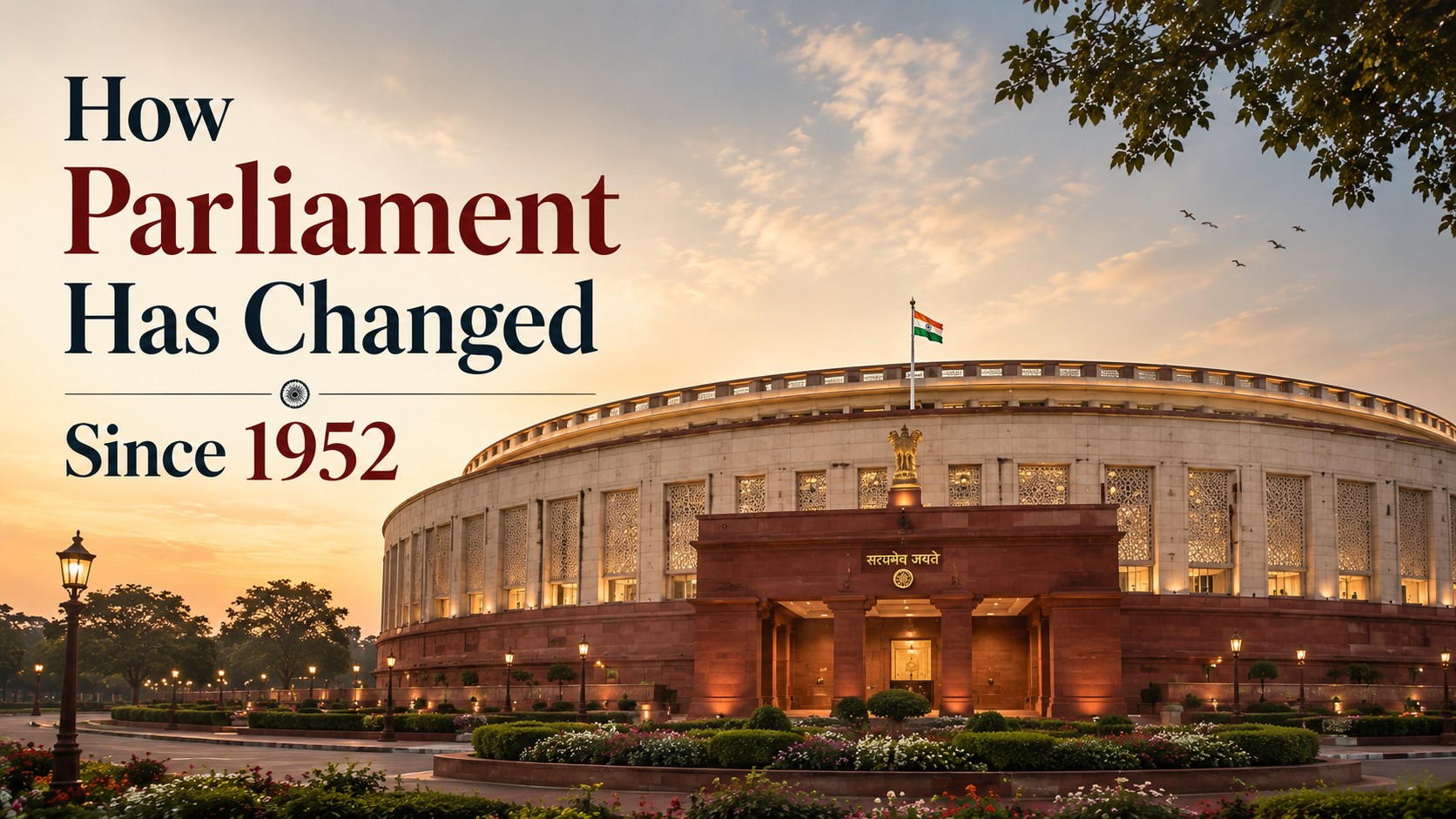
From handwritten speeches and radio broadcasts to digital debates and live television, India’s Parliament has witnessed enormous change over the last seven decades. But while the country has transformed, one question remains: has Parliament evolved at the same pace as the nation it represents?
On 13 May 1952, the First Lok Sabha met for the very first time.
India was a young republic.
The Constitution was only a little over two years old.
Most citizens had never voted before. Yet nearly 173 million people were eligible to vote in India’s first general election, making it the largest democratic exercise the world had ever seen. Despite challenges like widespread illiteracy and poor transport, over 45% of eligible voters cast their vote. It was a remarkable beginning for a nation that had chosen democracy over dictatorship. (Election Commission of India)
Inside Parliament sat representatives from every corner of the country.
Some were freedom fighters.
Some were lawyers.
Some were teachers, farmers, journalists, and social workers.
They came from different ideologies, spoke different languages, and represented different communities.
But they shared one responsibility: building the institutions of a newly independent India.
More than seventy years later, Parliament continues to perform that same constitutional role.
But almost everything around it has changed.
Parliament Has Grown With India
When the First Lok Sabha was constituted in 1952, it had 489 elected members, representing a population of nearly 361 million people.
Today, the Lok Sabha has 543 elected members, while India’s population has crossed 1.4 billion.
That means each MP today represents, on average, more than 2.5 million citizens, one of the highest representative ratios among major democracies.
The responsibility of an MP has therefore become far more demanding.
An MP in the 1950s largely dealt with issues like food shortages, land reforms, industrialisation, and national integration.
Today’s MPs discuss Artificial Intelligence, cybersecurity, digital privacy, climate change, data protection, semiconductor manufacturing, space technology, global trade, and national security.
The country they represent has become larger, richer, more connected, and far more complex.
A Parliament That Is Slowly Becoming More Representative
One of the most visible changes has been the increasing participation of women.
The First Lok Sabha had only 22 women MPs, making up about 4.5% of the House.
The 18th Lok Sabha has 74 women MPs, the highest number in India’s history, accounting for roughly 13.6% of the House.
That is clear progress.
Yet it also reminds us that Parliament still has some distance to cover.
Women make up almost half of India’s population.
Greater participation in legislatures means more perspectives, broader debates, and more representative policymaking.
Similarly, Parliament today represents far greater social and regional diversity than it did in the early years of the Republic.
The voices inside the House have become more varied, reflecting the changing character of India itself.
Debate Has Changed
If you watch recordings of parliamentary debates from the 1950s, 1960s, or 1970s, one thing immediately stands out.
The pace.
Speakers were rarely interrupted.
Arguments were often detailed and backed by facts.
Many debates lasted several hours, allowing members to explain complex issues before arriving at conclusions.
Leaders such as Jawaharlal Nehru, Atal Bihari Vajpayee, Hiren Mukerjee, Indrajit Gupta, Somnath Chatterjee, Sushma Swaraj, and Arun Jaitley became known for speeches that are still quoted decades later.
Today, Parliament still witnesses thoughtful discussions.
However, public attention often shifts towards disruptions, slogans, and short clips that circulate on social media.
Television changed parliamentary communication.
Social media accelerated it even further.
A thirty-second clip often reaches millions of people, while an hour-long policy speech may receive little attention.
Naturally, political communication has adapted to this new environment.
Sitting Days Have Declined
One of the biggest concerns raised by constitutional experts is the declining number of sitting days.
During the early decades after Independence, Parliament generally met for 120 to 140 days every year.
In recent decades, that number has often fallen to 70 or even fewer sitting days annually, depending on the parliamentary calendar.
At the same time, India’s economy has become one of the largest in the world.
The population has quadrupled.
Public policy has become significantly more complicated.
Ironically, Parliament now has more work to do while often meeting for fewer days.
This naturally raises questions about legislative scrutiny and debate.
Productivity Is About More Than Attendance
Many people judge Parliament only by whether members are present.
But attendance alone tells only part of the story.
What matters even more is productivity.
How many Bills were debated?
How many questions were answered?
How much time was spent discussing important national issues?
Some parliamentary sessions have recorded productivity exceeding 100%, where additional hours were used to complete legislative business.
Others have lost substantial working time due to repeated disruptions.
Every hour lost is not merely a political disagreement.
It is time that could have been spent discussing education, healthcare, infrastructure, agriculture, employment, defence, or economic reforms.
Democracy functions best when disagreement happens through debate, not disruption.
Parliament Has Become More Transparent
In 1952, only a small number of people could follow parliamentary proceedings through newspapers or All India Radio.
Today, almost anyone with a smartphone can watch Parliament live.
Proceedings are televised.
Questions and answers are publicly available.
Committee reports are accessible online.
Citizens can follow Bills from introduction to passage.
Technology has brought Parliament much closer to the people.
Transparency has increased significantly.
At the same time, greater visibility also means greater public scrutiny.
Every speech, every interruption, and every vote can now be seen almost instantly across the country.
The Role of Parliamentary Committees
While television often focuses on debates inside the Lok Sabha and Rajya Sabha, much of Parliament’s detailed work happens quietly in committees.
Standing Committees examine Bills, review government expenditure, question officials, and produce reports that often influence policymaking.
Many constitutional experts believe these committees are among Parliament’s strongest institutions because they allow detailed discussions away from television cameras and political slogans.
They remind us that democracy is not only about speeches.
It is also about careful examination.
Expectations From MPs Have Changed
The role of an MP today extends far beyond Parliament.
Citizens expect their representatives to be accessible on social media.
They expect quick responses.
They expect help during emergencies.
They expect regular constituency visits.
They expect development projects.
They expect communication.
In many ways, the public now sees MPs as lawmakers, communicators, problem-solvers, and community leaders all at once.
The expectations have never been higher.
Parliament Is Still the Heart of Indian Democracy
Despite criticism, Parliament remains one of India’s most important democratic institutions.
Every Union Budget is debated there.
Every major law passes through it.
The government is questioned there.
The opposition raises concerns there.
National priorities are discussed there.
No other institution brings together representatives from every region, language, religion, and political ideology under one roof.
That is the strength of Parliament.
It transforms disagreement into democratic decision-making.
Looking Ahead
India is moving towards 2047, when it will complete 100 years of Independence.
By then, Parliament will face even greater challenges.
Artificial Intelligence.
Climate resilience.
Water security.
Urbanisation.
Population ageing.
Digital governance.
Global competition.
The future will demand not only better policies but also stronger parliamentary debate.
Parliament does not need to become louder.
It needs to become wiser.
Because history rarely remembers who shouted the most.
It remembers those whose ideas shaped the nation.
More than seventy years after its first sitting, Parliament continues to evolve.
The responsibility now belongs to every generation of leaders to ensure that it remains a place where ideas matter more than interruptions, dialogue triumphs over division, and democracy grows stronger with every debate.
What change do you believe would make India’s Parliament more effective over the next 25 years?


Leave a Reply