
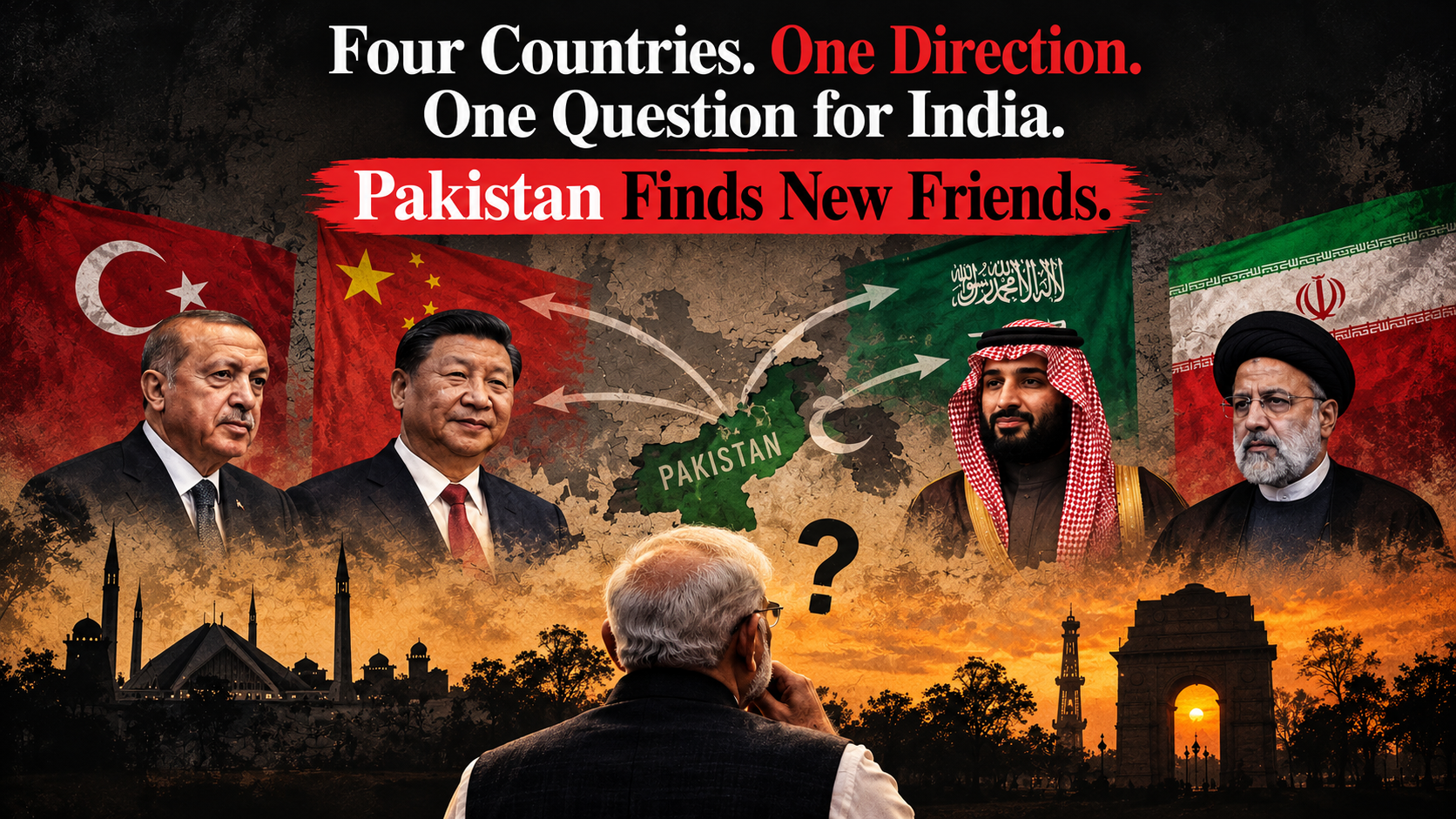
Turkey, Qatar, Pakistan and Indonesia signed a defence cooperation agreement in Doha this week.
They called it the Badr Memorandum of Understanding. Joint production. Technology sharing. Military training. Research and development. On paper it looks like another routine defence MoU between four countries looking to expand their industrial and military ties.
Look closer and the picture is less routine.
Pakistan is once again in the room. Collecting partners. Expanding the network. Searching for strategic depth while the house back home remains in permanent crisis mode. This is not the first time. It will not be the last. The pattern is consistent. When the internal order is broken, the external search for new friends intensifies.
What the Agreement Actually Covers
The Badr MoU focuses on defence manufacturing, technical training, research and development, and the pooling of each country’s military production strengths. Turkey brings a relatively mature defence industry and systems integration experience. Pakistan and Indonesia offer manufacturing capacity and sizeable domestic markets. Qatar brings investment potential and demand.
On the surface this is industrial cooperation. In practice it is another step in the quiet construction of parallel defence networks among countries that share certain strategic discomforts with the existing order.
Turkey has already deepened its defence ties with Pakistan and Saudi Arabia earlier this year through a mutual defence understanding. This new four-nation framework adds Qatar and Indonesia to the wider web. None of this happens in isolation. The region is watching.
Pakistan’s Persistent Search for Company
Pakistan’s presence in these arrangements is the part that deserves the most attention from an Indian perspective.
A nuclear-armed state that has spent decades relying on proxies, denial, and strategic ambiguity is now expanding its formal defence partnerships. The economy is under severe pressure. Debt. Inflation. Political instability. Structural problems that refuse to go away. Yet the defence diplomacy continues without pause. New MoUs. New photo opportunities. New statements about self-reliance and regional peace.
The gap between the language and the reality is not subtle. A country that struggles to stabilise its own finances and has repeatedly been called out for terrorism-related concerns does not suddenly become a stabilising force because it signs another document in Doha.
This is the same Pakistan that has long treated military capability as both shield and instrument. The same Pakistan that has found ways to keep certain networks alive even under international scrutiny. Adding more defence partnerships does not erase that record. It simply gives it new platforms.
Documents change. Patterns of conduct change more slowly.
Parallel Networks, Familiar Patterns
The Badr agreement is not an isolated event. It sits within a larger pattern of countries seeking alternatives to traditional security arrangements. Some of this is driven by genuine industrial ambition. Some of it is driven by a desire to reduce dependence on older suppliers. Some of it is driven by a shared sense that the current regional order does not fully serve their interests.
When those motivations include a nuclear-armed state with a history of using non-state actors as tools of policy, the rest of the region is entitled to take notes.
India does not need to overreact. Overreaction is rarely useful. But India does need to register the signal. Defence cooperation among these four countries may begin with manufacturing and training. Over time it can expand into deeper interoperability, shared platforms, and political signalling. The trajectory matters more than any single document.
The company Pakistan keeps has always revealed more than official statements.
The Economy That Never Improves and the Diplomacy That Never Stops
There is a certain dark humour in watching the sequence. The economy limps. The currency struggles. The political system remains unstable. And yet the defence MoUs keep arriving on schedule.
Pakistan is out here collecting defence agreements the way some people collect loyalty cards. One day Turkey. Next day Qatar and Indonesia. The list grows. The structural weaknesses stay exactly the same. At some point the question becomes unavoidable. How many more partners does a country need before it starts fixing the problems that keep forcing it to look for new ones?
Self-reliance is a fine word. It means very little when the fundamentals refuse to improve. The search for external validation and technology transfer is not a sign of strength. It is often a sign of unresolved problems that the leadership prefers not to confront at home.
What India Should Actually Do
India’s response should be measured and clear-eyed.
First, track the practical outcomes of this agreement. Industrial cooperation is one thing. Transfer of sensitive technologies or deeper operational coordination is another. The distinction matters. Watch the deliverables, not just the announcements.
Second, continue strengthening India’s own defence partnerships and indigenous capabilities. The best answer to parallel networks is a stronger, more self-reliant posture of one’s own. Capability is the only language that consistently gets respect.
Third, maintain strategic clarity about Pakistan’s long-term behaviour. Statements about peace and regional stability mean very little when the historical record points in a different direction. The record on terrorism, cross-border activity, and strategic ambiguity remains the more reliable guide.
Fourth, avoid both complacency and alarmism. This is not the beginning of a formal military alliance aimed at India. It is, however, another data point in the slow construction of alternative defence relationships that India must factor into its regional assessments.
Clarity is more useful than drama.
The Larger Signal
The Badr Memorandum is a defence industry agreement on paper. In the larger picture it is one more example of how certain countries are rearranging their security relationships. Pakistan’s participation fits a familiar pattern. Expand the external network while the internal crises continue.
The region becomes more complicated when a nuclear-armed state with a history of proxies finds new platforms for military collaboration. Complexity is not the same as immediate threat. But complexity that is ignored eventually becomes vulnerability.
India has seen this movie before. The names of the partners change. The underlying logic does not.
Watch the company Pakistan keeps.
Watch the networks it joins.
And remember that statements about peace and self-reliance mean very little when the record points in a different direction.
The Real Question
Every new partnership Pakistan announces raises the same uncomfortable question. Is this about genuine industrial modernisation, or is it about finding new layers of strategic depth while the old problems remain unaddressed?
The answer is rarely simple. But the pattern is consistent enough to notice. When a state keeps expanding its external military relationships while failing to stabilise its internal foundations, the region is entitled to treat the announcements with caution rather than celebration.
The latest handshake in Doha is not the end of the story. It is simply the newest chapter in a long and consistent one.
Pakistan will keep looking for partners. The partners will keep signing documents. And India will keep watching. Because in this neighbourhood, the company a nuclear-armed state chooses to keep is never just a bilateral matter. It is a regional signal.
The signal this week is clear enough. Parallel networks are being built. Quietly. Methodically. And Pakistan remains a willing participant.
That is the part that should not be ignored.


Leave a Reply