
Secularism in India has rarely meant equal distance from all religions.
It has more often meant something simpler and more convenient.
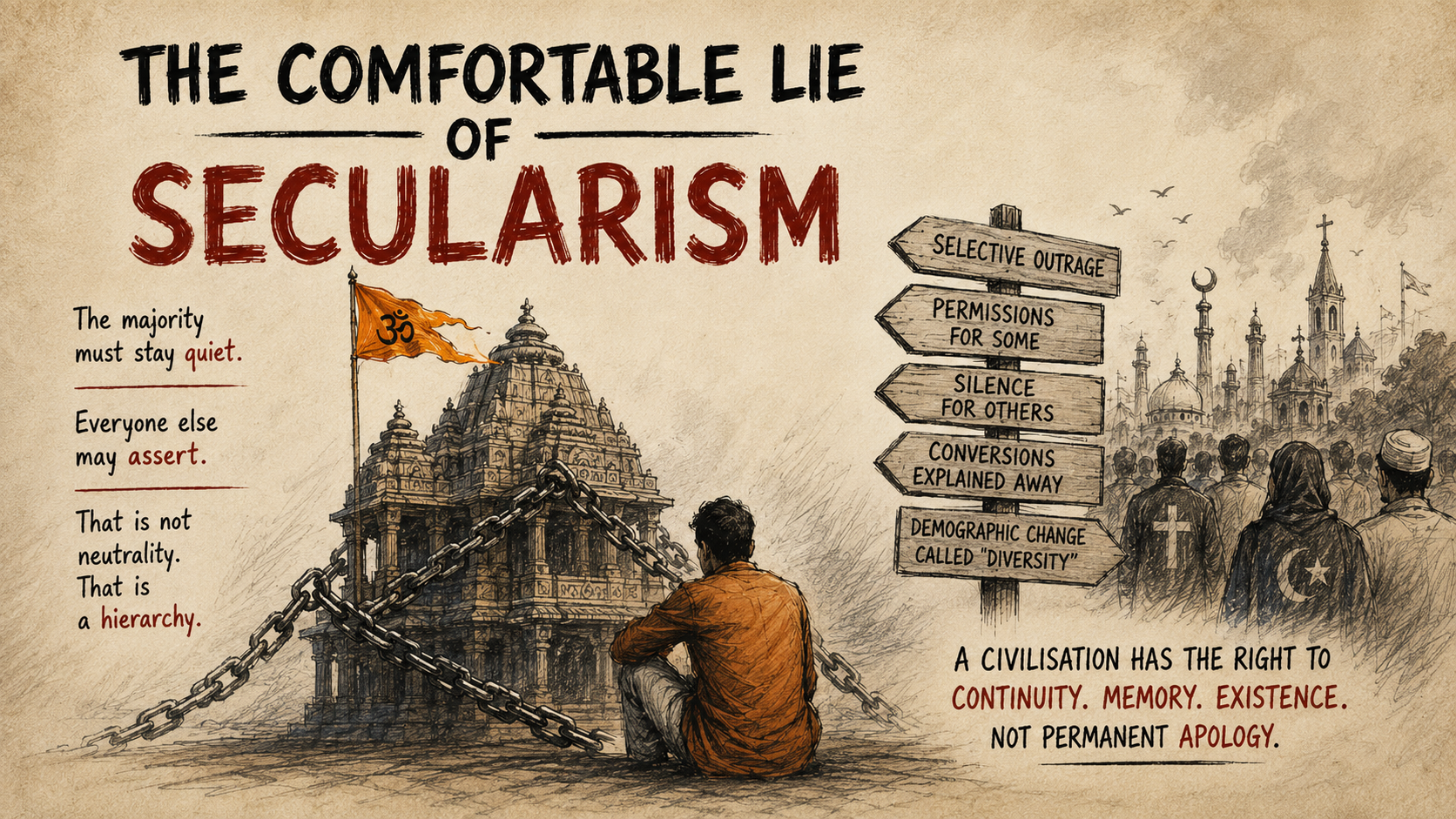
The majority must stay quiet.
Everyone else may assert.
That is the comfortable lie.
For decades the word was used like a moral weapon. Any expression of Hindu concern was quickly labelled communal. Any demand to protect temples, festivals, or demographic balance was called dangerous. At the same time, other identities were encouraged to organise, demand, and expand without the same hesitation.
This was not neutrality.
It was a hierarchy.
The Hindu was asked to be large-hearted.
The Hindu was asked to forget history.
The Hindu was asked to treat his own civilisation as something slightly embarrassing in public life.
Meanwhile, the same voices that preached secularism rarely applied the same standard when the pressure came from the other direction. Processions could be restricted. Loudspeakers could become selective. Conversions could be explained away. Demographic change in district after district could be called “diversity.” Criticism of these patterns was treated as hate.
A civilisation cannot survive permanently on the defensive.
Most countries do not ask their majority culture to permanently apologise for existing. The default culture is allowed to remain the default. In India the opposite experiment was tried. The majority was put under continuous moral supervision while every other identity was treated as needing special protection and encouragement.
The results are visible.
Temples that were broken centuries ago are still debated as if reclaiming them is extremism.
Festivals that have been celebrated for generations suddenly require extra permissions and face selective outrage.
Open discussion about population trends is treated as forbidden while the trends themselves continue.
Political parties long calculated that Hindu sentiment could be managed or divided while other vote banks needed constant nurturing.
This is not sustainable.
A society that is told for decades that its natural self-respect is dangerous will eventually stop accepting the lecture. That is what is happening now. The discomfort many feel is not because Hindus have become extreme. It is because they have stopped being permanently apologetic.
Secularism, properly understood, should mean the state does not favour one faith.
It should not mean the state and the discourse treat one civilisation as the permanent suspect.
When the word is used only to restrain the majority and never to demand reciprocity, it stops being a principle. It becomes a tactic.
The comfortable lie worked for a long time because enough Hindus accepted the terms. They accepted that speaking for their own interests was somehow less legitimate than others speaking for theirs. That phase is ending.
A civilisation has the right to continuity.
It has the right to memory.
It has the right to exist without permanent self-doubt.
Calling that right “communal” does not make it so.
The real choice is not between secularism and communalism.
The real choice is between a confident civilisation and a permanently apologetic one.
India tried the second option for decades.
The first is now asserting itself.
That is not a crisis.
That is a correction.


Leave a Reply