
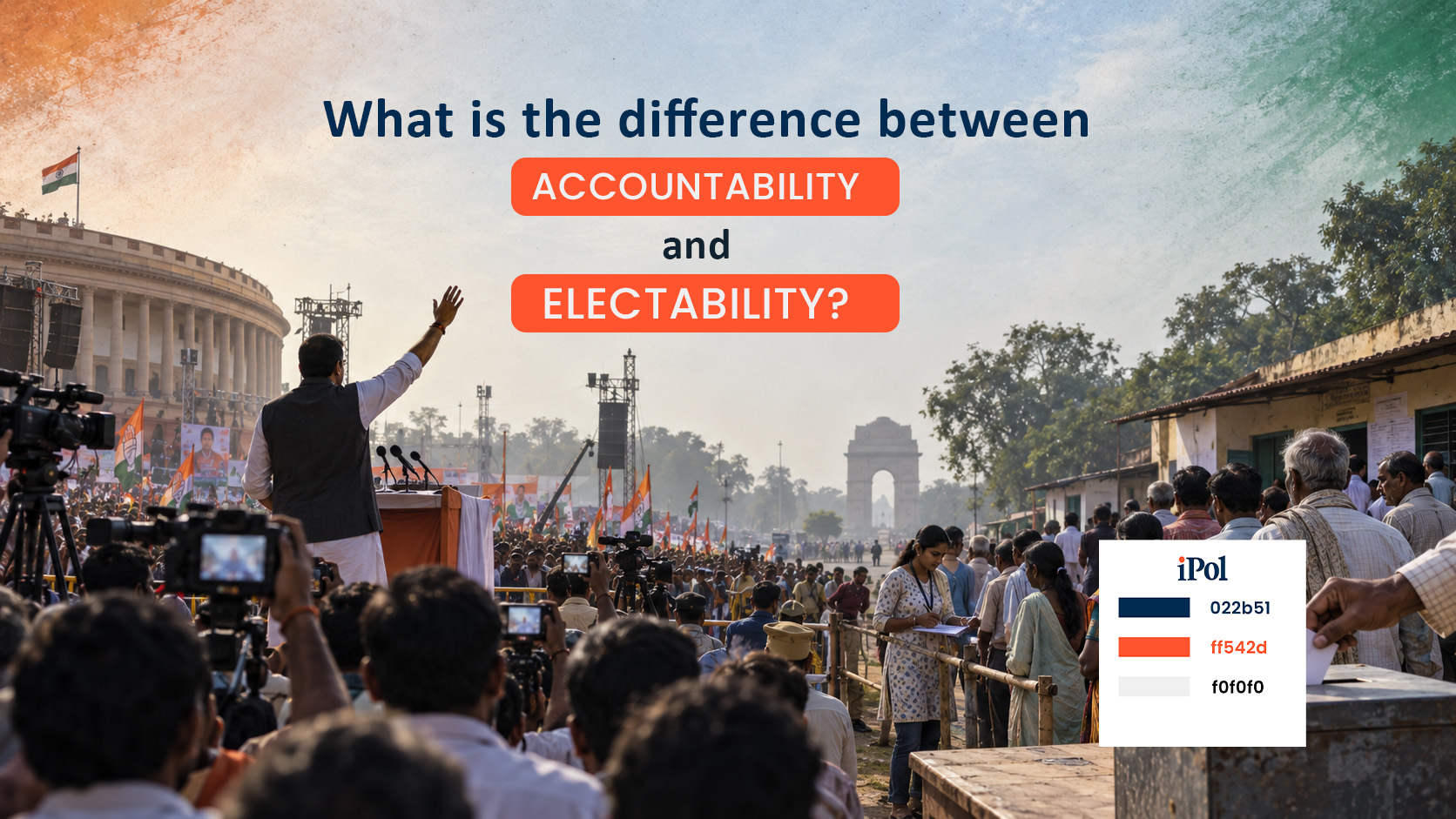
One of the easiest mistakes in politics is to confuse being popular with being electable.
They sound like the same thing. They are not.
A person can be widely recognised, have a large social media following, attract crowds and generate enormous public attention, and still struggle to win an election. On the other hand, a relatively low profile candidate with little national visibility can win comfortably because they have something more important in an election: a reliable path to the votes required to win.
That distinction matters more than ever in Indian politics.
The 2024 Lok Sabha election is a good reminder. India recorded a voter turnout of 65.79% at polling stations. With such a large and diverse electorate, an election is not a popularity contest in the conventional sense. It is a constituency by constituency exercise in converting support into actual votes. Elections 24
Popularity gives you attention. Electability gives you votes.
Popularity is about recognition and appeal.
Electability is about conversion.
The questions are different.
A popular politician may ask:
“How many people know me?”
An electable politician needs to ask:
“How many of those people will actually vote for me?”
And then comes the harder question:
“Can I get enough of them to actually turn up and vote?”
That last part is where elections are won.
The Election Commission’s data from 2024 shows just how different constituencies can be. For example, voter turnout in Lucknow was 52.5%, while Kannauj recorded 61.1%. In Rae Bareli it was 58.1%. Election Commission of India
So a campaign cannot simply look at national popularity or social media sentiment and assume that the same support exists on polling day in a particular constituency.
An election is local mathematics.
Amethi offered a particularly interesting lesson
Take Amethi.
Smriti Irani was not an unknown politician. Quite the opposite. She had enormous national visibility and had already defeated Rahul Gandhi there in 2019.
Yet in 2024, she lost the seat to Congress’s Kishori Lal Sharma.
Sharma received 539,228 votes, or roughly 55%, while Irani received 372,032 votes, around 38%. The winning margin was 167,196 votes. Election Results
The point here is not that popularity had no role.
The point is that past success, national visibility and political recognition do not guarantee electoral conversion five years later.
The constituency had changed. The political environment had changed. The campaign had changed. Voters had different priorities.
Politics rarely gives anyone a permanent electoral deposit.
Celebrity is not the same as electability either
The opposite lesson can also be seen in Mandi.
Kangana Ranaut entered electoral politics with enormous name recognition. She was already a major public figure before entering the election.
But celebrity alone did not win Mandi.
She won because that visibility was combined with a party organisation, a constituency, a political brand and an electoral coalition capable of converting attention into votes.
In 2024, Ranaut received 537,022 votes, around 52.87%, defeating Vikramaditya Singh by 74,755 votes. India Today
That is the important distinction.
Fame may open the door. It does not walk you through the polling booth.
Social media can create a dangerous illusion
This is perhaps one of the biggest challenges facing modern political campaigns.
A politician can look extremely strong online.
The posts get thousands of likes.
Videos get millions of views.
Supporters fill the comments.
A hashtag trends.
People at rallies shout the candidate’s name.
And everyone inside the campaign office starts believing that victory is inevitable.
But social media measures attention far more easily than it measures electoral commitment.
Someone can watch a political video without voting for the politician.
Someone can agree with a politician without voting for them.
Someone can even admire a politician and still vote for somebody else.
This is why good political strategy cannot stop at digital metrics.
The campaign has to understand what is happening outside the screen.
Who is actually organising?
Who has booth level workers?
Which communities are leaning towards the candidate?
Which voters are undecided?
Who is motivated enough to turn out?
Where is the opposition weak?
Where is the candidate personally strong?
And perhaps most importantly:
What happens when the excitement of the campaign meets the reality of polling day?
The candidate matters. But the constituency matters more.
Another mistake is judging electability in isolation.
A candidate may be excellent in one constituency and completely unsuitable in another.
Political capital is not automatically transferable.
A candidate with a strong reputation among young urban voters may struggle in a rural constituency. A leader with a powerful caste or community base may be highly competitive in one seat and marginal in another. A nationally respected public figure may still lack the local organisation required to win.
This is why I believe every serious electoral assessment should begin with the constituency, not the candidate.
Before asking “How popular is this person?”, ask:
“Where are their votes coming from?”
Then ask:
“How many votes can realistically be added?”
That is a much more useful question.
Winning does not require everyone to like you
This is another uncomfortable truth about elections.
A candidate does not need universal popularity.
They need a coalition large enough to cross the finish line.
The 2024 Lok Sabha results illustrate this across India. The Election Commission’s own data shows that winning candidates did not always secure overwhelming majorities of the vote. Its constituency level data records seats where winners secured between 40% and 50%, and even some below 40%. Election Commission of India
That means an election can be won by building a sufficiently strong coalition while the candidate remains unpopular with a substantial section of voters.
This is why negative vote, vote splitting, alliances, turnout, local equations and candidate selection matter so much.
Electability is not about being everyone’s first choice.
Sometimes it is about being the candidate who can assemble the strongest combination of first choices.
There is also a difference between visibility and trust
A politician may be visible everywhere and trusted nowhere.
Another politician may barely appear on television but have thousands of people who will answer their phone call.
That second politician may be far more electable.
In electoral politics, trust is often built through repetition and proximity.
The worker who knows every lane.
The councillor who can mobilise people.
The local leader who has spent years attending weddings, funerals and community meetings.
The candidate who can pick up the phone and speak to people directly.
These things rarely become viral content.
But they can become votes.
And elections are ultimately counted in votes.
So how should we measure electability?
There is no single formula, but I would look at at least six things:
1. Core vote
How many voters are genuinely committed to the candidate or party?
2. Transferable support
Can the candidate attract voters beyond their traditional base?
3. Organisation
Does the candidate have people capable of converting support into turnout?
4. Local credibility
Does the candidate have a real relationship with the constituency?
5. Vote ceiling
How far can the candidate realistically expand beyond their existing support?
6. Electoral arithmetic
What are the alliances, margins, turnout patterns and vote divisions that determine the actual contest?
This is where political analysis becomes different from popularity measurement.
A popularity survey might tell you who people like.
A serious electoral assessment has to tell you who can win, where they can win, why they can win and what could stop them from winning.
The real test comes on polling day
India’s electoral politics is too large and too complicated to be reduced to follower counts, television appearances or viral clips.
The Election Commission recorded 63,71,839 NOTA votes in the 2024 Lok Sabha election, about 0.99% of votes polled. Even that relatively small figure represents millions of voters who participated but chose not to support any candidate. Election Commission of India
That is another reminder that attention does not automatically become support.
Ultimately, there are three separate questions in politics:
Are you known?
Are you liked or trusted?
Will people vote for you?
The first is popularity.
The second is political appeal.
The third is electability.
The best candidates understand the difference.
And the best campaigns never confuse a room full of supporters with a constituency full of votes.
Because elections are not won by being the most talked-about person in the room.
They are won by having the right people with you, in the right places, on the right day.


Leave a Reply