
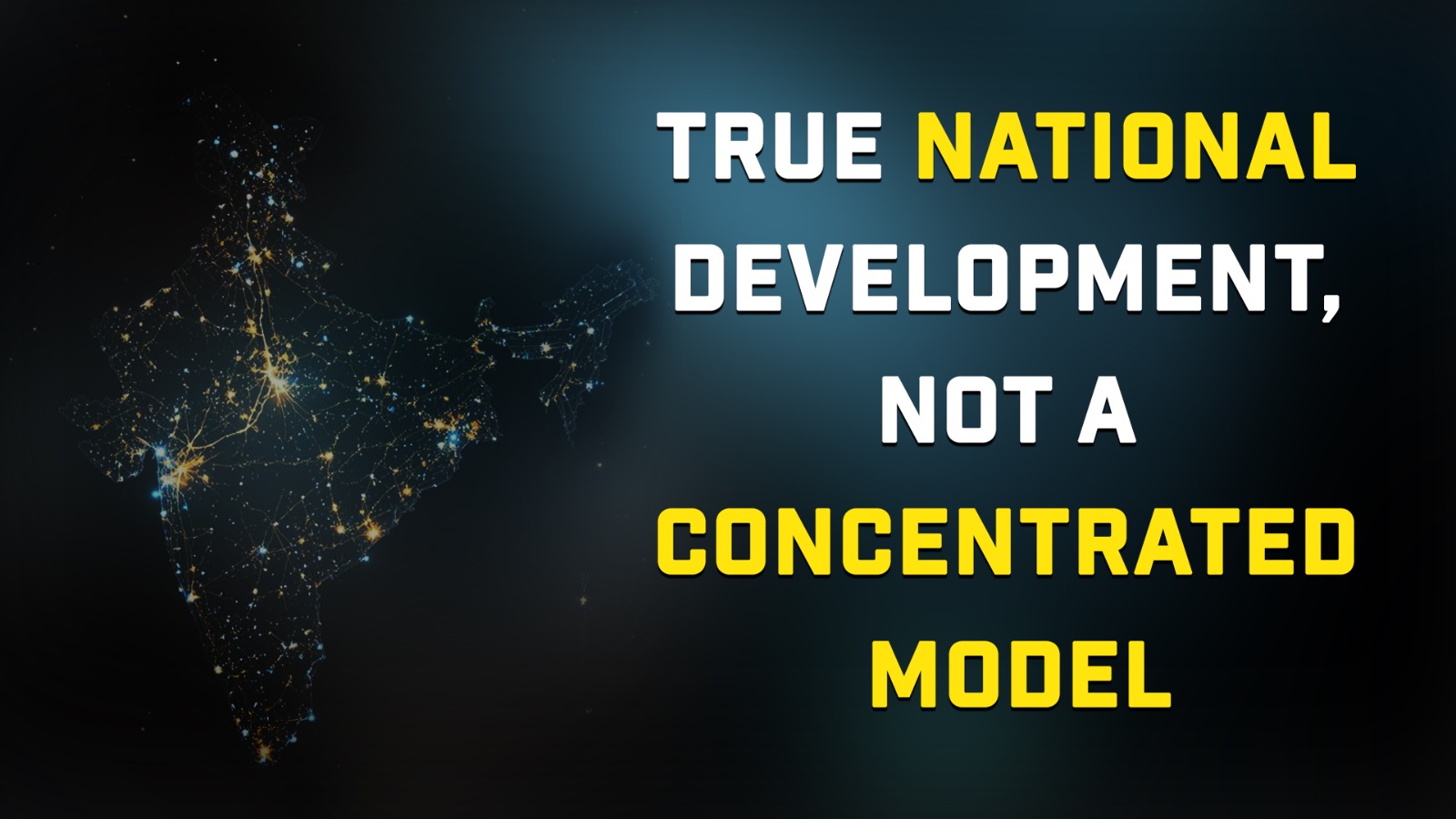
India’s growth story over the past decade is undeniable. Infrastructure has expanded, digital public goods have scaled, manufacturing ambitions have taken root, and the country’s global profile has risen.
Yet beneath these achievements lies a quiet but growing unease: the sense that decision-making remains overly centralised and that the highest-profile opportunities continue to cluster in a narrow geography.
This is not a regional complaint. It is a national concern that touches Maharashtra, Delhi, Jharkhand, Himachal Pradesh, West Bengal, Tamil Nadu, Andhra Pradesh, Kerala and beyond.
Political parties of every colour have long struggled with the same internal pattern. Ambitious state leaders who build organisational strength, connect with local aspirations and deliver results often find themselves constrained or sidelined by a distant high command.
Decisions that should be shaped by those who live the realities of a state are taken far away, in meeting rooms that rarely feel the pulse of the ground. This happens across party lines. It is neither new nor surprising.
When a leader who has experienced that sidelining speaks of the need to empower state-level voices, the observation is natural and deserved. Recently this very concern was echoed by Annamalai at a conclave. The point, however, stands on its own merit.
A healthy federal democracy requires that state leaders be trusted with real authority. They understand local languages, economic strengths, social equations and electoral moods far better than any remote secretariat.
When core strategy, project prioritisation and even alliance choices appear to flow primarily from the national capital, the message to the rest of the country is clear: your agency is secondary. Over-centralisation weakens the very federal spirit the Constitution envisages.
It also limits the ability of national parties to expand or consolidate in diverse states, because people sense when their priorities are being filtered through a distant lens.
The concentration of opportunity compounds the problem. Gujarat has built genuine industrial capacity, policy continuity and infrastructure that make it an attractive destination. Competitive federalism should reward performance.
The difficulty arises when the same destinations repeatedly absorb the most prestigious national projects and global events. Semiconductor fabrication and packaging units, AI and advanced technology investments, the 2030 Commonwealth Games, related police and fire games, and the strong positioning of Ahmedabad in India’s 2036 Olympic ambitions have all found a natural home in one state.
None of this is illegitimate in isolation. The question is whether a model that repeatedly channels the highest-visibility opportunities into one geography can still be described as all-India development.
Maharashtra remains India’s largest sub-national economy, a manufacturing powerhouse with deep strengths in automobiles, pharmaceuticals, services and FDI. It has every reason to expect a fair share of cutting-edge industrial and technology projects.
Delhi and the National Capital Region offer unmatched research, connectivity and services advantages that could support a broader distribution of knowledge and event ecosystems. Jharkhand sits on critical mineral and industrial resources that need high-value processing and manufacturing investments to convert potential into widespread employment.
Himachal Pradesh possesses clean-energy, tourism and high-altitude research possibilities aligned with green and knowledge-economy goals. West Bengal, with its eastern gateway location, ports and industrial history, continues to seek larger participation in national logistics, manufacturing and technology corridors.
Southern states that have already demonstrated capability in automobiles, electronics and human capital watch the same pipeline of prestige and ask why the distribution remains so uneven.
When the pipeline of chips, AI facilities and mega-events appears heavily tilted, the political consequence is predictable. Citizens in non-favoured regions begin to wonder whether national development is truly national.
Regional parties gain oxygen. National parties find it harder to speak convincingly to electorates that feel overlooked. Uneven opportunity risks converting legitimate regional pride into grievance, an old Indian anxiety that modern growth was supposed to dissolve, not reinforce.
Practical questions follow. Why cannot semiconductor and advanced-electronics capacity be deliberately multi-polar rather than concentrated?
Why must the biggest global sporting spectacles of the coming decade cluster in one urban corridor when India has multiple cities with international airports, hotel capacity and young populations hungry for inspiration?
Why should state-level leaders feel constrained in shaping priorities for their own people?
If decisions on industrial location, language policy or inter-state disputes appear calibrated more to certain electoral calendars than to consistent national principles, trust erodes.
Markets and state-level ease of doing business matter. Gujarat’s speed on land, clearances and incentives is real.
Yet the government retains significant leverage through incentives, project clearances, event bids and public investment. When that leverage repeatedly points in one direction, the model becomes political as much as economic.
Other states have proven capacity. A confident national strategy would deliberately spread high-value opportunities so that multiple growth poles reinforce one another instead of one pole absorbing disproportionate prestige.
The larger diagnosis is straightforward. Structures that remain top-heavy—whether from the national capital or a state capital leave the district and taluk levels under-empowered. Parties that fail to speak the language of specific states, in both the literal and the cultural sense, struggle to expand.
Governance that prioritises spectacle over sustained, distributed service eventually loses touch with restless young electorates. Leadership generation must happen at the grassroots, not merely be announced from above.
India’s strength has always been its ability to hold unity and diversity in creative tension. The economic transformation of recent years is real. That success will prove durable only if it is visibly shared.
A development architecture perceived as overly centralised and geographically concentrated risks weakening the national fabric it seeks to strengthen. Broad-based development is not a slogan directed against any single state.
It is the only sustainable path for a continental democracy that aspires to remain united, competitive and just.
People across the country are watching. They notice when decisions feel remote. They notice when the highest opportunities keep landing in the same places. They notice when local leadership is sidelined rather than trusted.
The answer is not resentment. The answer is a deliberate rebalancing: empower state leaders, distribute prestige projects and events more widely, and treat every region as a genuine stakeholder in the national story. Only then will growth feel truly national.


Leave a Reply