
Indian democracy has long carried a quiet contradiction.
We celebrate the act of voting as the purest expression of popular will, yet the money that fuels campaigns, parties, and policy influence has remained largely opaque, concentrated, and often detached from ordinary citizens.
Elections have become expensive spectacles. Parties have grown into sophisticated financial machines.
And the ordinary voter has mostly remained a passive recipient of slogans, freebies, or last-minute inducements.
Against this backdrop, a small but visible experiment in Meghalaya has begun attracting attention.
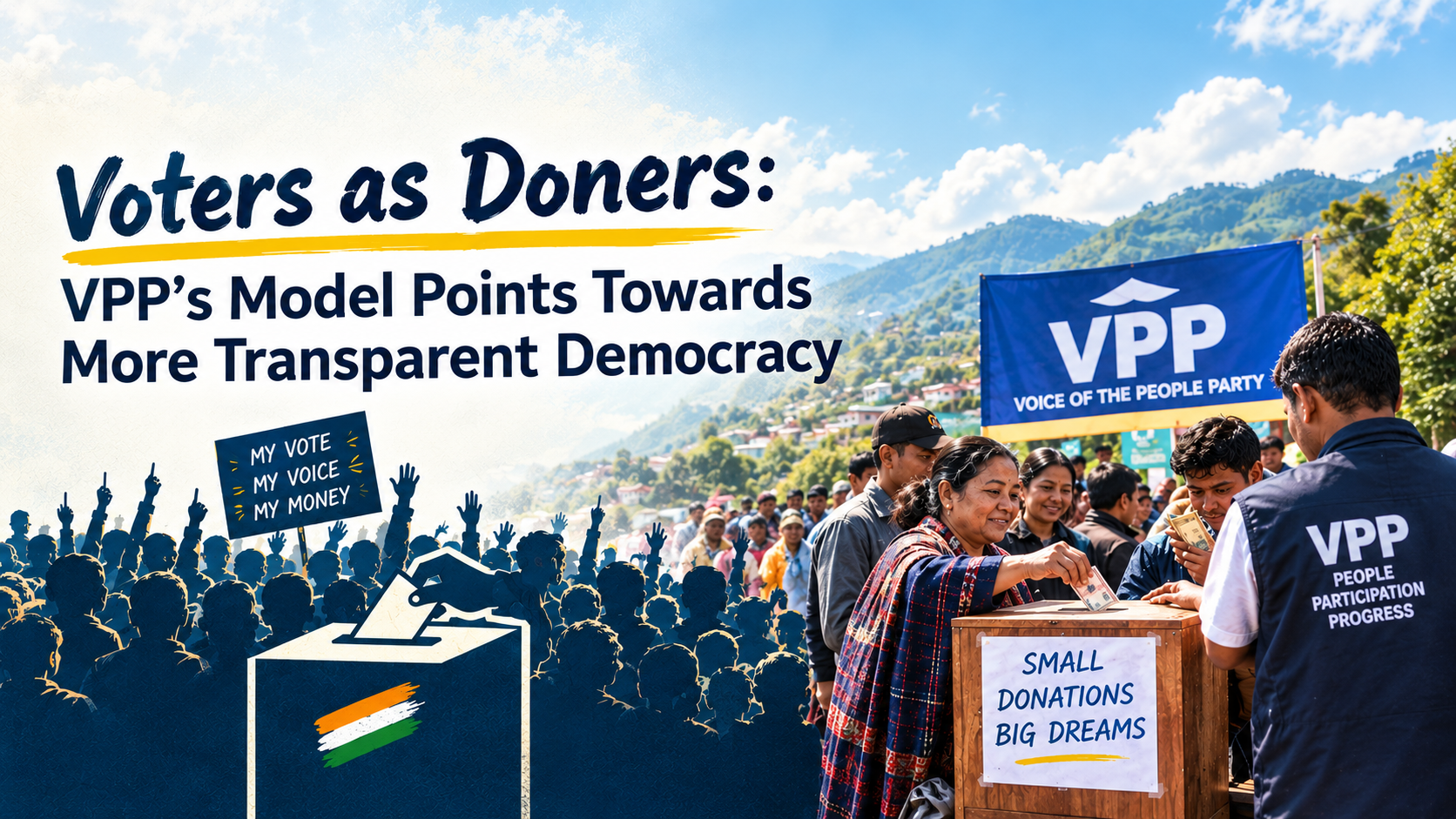
The Voice of the People Party (VPP), led by Ardent Miller Basaiawmoit, has been campaigning for the Shillong Lok Sabha by-election with a simple, almost counter-intuitive practice: voters are becoming donors.
At a recent rally attended by more than ten thousand people at Polo Ground in Shillong, supporters contributed over ₹3.07 lakh on the spot.
Reports from earlier meetings show people handing over coins, ₹10 notes, ₹500 notes, and whatever they can spare, sometimes counted publicly in a cloth.
The party has made a point of neither paying people to attend nor arranging food to draw crowds.
Leaders describe themselves as servants of the people; the people, in turn, are asked to fund the work they want done.
This is not yet a fully institutionalised system of transparent party financing. It is still early, limited in scale, and open to legitimate questions about how consistently the model will be maintained if the party grows.
Yet the direction is significant.
When ordinary citizens fund a party, they acquire a stronger moral and practical claim to ask questions about how that money is spent, which policies are prioritised, and whether promises are kept.
In a limited but real sense, the funder and the voter become the same person. That alignment is rare in Indian politics, and it is worth examining carefully.
The Long Shadow of Money in Indian Elections
To understand why VPP’s approach feels distinctive, it helps to recall how political funding evolved in India.
Even decades ago, leaders recognised the problem. Atal Bihari Vajpayee, speaking at a national seminar on electoral reforms organised by the Law Commission in 1999, described the mounting cost of elections as “the very root of political corruption.”
He noted that while the law imposed ceilings on electoral expenses, those limits were observed more in the breach.
Parties, he observed, no longer primarily raised funds from the people; they increasingly tapped moneybags.
He pointed out that companies were legally barred from donating at the time, yet parties collected funds that were effectively unaccounted.
The growing influence of money, he warned, was also facilitating the entry of criminal elements into politics.
These concerns were not new even then. In 1962, as a private member, Vajpayee had introduced a bill in the Rajya Sabha seeking to curb the influence of money power, including by restricting corporate funding.
The bill failed, but the underlying diagnosis remained relevant. Over subsequent decades the costs rose sharply.
Estimates of overall election expenditure have climbed dramatically from roughly ₹9,000 crore around the late 1990s to tens of thousands of crores in recent Lok Sabha cycles, according to various analyses by research organisations and the Centre for Media Studies.
Candidate spending limits exist on paper, but party expenditure is effectively unlimited.
Large portions of party income have historically come from sources that are either opaque or difficult for ordinary citizens to track.
The pattern has been consistent across parties and eras: reliance on corporate contributions, electoral trusts, and, for a period, electoral bonds (later struck down by the Supreme Court for lack of transparency).
Unknown or poorly disclosed sources have regularly formed a substantial share of reported income.
The result is a structural tilt.
Parties with better access to large donors can outspend rivals, dominate media and ground machinery, and shape the political conversation.
Ordinary citizens contribute votes but rarely money in any systematic, transparent way. Accountability flows mainly upward to big funders or party high commands rather than outward to the people who cast the ballots.
Vajpayee’s earlier warning that money power distorts priorities and weakens the link between elected representatives and citizens still resonates.
When parties function primarily as collectors and distributors of large, opaque funds, the incentive structure favours short-term inducements, patronage, and post-election returns to donors over sustained public value.
What VPP Is Attempting ?
VPP’s recent campaign in Meghalaya flips the usual script in a modest but deliberate way. Instead of treating supporters as people who must be mobilised with money, food, or freebies, the party has invited them to contribute.
Public statements from leaders emphasise that they will not pay people to attend meetings.
The message is that leaders are servants and the people are the masters; masters fund the work they want their servants to perform.
Collections have been small in absolute terms relative to major national parties, but the symbolic and practical shift is clear: the money comes from people who are also voters, not primarily from distant corporate or high-net-worth sources.
This creates a different relationship. When a farmer, a shopkeeper, a student, or a daily-wage earner contributes even a small amount, that person has a direct stake in asking how the money is used.
Will it go toward legitimate campaign expenses?
Will accounts be maintained and made available?
Once elected, will the party treat these contributors as legitimate participants in prioritising local problems, roads, recruitment transparency, education, land rights, or whatever the constituency actually needs?
The model does not automatically solve every problem of governance, but it strengthens the basis for ongoing accountability.
Citizens who fund the party have both the right and the incentive to demand answers.
In a fuller form, this approach could move closer to what democratic theory often assumes but Indian practice rarely delivers: parties that are financially dependent on a broad base of citizens, and therefore structurally more responsive to them.
Transparency becomes practical rather than merely rhetorical. Spending decisions can be scrutinised by the same people who will later vote.
Policy priorities can be debated with those who have skin in the game beyond a single election day.
If the party reaches power, the same contributors can reasonably expect channels of public meetings, documented feedback, published accounts, or constituency-level consultations to influence what gets done.
Practical Realities and Limits
None of this means the model is complete or immune to critique.
Scale matters.
What works for a regional party contesting a by-election may face different pressures if it expands significantly.
Maintaining internal discipline so that donated funds are not diverted, ensuring genuine public accounting rather than selective disclosure, and preventing any new forms of patronage will require continuous effort.
Critics have already raised questions about the declared assets of some leaders versus the grassroots funding narrative; such questions are legitimate and should be answered with clear records rather than rhetoric.
Any party that asks ordinary people for money must be prepared for higher standards of disclosure than parties funded mainly by large, opaque sources.
There are also broader structural constraints. Election expenditure limits apply mainly to candidates, not parties.
Regulatory gaps remain.
Cultural expectations around freebies and personal favours do not disappear overnight.
A crowdfunding model does not, by itself, eliminate the need for competent organisation, clear policy ideas, or effective ground presence.
It does, however, change the starting incentives. When the primary funders are also the primary voters, the cost of ignoring them rises.
Toward a More Accountable Practice
I have consistently argued that ethical politics is possible when people focus on creating genuine value rather than extracting short-term gains, and when ordinary citizens move from passive frustration to disciplined participation.
The VPP experiment illustrates one practical pathway. It treats political awareness not merely as commentary but as a reason to contribute resources and then demand accountability.
It reduces the distance between the person who votes and the person who funds. And it creates a foundation still incomplete, still tested by real pressures for citizens to ask questions about spending and policy both during campaigns and after elections.
Indian democracy does not become perfect because one regional party collects a few lakhs in public donations.
But practices that make party funds more transparent, that make parties answerable to a broad base of citizens, and that give those citizens a continuing stake in policy choices move the system closer to the principle that power ultimately rests with the people.
Vajpayee warned decades ago that unchecked money power corrupts priorities.
Experiments that reverse the flow making voters the donors offer one way to restore a measure of that accountability.
Whether the model survives growth, maintains its standards, and influences others will depend on the discipline of those who practice it and the vigilance of those who fund it.
For now, it is a reminder that democracy improves when citizens do more than cast a vote: they also become active partners in funding, questioning, and shaping the politics they want.


Leave a Reply