
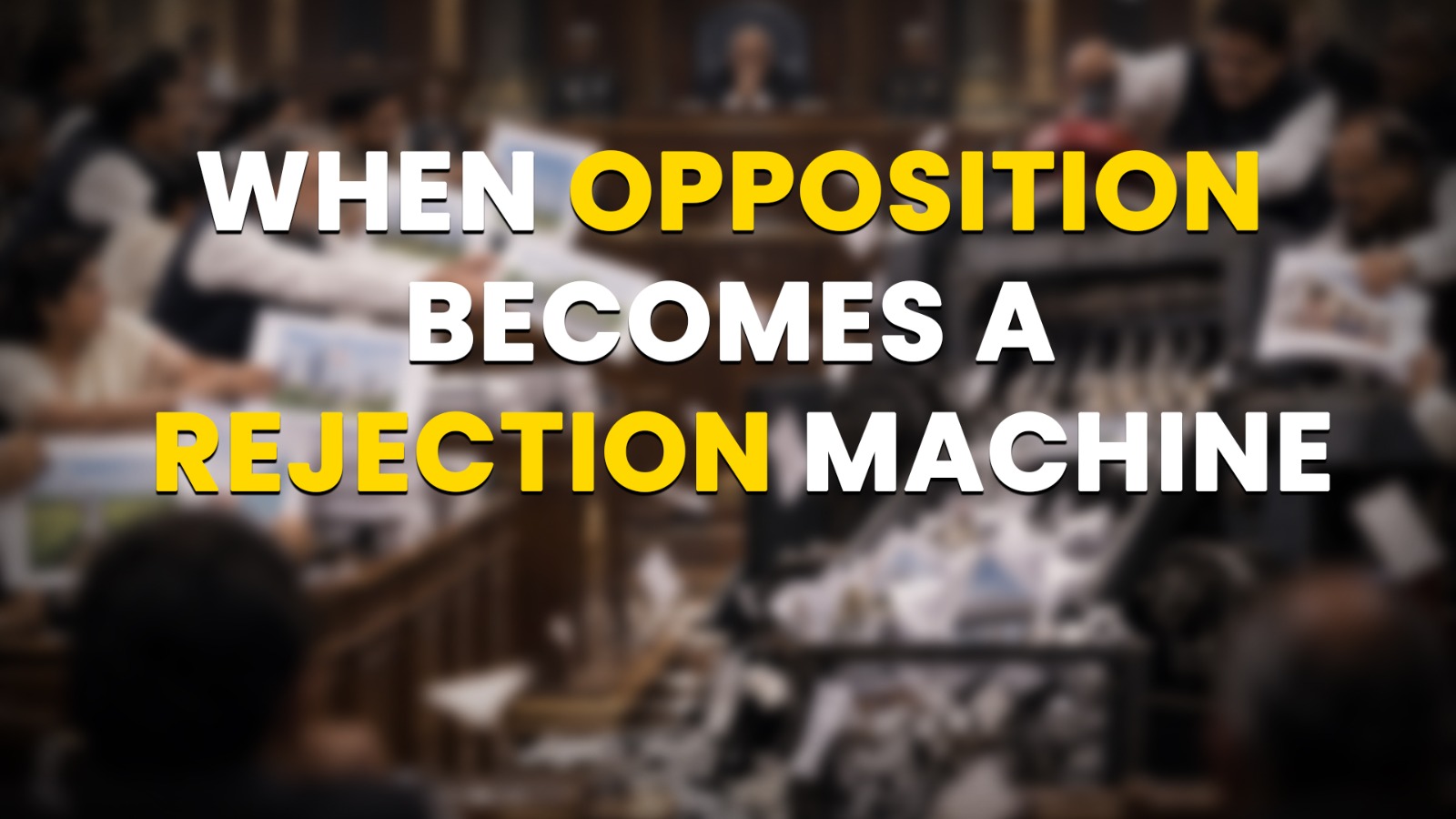
Some parties have stopped offering alternatives.
They only offer objections.
India hosts a major international summit and the first reaction from senior leaders is that there is no benefit.
Voter lists undergo revision and the cleanup is immediately called targeting.
A professor linked to their own political ecosystem faces multiple student allegations of harassment and the usual moral voices fall silent.
Border regulations are enforced and the action is converted into a story of communal attack.
The pattern does not change.
Whatever the government does must be framed as failure or conspiracy.
Whatever raises difficult questions about their own side must be softened, delayed, or ignored.
The default setting is rejection.
This is not accountability.
Real accountability requires consistency.
It requires the same standard for allies and opponents.
It requires the ability to accept that the country can make progress even when one particular party is not in power.
It requires the maturity to separate national interest from partisan discomfort.
Instead the public is given permanent suspicion.
Every diplomatic engagement is dismissed in advance.
Every administrative step that involves verification or enforcement is painted as selective and malicious.
Every uncomfortable fact that emerges from their own ranks is met with silence or quick whataboutery.
The energy that should go into building a credible alternative goes into finding fault with the present.
Look at the recurring script.
When India takes the lead on a global platform the question asked is never how the country can use the moment.
The question is why the moment should not be trusted.
When electoral rolls are cleaned the focus is never on the principle of one genuine voter one vote.
The focus is on who might lose numbers.
When serious allegations surface against someone from the extended ecosystem the demand for swift process suddenly becomes complicated.
The same voices that demand immediate action in other cases discover the virtues of waiting and due process only when the accused is familiar.
This selective urgency is noticed.
Voters are not blind to the difference.
They see an opposition that sharpens governance through serious, consistent critique and an opposition that only knows how to reject.
One improves the system by forcing better performance and exposing real gaps.
The other simply waits for its turn while running down institutions, platforms, and outcomes in the meantime.
One treats the country as a shared project.
The other treats every success that occurs outside its own leadership as a problem to be minimised.
A healthy democracy needs a strong opposition.
That is not in dispute.
It needs voices that ask hard questions about policy, execution, and priorities.
It needs parties that prepare themselves to govern rather than merely to oppose.
What it does not need is a permanent rejection machine that treats every national platform as a loss and every internal failing as someone else’s problem to be buried.
The cost of this habit is not only political.
It is institutional.
When every cleanup of voter lists is called targeting, public trust in the idea of clean rolls weakens.
When every diplomatic initiative is dismissed, the space for serious foreign policy debate shrinks into slogans.
When campus or internal allegations are met with silence from the usual moral entrepreneurs, the larger claim to speak for justice loses force.
People begin to tune out.
They start assuming that criticism is rarely about the issue and mostly about the side.
That cynicism damages everyone.
The country continues to move on infrastructure, digital delivery, manufacturing ambition, and global positioning.
Progress is uneven and many problems remain.
Unemployment pressures, urban safety, quality of education, and institutional delays are real and require constant scrutiny.
The right response to those problems is focused, honest criticism backed by alternative ideas.
The wrong response is the reflex that says nothing done by the present dispensation can be allowed to stand as achievement.
Automatic rejection is not critique.
It is a habit.
And habits that no longer persuade eventually stop mattering.
There is a deeper political failure here.
An opposition that cannot acknowledge any positive movement under its rivals eventually loses the ability to speak credibly about the negative.
When every statement begins from the position that the other side must be wrong, the audience learns to discount the statement before it is finished.
Credibility is not built by volume.
It is built by consistency and by the willingness to apply the same yardstick to oneself.
The same parties once in power defended many of the same institutional processes they now find suspicious.
They once claimed credit for international engagements they now describe as empty.
The reversal is too complete to be explained by principle alone.
It is explained by position.
When in office the system is workable.
When out of office the same system becomes suspect.
Citizens watch this switch happen in real time.
They draw their own conclusions about seriousness.
A serious opposition would spend less time declaring every platform useless and more time explaining what it would do differently and better.
It would treat clean electoral rolls as a shared democratic good rather than a threat.
It would demand fast, transparent processes in harassment cases regardless of the political colour of the accused.
It would critique foreign policy choices on the basis of outcomes and leverage rather than on the basis of who is sitting at the table.
That version of opposition strengthens the country.
The rejection machine version only strengthens its own sense of grievance.
The choice is visible in daily politics.
One path accepts that the nation is larger than any single party’s fortunes and that good policy remains good even when delivered by rivals.
The other path treats politics as a zero sum contest in which any advance outside one’s own control must be undermined.
India has room for only one of these as a governing culture.
The first builds.
The second merely waits and corrodes.
Critique will always be necessary.
Automatic rejection is not critique.
It is the refusal to engage with reality on any terms except one’s own political comfort.
In the long run that refusal becomes irrelevant.
The country moves anyway.
The only question is whether the opposition moves with it as a serious force or remains stuck in the comfort of saying no.


Leave a Reply