
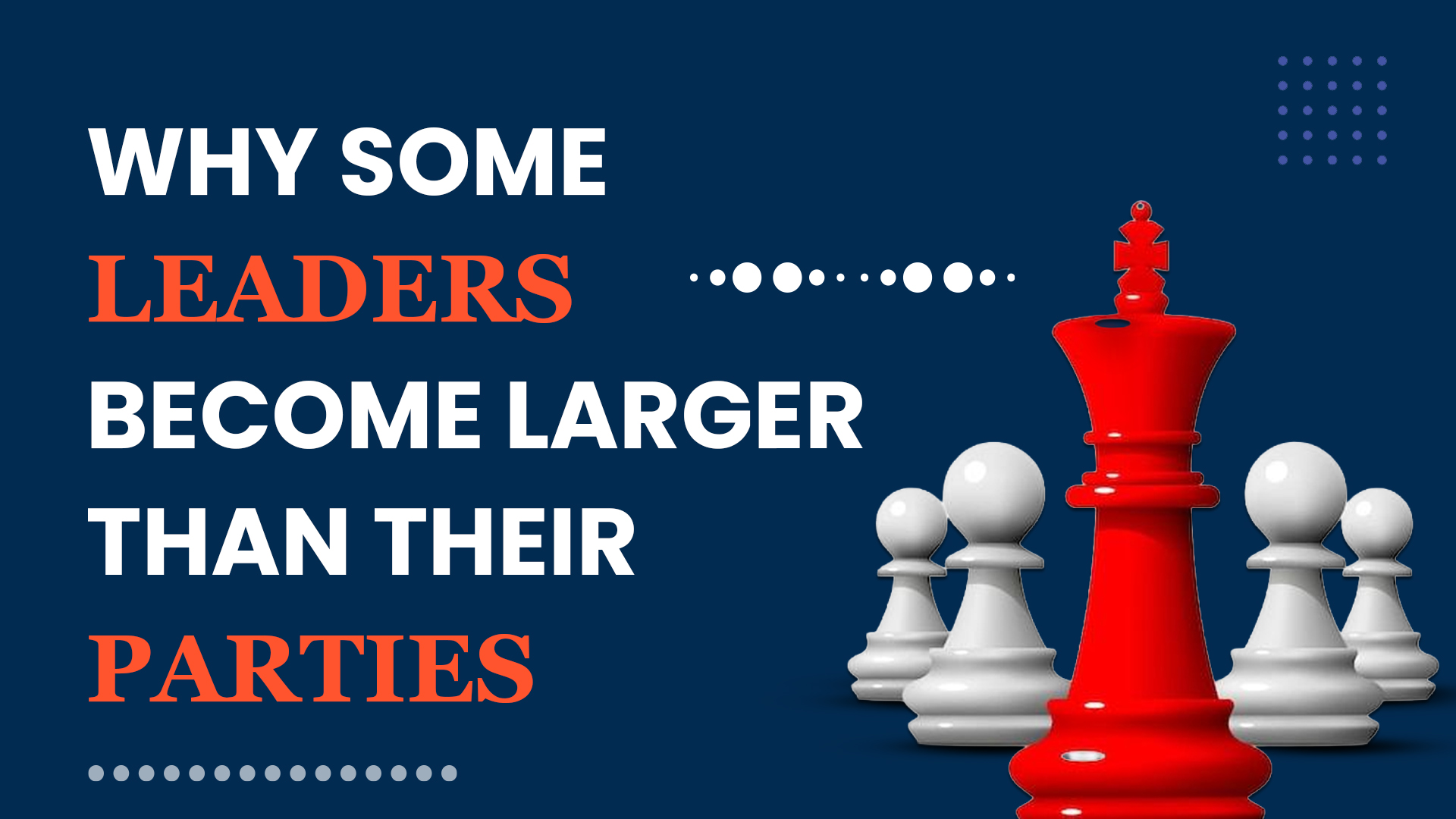
Political parties are built to last.
They have constitutions, offices, workers, symbols, ideologies and organisational structures. Leaders are supposed to come and go.
Yet Indian politics has repeatedly produced a different kind of politician: the leader whose personal identity becomes so powerful that voters begin to associate the party almost entirely with them.
People stop saying, “I support this party.”
They start saying, “I support this leader.”
That shift can transform an election.
It can expand a party’s reach, bring new voters into its coalition and turn a complicated political contest into a much simpler question of trust, personality and leadership.
But it also creates a difficult question:
What happens to a political party when its biggest asset becomes one person?
It Starts With a Story
The most powerful political leaders rarely present themselves simply as candidates.
They represent a story.
Jawaharlal Nehru became closely associated with India’s early vision of parliamentary democracy, scientific development, secularism and institution-building.
Indira Gandhi developed a very different political identity. After the Congress split in 1969, her leadership became increasingly central to the party’s public image. The 1971 campaign slogan “Garibi Hatao” turned the election into a direct appeal around her leadership and a promise of poverty removal.
The Congress won 352 of 518 seats in the 1971 Lok Sabha election, with 43.68% of the valid votes polled, according to Election Commission data.
The important point is not simply that Congress won.
It is that the political contest increasingly revolved around Indira Gandhi herself.
That was an early and powerful example of personal leadership becoming central to Indian electoral politics.
When the Leader Becomes the Brand
Political parties traditionally build their identity around ideology.
Leaders build theirs around personality, experience and emotion.
A party can promise development.
A leader can say:
“I will deliver it.”
A party can publish a manifesto.
A leader can stand before millions and turn that manifesto into a personal promise.
That personal connection is powerful because politics is complicated.
There are hundreds of issues, thousands of candidates and millions of individual voters.
A recognisable leader provides a shortcut.
Instead of asking only:
“What does this party stand for?”
voters may also ask:
“Do I trust this person?”
Once that happens, the leader starts becoming larger than the organisation.
Vajpayee: When Personal Appeal Expanded a Party’s Reach
Atal Bihari Vajpayee is one of the clearest examples of how a leader’s personal reputation can extend beyond the traditional boundaries of a political organisation.
He was one of the founding figures of the BJP and had already established himself as a formidable parliamentarian and orator long before becoming Prime Minister.
The 1999 election is particularly interesting.
Vajpayee offered something important to a growing political formation: political acceptability beyond its core support base.
His reputation as an orator, parliamentarian and coalition-builder helped the BJP-led alliance work with parties that did not necessarily agree with every aspect of the BJP’s ideology.
The organisation mattered.
But the leader helped expand its political vocabulary.
That is one way a politician becomes larger than their party.
They don’t replace the organisation.
They make the organisation bigger.
Narendra Modi and the Personalisation of National Campaigning
The phenomenon became even more visible with Narendra Modi.
Before entering national politics, Modi had served as Gujarat’s Chief Minister from 2001 to 2014. His political identity became strongly associated with governance, development and administrative efficiency.
The 2014 Lok Sabha election transformed that state-level political identity into a national campaign.
The BJP won 282 seats, with 31.34% of the national vote. (Election Commission of India)
It was the first time since 1984 that a single party had won an outright Lok Sabha majority on its own.
Five years later, the BJP increased its tally to 303 seats, with 37.7% of the national vote. (Election Commission of India)
The BJP’s organisational machinery was obviously central to these victories. It would be inaccurate to attribute them to one person alone.
But Modi’s personal political brand became an unusually important part of the campaign.
The party had an organisation.
The organisation had a leader.
And the leader had become the face through which many voters understood the national election.
But 2024 Complicated the Story
The 2024 Lok Sabha election is an important reminder that personal popularity does not erase political organisation.
The BJP won 240 seats, falling short of a majority on its own. The NDA, however, secured enough seats to form the government.
That tells us something important about Indian democracy.
Even when national politics becomes highly leader-centric, elections are still fought in 543 separate constituencies.
Local candidates matter.
Regional parties matter.
Caste and community equations matter.
State governments matter.
Local issues matter.
Alliance arithmetic matters.
A leader may dominate the national conversation, but they cannot personally campaign in every village, every ward or every polling booth.
That is where the organisation comes back into the picture.
Regional Politics Makes the Pattern Even Clearer
The phenomenon is not restricted to national politics.
India’s states provide some of the strongest examples of leaders whose political identities became deeply intertwined with their parties.
M. G. Ramachandran and the AIADMK.
N. T. Rama Rao and the Telugu Desam Party.
Jayalalithaa and the AIADMK.
Mamata Banerjee and the Trinamool Congress.
Mayawati and the BSP.
Naveen Patnaik and the BJD.
Their ideologies and political circumstances were very different.
But the pattern was similar.
The leader became the party’s most recognisable political symbol.
For many voters, the party name and the leader’s name became almost interchangeable.
Why Does This Happen?
There isn’t one explanation.
Several forces work together.
1. People Remember Faces
Political institutions are complicated.
People remember people more easily than organisational structures.
A party may have thousands of workers, but a voter may associate its entire political identity with one face.
That is why leaders matter so much in campaign politics.
2. Leaders Turn Policies Into Stories
A government programme can be explained through statistics.
A leader can turn it into a story.
Instead of discussing infrastructure spending in abstract terms, a politician can talk about the road built in a village.
Instead of talking about welfare transfers, they can talk about a family receiving assistance.
Political communication becomes personal.
And personal stories are easier to remember.
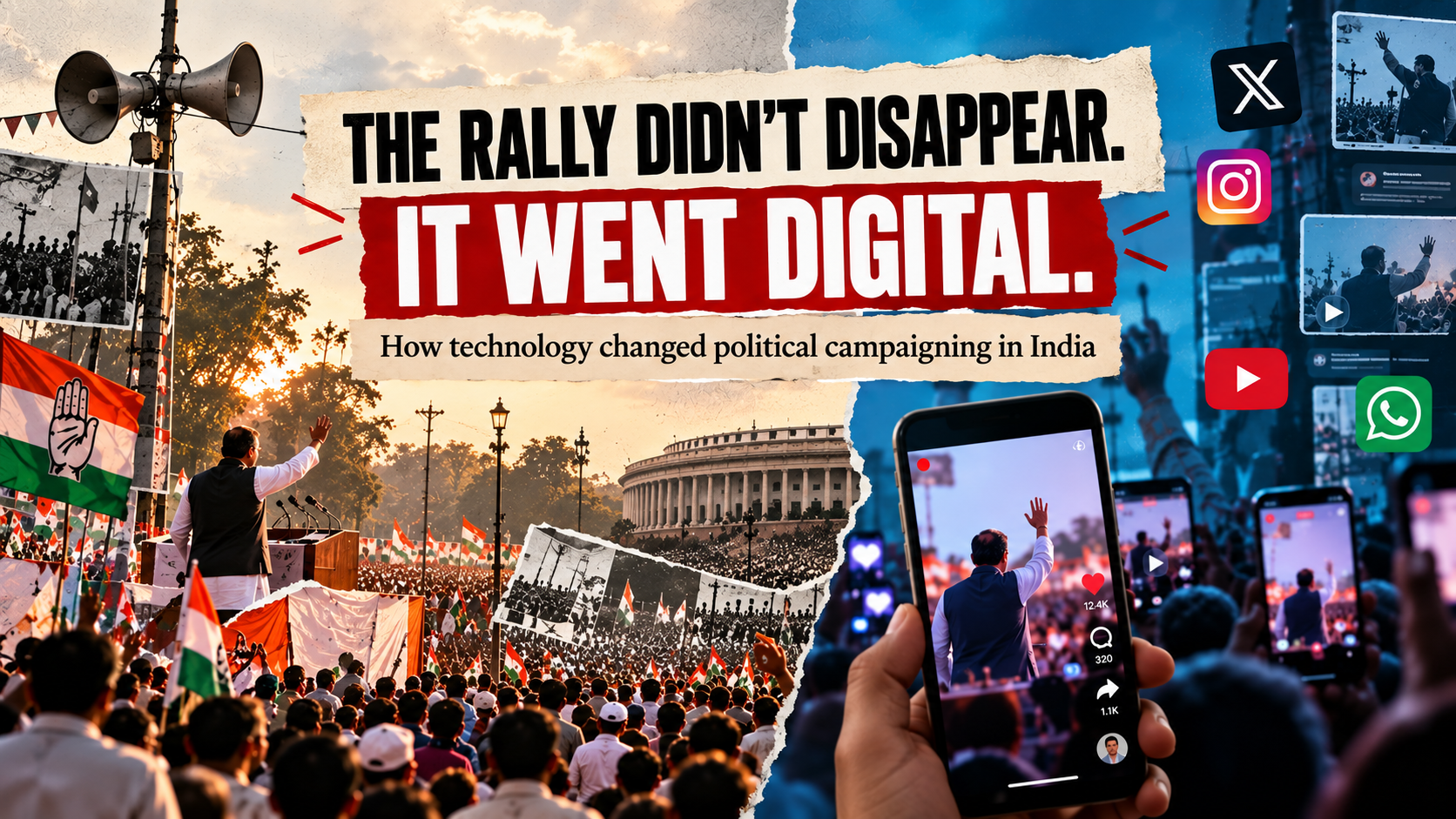
3. Television & Social Media Changed the Equation
Political communication has undergone a massive transformation.
In the early decades of the Republic, political leaders depended heavily on newspapers, radio, public meetings and party networks.
Television dramatically increased the importance of political personalities.
Social media went further.
A leader can now communicate directly with millions of people without depending entirely on traditional media.
That has made political branding far more powerful.
The leader is no longer simply the candidate.
They can become their own media channel.
Crisis Can Make Leaders Larger
There is another factor that should not be underestimated:
crisis.
Economic crises, wars, pandemics, natural disasters and political instability often make voters look for a recognisable person who appears capable of taking responsibility.
In moments of uncertainty, leadership becomes more visible.
A politician who communicates effectively during a crisis can create a personal relationship with voters that lasts well beyond the immediate event.
The public may begin to associate stability, competence or even national identity with that individual.
This is one reason crises can accelerate political personalisation.
But There Is a Price
A leader becoming larger than their party can be electorally useful.
It can also be dangerous.
When the party becomes too dependent on one personality, several problems emerge.
The first is succession.
What happens when the leader retires?
What happens when they lose?
What happens when they die?
What happens when their popularity declines?
A healthy political organisation should have an answer to these questions.
The Indira Gandhi Lesson
Indira Gandhi’s dominance over Congress illustrates both sides of personalisation.
After the 1969 split, her leadership became increasingly central to Congress politics.
Her political dominance peaked in the early 1970s, particularly after the 1971 victory.
But the Emergency of 1975-77 dramatically changed the political environment.
In the 1977 Lok Sabha election, Congress suffered a historic defeat and the Janata Party-led formation came to power.
The lesson is not that personality-driven politics always fails.
It is that personal popularity is never permanent.
Political capital can take years to build and can change surprisingly quickly.
A Leader Can Carry a Party. But a Party Must Carry the Leader Too.
This distinction is crucial.
A great leader can expand a party’s appeal.
But a great organisation must also be capable of producing leaders.
The healthiest relationship is not:
Party serves leader.
And it is not:
Leader serves party blindly.
It is:
Leader and organisation strengthen each other.
The leader provides direction, visibility and emotional connection.
The organisation provides workers, institutional memory, local knowledge and continuity.
One without the other is fragile.
The Numbers Tell an Interesting Story
India’s electoral history demonstrates how dramatically political fortunes can change.
The Congress won 364 seats in the first Lok Sabha election in 1951-52.
It won 352 in 1971.
It won 414 in 1984-85.
The BJP won 282 in 2014 and 303 in 2019.
But India’s first-past-the-post system means a party does not need 50% of the national vote to win a majority of seats.
That is why leadership, organisation and the geographic distribution of support matter so much.
A relatively modest shift in votes across strategically important constituencies can produce a dramatic change in seats.
What Happens When the Leader Becomes the Entire Brand?
This is where personality-driven politics becomes complicated.
If every government achievement is associated with one person, that person receives enormous political credit.
But if something goes wrong, the same person can become the focus of enormous criticism.
If every election becomes a referendum on one leader, local candidates can become less important.
If every disagreement becomes personal, policy debate can become weaker.
And if succession is ignored, the party may eventually discover that it has built an enormous political house around one pillar.
The stronger the pillar becomes, the more important it is to ask whether the building can stand without it.
Personality vs Institution
There is an important distinction between personal leadership and personality cults.
Personal leadership can be democratic.
Citizens may genuinely admire a leader’s competence, communication, ideology or record.
There is nothing inherently undemocratic about that.
The danger begins when institutions become secondary to the individual.
A democracy cannot depend entirely on whether one person is wise, competent or popular.
It needs institutions capable of functioning regardless of who occupies the top office.
Courts.
Parliament.
Election authorities.
Political parties.
The bureaucracy.
The media.
Civil society.
These institutions provide continuity when personalities change.
The Real Test of Leadership
Perhaps the most interesting question is not:
“How big did the leader become?”
It is:
“What did the leader build that could survive them?”
A politician who wins three elections but leaves behind a weak organisation may have built a remarkable personal career.
A politician who creates institutions, develops successors, strengthens the party and leaves behind a durable political philosophy has created something much larger.
That is the difference between a following and a legacy.
A following depends on a person.
A legacy can survive the person.
The Future of Indian Politics
Indian politics is likely to remain a mixture of personality and organisation.
Social media will continue to make individual leaders more visible.
Television will continue to reward recognisable personalities.
Campaigns will become increasingly data-driven and personalised.
But India’s federal structure will continue to give regional leaders enormous importance.
A national leader may dominate the headlines while a Chief Minister determines the political mood of an entire state.
That tension between national personality and regional identity is one of the defining features of Indian politics.
The future may not belong entirely to parties.
Nor will it belong entirely to individuals.
It will belong to those who can combine personal credibility with organisational strength.
The Final Question
Political parties are supposed to survive their leaders.
But some leaders become so influential that, for a period, the distinction almost disappears.
They become the face of the party.
The voice of the campaign.
The symbol on the ballot.
The person voters imagine when they hear the party’s name.
That can be an extraordinary political advantage.
But it comes with an equally extraordinary responsibility.
Because eventually every leader leaves the stage.
And when the applause stops, the rallies end and the posters come down, one question remains:
Did the leader build a political institution that could survive without them?
Perhaps that is the most meaningful measure of political leadership.
Not how large a leader became.
But how much larger they left the institution.
Leave a Reply