
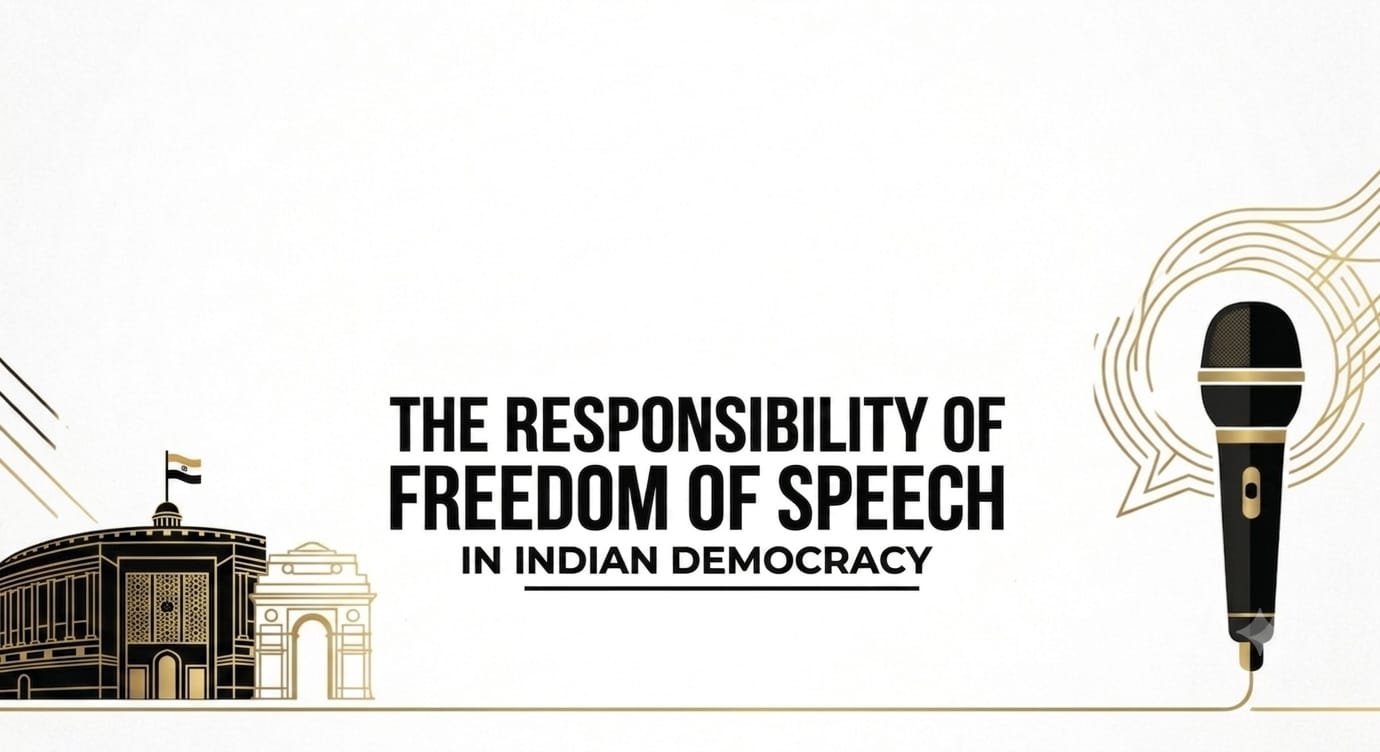
Freedom of speech is often called the base of democracy. It lets people share their views question those in power debate ideas and take part in building the country’s future. In India this freedom is not just a nice idea. It is a clear right written in the Constitution under Article 19(1)(a).
But freedom of speech is only half the story.
The other half of the story that people often forget is responsibility.
In today’s fast digital world one post can reach millions in minutes. The question is no longer whether we have the right to speak. The real question is whether we understand the duty that comes with that right.
Democracy stays alive not only because people can speak freely. It stays alive because people choose to use that freedom with care.
Freedom of Speech Is A Constitutional Promise
When the Constitution started in 1950 the people who wrote it knew democracy cannot work without free expression. Citizens needed the power to point out problems in government question policies push for change and share their beliefs without fear.
Freedom of speech became a basic right because it protects more than one person’s opinion. It protects the open space where ideas can be tested.
Every big change in India’s past came with voices that spoke up. The freedom struggle itself grew through speeches newspapers books debates and public meetings. Leaders like Mahatma Gandhi Dr B R Ambedkar Jawaharlal Nehru Maulana Abul Kalam Azad and many others used words to guide teach and bring people together.
Their words did not just attack what was wrong. They showed a picture of something better.
That is the real job of free speech in a democracy.
Freedom Does Not Mean Freedom From Responsibility
Many people think freedom of speech means saying anything anywhere without any result.
That is not true.
Every freedom comes with duty.
The Constitution itself says this in Article 19(2). It allows reasonable limits for the safety of the country public order decency morality and other clear needs.
But responsibility is more than just following the law.
It is also a personal duty.
Before speaking every citizen should ask one simple question.
Will my words help people understand each other or will they push people further apart?
Freedom of speech gives us the right to point out faults.
Responsibility tells us to do it in a fair way.
Freedom allows us to disagree.
Responsibility stops disagreement from turning into hate.
The Difference Between Criticism and Hostility
Good democracies need criticism.
No government no party no leader is above questions. Fair criticism makes democracy stronger. It shows problems creates pressure for answers and opens the door for better ideas.
But today’s talk often mixes criticism with hostility.
Disagreement is treated like betrayal.
People with different views are called enemies instead of fellow citizens who simply think differently.
Social media has made this worse. It rewards anger more than careful thought. Sharp insults spread faster than calm arguments. The systems that run these platforms push content that gets strong reactions and anger is easy to create.
The result is a public talk where noise often replaces sense.
Freedom of speech should help debate. It should not kill conversation.
Look at the recent Cockroach Janta Party protest. What started as youth anger over exam paper leaks and real worries about the education system quickly grew into something else. Crowds gathered at Jantar Mantar. Demands were raised.
But parts of the protest turned messy.
There were reports of violence attacks on journalists and people who seemed more interested in creating scenes than solving problems. Some anti social elements joined in.
The focus shifted quickly.
The original concern about students and fair exams got mixed with slogans drama and online show.
This is a clear example of how free speech and the right to protest can lose their strength when responsibility is missing.
Real issues deserve serious voices not chaos that hurts the very people it claims to help. When protest becomes more about heat than light, it weakens the cause and damages public trust.
The Rise of Social Media
A few decades ago public talk was shaped mainly by newspapers, television, a colleges and big institutions. Today almost anyone with a phone can reach thousands or even millions.
This change is powerful.
Voices that were once silent now have space.
Groups that were ignored can organise.
Citizens can share what they see as it happens.
Governments can get quick feedback.
But this power also brings a heavy duty.
False information spreads faster than real one.
Edited videos create wrong stories.
Claims without proof become accepted as truth before anyone checks the facts.
The results are real.
Rumours have caused panic.
Online abuse has stopped many good people from taking part.
Public trust has gone down.
Freedom of speech loses its meaning when truth becomes optional.
Listening Is Part of Free Speech
We usually think of freedom of speech as the right to talk.
Just as important is the will to listen.
Democracy is built on talking with each other not on one side shouting alone.
Listening does not mean you have to agree.
It only means you show respect.
A society where everyone speaks but no one listens becomes noisier not smarter.
The best democratic leaders were not only strong speakers. They were also careful listeners.
Understanding a different view is not weakness.
It is a sign of real democratic strength.
Universities and the Culture of Debate
Universities have always been places where ideas are questioned tested and improved.
Students should feel free to challenge old thinking debate public policies and discuss hard topics without fear.
At the same time campuses must stay places where disagreement happens through reason not through force or threats.
The goal of debate is not to shut others up.
It is to grow understanding.
The better argument should win because it makes sense not because the other side was silenced.
Journalism and Public Responsibility
The media has a big role in protecting freedom of speech.
Independent journalism tells citizens what is happening checks wrongdoing and keeps power in check.
But journalism also carries big duty.
Getting facts right must come before being first.
Checking must come before publishing.
Loud headlines may get attention but trust is built only through careful work.
In a time of instant news and viral clips responsible journalism matters more than ever.
Without reliable information citizens cannot make good choices in a democracy.
The Role of Citizens
Freedom of speech is not protected only by courts or the Constitution.
It is protected by ordinary people.
Every time someone talks with respect to a person who holds different political views democracy grows stronger.
Every time false information is checked before being shared public trust grows.
Every time criticism stays on ideas and avoids personal attacks the political culture improves.
Democracy is not kept alive by laws alone.
It is kept alive by the daily habits of citizens.
Patriotism and Criticism Can Coexist
One common myth is that criticising the government means criticising the nation.
The two are not the same.
Governments change.
Policies change.
Parties win and lose.
The nation stays.
In India’s history many of its best reformers questioned the systems of their time because they believed the country could do better.
Fair criticism has often led to stronger institutions better policies and more accountability.
Patriotism is not shown by never criticising.
It is shown by the wish to make the nation better.
The Future of Free Speech
India has huge diversity.
Hundreds of languages.
Many religions.
Different cultures.
Endless political views.
Handling this diversity needs more than rules in the Constitution.
It needs mature democratic behaviour.
As artificial intelligence deepfakes and digital falsehoods change the way we talk the duty that comes with freedom of speech will only grow heavier.
The challenge is no longer just protecting the right to speak.
It is protecting honest respectful and meaningful public conversation.
This duty belongs to governments media groups technology platforms educational places and every single citizen.
Freedom of speech is one of India’s greatest democratic strengths. It lets citizens question power push for justice celebrate difference and dream of a better tomorrow.
But rights grow only when they come with responsibility.
Words can bring people together or tear them apart. They can teach or mislead. They can make democracy stronger or weaken the trust people have in each other.
The real test of a democracy is not whether people are free to speak. It is whether they use that freedom to build a society where disagreement is possible without hate criticism is welcome without fear and truth stays stronger than noise.
India’s democracy will not be judged only by the freedom its people have.
It will also be judged by how carefully they choose to use that freedom.
What do you think Has social media given more people a real voice in India or has it made thoughtful public talk harder?

Leave a Reply