
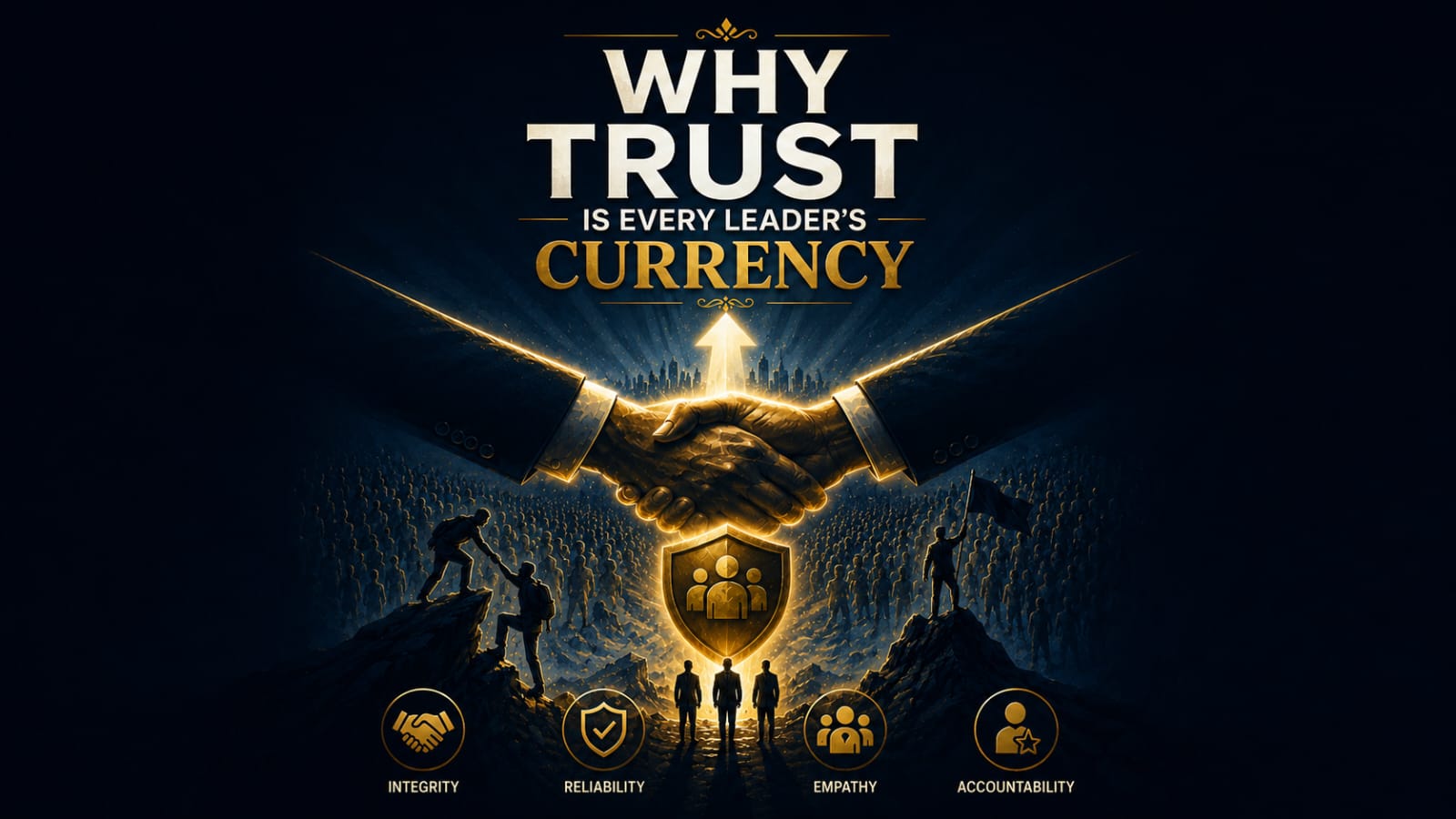
What makes people follow a leader?
Is it power?
A title?
A position?
Experience?
These things certainly matter, but they are not enough.
A CEO may have authority over an organisation. A prime minister may have the authority to govern. A school principal, a military commander, or the captain of a sports team all hold positions that allow them to make decisions.
But authority alone does not guarantee trust.
And without trust, leadership becomes incredibly difficult.
Trust is the invisible force that allows leaders to inspire confidence, unite people around a common purpose, and guide them through uncertainty. It is one of the few things that cannot be demanded or purchased. It has to be earned, one decision at a time.
That is why trust is every leader’s most valuable currency.
Unlike money or political power, trust cannot be created overnight. It grows slowly through consistent actions. Every promise kept strengthens it. Every promise broken weakens it. People may forgive mistakes, but they rarely forget repeated dishonesty or inconsistency.
This applies everywhere. In politics, citizens trust leaders who communicate honestly and take responsibility for difficult decisions. In business, employees trust managers who are fair and transparent. In families, children trust parents who keep their word. The setting may change, but the principle remains the same.
Trust is built long before it is tested.
The importance of trust becomes most visible during difficult times. When everything is going well, leadership is rarely questioned. But when a crisis arrives, whether it is an economic slowdown, a public health emergency, a natural disaster, or an organisational challenge, people begin looking for more than instructions.
They look for reassurance.
They want to know that the person leading them understands the situation, has a plan, and is willing to stand with them through uncertainty.
That is why crises rarely create leaders.
They reveal them.
History offers countless examples of leaders who earned respect not because every decision they made was perfect, but because people believed they were acting with honesty and conviction. They communicated clearly, accepted responsibility when things went wrong, and remained calm under pressure. Their credibility gave people confidence, even during uncertain times.
Trust is also closely linked to consistency.
Imagine a leader who speaks passionately about transparency but avoids difficult questions. Or someone who talks about teamwork but takes all the credit when things go well. These contradictions are easy for people to notice. Leadership is judged far more by actions than by speeches.
People listen to what leaders say.
But they believe what leaders do.
This is why small everyday actions matter more than many realise. A leader who arrives prepared for meetings, follows through on commitments, acknowledges mistakes, and gives credit to others is quietly building trust every single day. These actions may seem ordinary, but over time they shape how people view a leader’s character.
Trust is not built through grand gestures.
It is built through consistent behaviour.
Another common misunderstanding is that trust requires perfection.
It doesn’t.
In fact, people often trust leaders who admit they don’t have all the answers. No one expects a leader to be perfect, especially during complex situations. What people do expect is honesty.
Saying, “We don’t have every answer yet, but we’re working on it,” often builds far more confidence than pretending everything is under control.
Humility is not a weakness in leadership.
It is a sign of confidence.
Leaders who are comfortable admitting mistakes also create environments where others feel safe to speak openly. Teams become more innovative when people know they can ask questions without fear. Organisations become stronger when problems are identified early instead of hidden to protect someone’s image.
Trust creates psychological safety.
And psychological safety creates better decisions.
This principle is equally important in public leadership.
Governments make difficult decisions every day. Citizens will not always agree with those decisions, and that is perfectly normal in a democracy. However, even when opinions differ, people are far more likely to accept difficult choices if they trust the intentions, transparency, and competence of those making them.
Public trust cannot be maintained through slogans alone.
It depends on consistency between words and actions.
That is why accountability matters. Leaders who accept responsibility during failures often gain more respect than those who spend their energy finding someone else to blame. People understand that mistakes happen. What they struggle to accept is a refusal to acknowledge them.
Taking responsibility is not a sign of failure.
It is often the first step towards rebuilding trust.
Trust also influences the speed at which change becomes possible.
Imagine two organisations introducing the exact same policy. In one organisation, employees trust their leadership. In the other, they don’t. The policy itself may be identical, but the outcomes are likely to be very different. Where trust exists, people are more willing to adapt, cooperate, and support change. Where trust is missing, even good ideas are met with doubt.
The same is true for governments.
Economic reforms, public health campaigns, educational changes, and infrastructure projects all depend, to some extent, on public confidence. Without trust, even well-designed policies struggle to achieve their full potential.
Perhaps this explains why trust is so difficult to rebuild once it has been lost.
A single dishonest decision can undo years of credibility. People begin questioning not just one action, but every future promise. Rebuilding that confidence takes patience, transparency, and sustained effort.
Trust is slow to earn.
Quick to lose.
And incredibly difficult to regain.
In today’s world, where information travels instantly and public scrutiny is constant, trust has become even more valuable. Every decision, statement, and action is observed, discussed, and evaluated. Leaders cannot rely solely on authority or popularity. They must rely on credibility.
Because credibility creates confidence.
And confidence creates leadership.
Ultimately, people don’t follow leaders simply because they hold a title. They follow leaders because they believe those leaders will act with integrity, make thoughtful decisions, and place the interests of the people they serve above their own.
That belief cannot be commanded.
It has to be earned.
Leadership is not measured only by the number of people who listen to you when you speak.
It is measured by the number of people who continue believing in you when times become difficult.
And that belief begins with trust.
Because in leadership, trust isn’t just another quality.
It is the currency that makes every other quality matter.
What do you think?
Can a leader succeed in the long run without trust, or is trust the foundation on which every form of leadership is built?


Leave a Reply